All Posts (2056)

Sort by


DRHA 2010 Conference: Digital Resources for the Humanities and Arts
Sunday 5th September - Wednesday 8th September 2010
Brunel University, West London
www.drha2010.org.uk


CONFERENCE THEME: Sensual Technologies: Collaborative Practices of Interdisciplinarity

The conference’s overall theme will be the exploration of the
collaborative relationship between the body and sensual/sensing
technologies across various disciplines. In this respect it will offer
an interrogation of practices that are indebted to the innovative
exchange between the sensual, visceral and new technologies.
At the same time, the aim is to look to new approaches offered by
various emerging fields and practices that incorporate new and existing
technologies. Specific examples of areas for discussion could include:

• Delineation of new collaborative practices and the interchange of knowledge
• Collaborative interdisciplinary practices of embodiment and technology
• Integration/deployment of digital resources in new contexts
• Connections and tensions that exist between the Arts, Humanities and Science
• Notions of the ‘solitary’ and the ‘collaborative’ across the Arts, Humanities, and Sciences
• eScience in the Arts and Humanities
• Use of digital resources in collaborative creative work, teaching, learning and scholarship
• Open source and second generation Web infrastructure
• Digital media in time and space
• Music and technology: composition and performance
• Dance and interactive technologies
• Taking inspiration from SET: imaging, GPS and mobile technologies
• Evaluating the experience among providers and users / performers and audiences
• Interface Design and HCI
• Performative Practices in SecondLife or other virtual platforms
• New critical paradigms for the conference’s theme

The DRHA (Digital Resources for the Humanities and Arts) conference is
held annually at various academic venues throughout the UK. This year’s
conference is hosted by Brunel University, West London. It will take
place from Sunday 5th September to Wednesday 8th September 2010. It
will be held across various innovative spaces, including the newly
expanded Boiler House laboratory facilities, housed in the Antonin
Artaud Building, and state of the art conference facilities plus high
standard accommodation.

Confirmed Keynote Speakers
- Richard Coyne - Professor of Architectural Computing at the University of Edinburgh.
- Christopher Pressler: Director of Research and Learning Resources and
Director of the Centre for Research Communications, University of
Nottingham.
- Thecla Schiphorst: Media Artist/Designer and Faculty Member in the
School of Interactive Arts and Technology. Simon Fraser University,
Vancouver, Canada.
- STELARC, Chair in Performance Art at Brunel University and Senior
Research, Fellow in the MARCS Labs at the University of Western Sydney.

We invite original papers, panels, installations, performances,
workshop sessions and other events that address the conference theme,
with particular attention to the ‘Sensual Technologies’ focus. We
encourage proposals for innovative and non-traditional session formats.

DRHA 2010 will include a SecondLife roundtable/discussion event, led by
performance artist Stelarc, which will enable international
participants to present performative work via Second Life. For this
event, we particular encourage submission of Machinima works that can
be screened as part of this panel.
Short presentations, for example work-in-progress, are invited for poster presentations.
Anyone wishing to submit a performance or installation should visit http://www.drha2010.org.uk for information about the spaces and technical equipment and support available.
All proposals - whether papers, performance or other - should reflect the critical engagement at the heart of DRHA 2010.
The deadline for submissions will be 31 March 2010. Abstracts should be between 600 - 1000 words.
Letters of acceptance will be sent by 15th of May 2010, when the conference registration will be opened.
Please see http://www.drha2010.org.uk more information and a link for online submission.

Franziska Schroeder
DRHA 2010 Programme Chair
Read more…
On Wednesday, March 3rd, 2010, our class had a Skype session with Prof. Ellen Bromberg of the University of Utah. Prof. Bromberg raised many challenging questions and interesting ideas regarding telematic performance (TP) which I think will be very helpful in guiding our future collaborations with SARC and others.

Ideas and thoughts:
-Delay, Distance, Decay - Elements of TP to be overcome, or embraced(?)
-Sound and alternative sense of space are results of telematic experiences
-Simplify - Complex dance can muddy the overall intention of a TP
-Camera choreography as critical part of TP experience (including specific ideas for artistic use of camera in TP)

Challenges:
-WHAT - Is TP a screen dance?
-WHERE does TP take place? On the screen? In the spaces?
-WHERE is the audience?
-WHO is the audience? IS THERE AN AUDIENCE?
-Discovering the "plie" of telematic dance - Will there be such a thing?
-WHY does any of this matter? Couldn't we just dance to a recorded video and have the same experience?

...are we feeling the "Telematic Embrace" yet?

-Jeff Z.
Read more…
Today I post a first report of how our telematic collaborations are going. Our class is trying to collaborate on networked performance with musicians from SARC in Belfast and RPI in Troy, NY. The technologies we have decided to use for now are, with SARC, SKYPE for video with JackTrip for audio, and Max/MSP for sending data to affect the sound. So far we've been taking small steps each week, one week getting JackTrip to work, the next week getting it to work better, and finally this week achieving a short improv between us. Next week we will hopefully get the four-channel audio from SARC properly spatialized in the room so we can respond to that in our movement choices, and to get video of the musicians from SARC on the screen in addition to our video. It is a bit frustrating to have the setup take so much time, but I hope and believe that we will get faster and more fluent with it so that we can make art rather then deal with the technology for so much of the class period. It is GREAT to have partners willing to work with us on a weekly basis to get this going...and by the end of the semester I know we'll have something wonderful to show for it. We need next also to develop scores for dances over the Internet that will make some artistic sense.


John Toenjes, instructor of 362 Networking & Performance
Read more…

INVISIBILITY OF THE PRESENT - TRANSMEDIALE 2010

The speed of our times is accelerating, day by day the rhythm grows faster. We are doing more and more things at the same time. Our digitalized lives are virtually (social-)networked. Digital technologies and information last only for very short time. A computer is outdated within less than 5 years time, news are updated in a 5 second frequency and thus outdated within a couple of hours. Thanks to micro-blogs, messages get shorter and shorter, provide us with life search to keep up with the pace.

The huge amount of digital data processed per day makes it difficult to keep track of them. This also occurs to digital art projects, whose creators or buyers stand before the problem on how to archive them in a reliable way. Everything we do and use is more temporary than ever before. The present seems to get shorter and shorter. To be able to project towards the future, we'd need to be able to define presence more thoroughly. To know what the present is. BUT: The importance of thinking of the future helps us to give meaning to the present. A viscous circle then?

Contemporary visions and imagination of future have a big identity problem.

Future is no longer what it had been. Present is no longer what it had been. And the present is not yesterday's future... tm10 (Transmediale Festival 10, 2 - 7 February 2010) was dedicated to this contemporary identity crisis of the future. With its great varieties of installations, performances, conferences, workshops , etc., we had wonderful, very versatile and contrary discussions and approaches, not so much to tackle the problem of the future's identity crisis, but to name it and think about it, to raise new questions, to explore solutions for not being part of a disappearing past.

After an inaugural speech that shows us images of the moon landing (yes the original 1969 event), the tm10 opens officially with a flashback to "modern" vision of future. Charlemagne Palestine, modern composer, musician, bell expert (& whiskey lover), gives us a half hour concert, ringing bells of the Tiergarten's bell tower…. With this image of an ancient means of communication, the bell tower, we are prepared to travel towards a nearer past, the 1980s: At the same time Yvette Mattern's7-colored rainbow laser-beam was projected from Berlin's hkw, (with its' stunning 1950s architecture in shape of an oyster shell) to the 1960s architectural gem Fernsehturm at Alexanderplatz.

© Photographer: Frank Paul
hkw © Photographer: Frank Paul

© ANBerlin
Fernsehturm Alexanderplatz © ANBerlin

Two symbolic architectonic cold war signs of the former east and the former west part Berlin. A sign for the reunification of Berlin, she states. To me it seems rather a time travel to a period when two superpowers were competing to own the future. The whole opening ceremony was visually, sonically and conceptually a collective time travel towards a moment when
utopia and future vision were still intact.

Let's jump to more present times: tm10 invited — amongst many others - Bruce Sterling (placing him next to an overhead projector he unfortunately didn't use). Sterling, sci-fi novelist and a central figure in utopia and visions of future, gives us an entertaining but dark-visioned speech about atemporality [1], to place ourselves in the present, questioning the relations and concepts of past, present and future. His talk, full of pleonasms and contradictions gets confusing, as he seems to mix up art-historic terms. The difference in postmodernism and network culture/atemporality is, that the latter doesn't define the problem, gets overloaded by irrelevant information and stays completely disorganized. That's why we cannot define history or present.

He appeals to "creative artists" to refuse being driven by technology, refuse reverence to the past in order to move forwards; to become the vision of the future ourselves in order to be convincing with our art. To give a ••• about what others think of us and personify our utopia(s).[2] His visions will give you a chill….

THE EXPOSITION

At Future Obscura, the festivals exhibition at hkw, the presented artworks are using language of the past to talk about the present situation. About a present that might have been future in the past. A nostalgic and historical presence. The artworks use any historic image making techniques (rather than THE state of the art) from photography, film-making and robotics to "create a collisions between the past, the present and future" [3], whereas I found future visions were lacking completely .

The artworks thematize already existing technologies, putting them in context with contemporary everyday life. They translate common digital situations and phenomena into the visual, sonic, into the artistic field. The little Paparazzi-Bot, a robot that recognizes movement and (if you're not too quick), shoots a photo of you, that is transmitted via a noisily disturbed wifi connection to a small flatscreen just behind it. The images shot by the robot will be uploaded to the webpage manually by human beings. Quite a 1970s manual work for nowadays…

Paparazzi-Bot © Jonathan Gröge

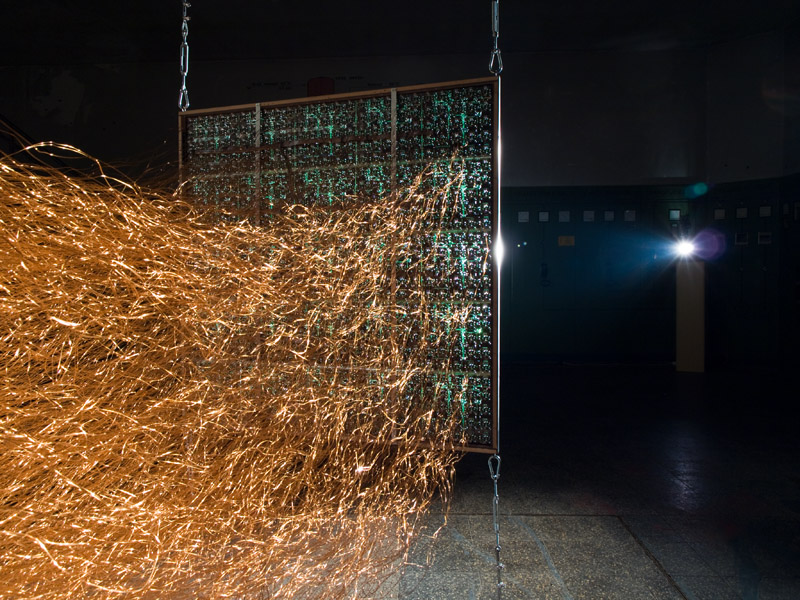
The most impressive work at the exhibition was Gebhard Sengmüller's A Parallel Image. An electronic Camera Obscura, the installation uses 2500 copper cables connecting a photo sensor unit with a display unit, consisting of 2500 light bulbs. It illustrates how the composition of a digital image would look like if serial data transmission had never come to existence. The installation sends all pixel data in parallel. A very poetic way of reflecting the present, assuming past events didn't happen and offering a "new" solution to an old, already solved problem: how to live-project moving image.

A Parallell Image - © Gebhard SengmüllerA
Parallell Image - © Gebhard Sengmüller

A Parallell Image - © Jonathan GrögeA
Parallell Image - © Jonathan Gröge


SATELLITE EXPOSITIONS

[The User], with Coincidence Engines One & Two: Universal People's Republic Time translates the "atemporality" problem by using the time machine itself as part of his installations. The two-part installation, takes the clock out of context and uses it as a sound and light making machine. Coincidence Engine One is a tower of unsynchronized analogue alarm clocks whose tickings build up to a beautiful sonic environment. The second part is a wall of synchronized clocks, that are equipped with an external control, so each clock ticks only in response to instructions issued by the artists. Patterns of light and sound events move rhythmically across the vertical plane. Coincidence Engines is an actual reflection about the present, about time and atemporality with thoughts and play behind it.

the_user_part01_karla


One of the few women present(ed) at tm10, AgnesMeyer-Brandis surprises amusingly with an unimaginable imaginative piece of work: The installation Cloud-Core-Scanner – Inside the Tropospheric Laboratory [4] exhibited at Schering Stiftung. Agnes Meyer-Brandis explores the experimental edge between art, science and technology and borders between facts and fiction, which
you definitely will discover when looking at the installation. My first impression left me confused. You really have to confront yourself with the piece to dive into it's surreal narrative.

The installation Inside the Tropospheric Laboratory gives insights into material that Agnes Meyer-Brandis generated under conditions of extraterrestrial realities: it was developed in micro-gravity on a scientific flight in corporation with the German space agency. The oversized test tube construction consisting of a variety of elements that, one after another get into action at a certain point, has something theatrical, scenic about it.

A laser printer and a lit candle produce CO2 particles which are captured into a glass balloon. The number of particles are measured. At a certain amount, a noisy sound coming from a vacuum pump (that leaves the bowl in vacuum as you can imagine), announces the creation of a little cloud. This triggers (or seems to at least) subsequent events: a disc filled with objects is rotating. A video of one randomly selected object filmed in microgravity is projected on the wall and on a thick piece of plastic. At the same time a stone who seemingly lives in zero gravity, is being measured by a constantly moving aluminum bar.

Far away from artistic romanticism she wants to scan the cores of the clouds. To get into the heart of the object of investigation. As artistic science the results are images rather than formulas. Images and relations. A very poetic research-experimentation on how the future of art could look like.

She was also participant at tm10 salon talk: Destination Moon, where she made the listeners dive into her surreal scientific dreamlike narratives.[5]

www.transmediale.de/modules/transmediale/flashplayer/player.swf">www.transmediale.de/modules/transmediale/flashplayer/player.swf" quality="high" allowfullscreen="true" flashvars="fullscreen=true&bufferlength=2&file=http%3A%2F%2Fwww.transmediale.de%2Ffiles%2Fvideos%2F20100206-1500-d-AgnesMeyer-Brandis.flv&image=http%3A%2F%2Fwww.transmediale.de%2Ffiles%2Fimages%2F20100206-1500-d-AgnesMeyer-Brandis.flv.video-thumb.jpg%3F9a2440d7c850cc8afc695823c9735c37&autostart=false&controlbar=over" bgcolor="#FFFFFF">

ROUND UP

A big trend in the exposed artworks at tm10 was the visualization of the invisible. In his audio visual performance Test Pattern, Ryoji Ikeda, pictures the invisible: Data-streams we are exposed to continuously are transformed into a stroboscopic optic attack of black and white barcode patters, flittering flickering and flashing in an almost unbearable speed (100s of frames per second), synchronized perfectly to aggressively electronic sounds that remind of an overlay of dozens of digitalized morse codes, morphing towards some very heavy beats. The system of Test Pattern is converting any kind of data (such as texts, sounds, images, videos….) into barcode patterns. A visualization of the immaterial in the most minimalistic and direct form.


Another approach to the data visualization: the Panoramic Wifi Camera by Adam Somlai-Fischer, Usman Haque, Bengt Sjölénvon, who illustrate the wifi-nets as colorful clouds and their physical behavior;

http://mediastore.freshmilk.de/media/mediastore/2131/web.flv","autoPlay":false},"screen":{"width":700,"height":393,"left":0,"top":0},"canvas":{"backgroundImage":"url(http://mediastore.freshmilk.de/media/mediastore/2131/preview.jpg)"},"logo":{"url":"http://www.freshmilk.tv/site-media/themes/freshmilk/embed-logo.png","fullscreenOnly":false}}">
Julius von Bismarck visualizes the camera movement of movies in his The Space Beyond Me [6], Agnes Meyer-Brandis with her Cloud-Core-Scanner the consistence of a cloud, Ken Rinaldo's Paparazzi-Bots the users that interact with it, Alice Miceli's Chernobyl Project the invisible radioactive contamination in Chernobyl…

On the contrary, the Artvertiser project un-visualises the visible by replacing (visual) data we usually consume on a daily basis. Julian Olivier and Clara Boj, Diego Diaz and Damian Stewart have developed a little binocular which, walking through the city, distresses our overcharged visual senses. Ads are detected by the machine and replaced by artworks of your choice (still images, video, animation…).


AWARDS

The aspects of Bruce Sterlings "atemporality" idea, the shallowness and disorder of contemporary (or atemporally) art are mirrored not only in this year'snominations, but also in the awarded work by Michelle Teran, "Buscando al Sr. Goodbar". Connecting the virtual and "real life," Teran uses geo tagged youtube videos in the city of Murcia, Spain, that automatically get displayed on GoogleEarth. The "participatory performance" offered a bus tour to explore the city's the geo-tagged places. The tour took simultaneously place on Google Earth and YouTube. With this (voyeuristic) work she wants to question the reason behind publishing intimate data with the exact geographic location. Her answers are not really convincing, seemingly shallow she states "people seem to have the urge to reveal and display their private lives." The award jury's statement didn't help to convince either. [7]

Connecting the (social) web and the physical space is in not so much a novelty and has been done in more interesting ways before.[8]

It seemed not to have undergone the filter of the artists' perception/opinion, world and future view, seems rather the ingredients for an uncooked meal. Take a youtube, take a google earth, travel to the place of investigation and invite some viewers to travel the map….

Should transmediale's future-barometer be the only truths, we'd face a mixture of a quite stressful, chaotic and indigestible digital era of consumption without time and space for reflection…. And a time of wild creation of new visual forms of anything you'd never known about…. It was definitely a very communicative, networked and entertaining event, and a big petty I couldn't stay for the whole event.

__________

[1] Atemporality is a "modern (I think he means contemporary) phenomenon… a problem in the philosophy of history. His definition is well worth checking out: The full transcript of the speech can be read on Sterling's blog

[2] The whole conference can be seen in video here. An interview with Bruce Sterling in german at de-bug

[3] Comment by Honor Harger, the curator of the exhibition in an interview with freshmilk.tv

[4]Agnes Meyer-Brandis' installation Inside the Tropospheric Laboratory looks for an answer to the question: "what are clouds made of"? By moving towards the clouds, on a micro-gravity flight with a German Space Agency plane, she leaves terrestrial realities behind, gets close to her subject of studies, trying to grasp it with her hands.

[5] here she was presenting various of her projects: the one I liked most was meteorites… a project in a siberian she organized public meteorite-crash-onto-earth-viewing event together with the museum.

[6] Old school film camera with a light source to convert it into projector. A software analyses the camera movement and makes the projection move accordingly. It is a mechanical version of a process that happens in the brain when watching a film with camera movement.

[7] Jury Statement:“Buscando al Sr Goodbar by Michelle Teran is a timely and considered exploration of synergies between online social space and physical urban spaces. Her work asks us to consider the hidden pockets of virtuosity that take place all around us. In her hands, online tools become not only a platform for display, but a method of discovery and reconnection to other people. She combines old methods (bus tours)and new (online tools) to create a work that is a complex commentary on our present moment, but also points the way to future layering of our digital and physical selves."

[8] Looking at works like Goldberg's 'The Robot in the Garden'[ link], and at [link], the builders association, Blast Theory, you will find a relevant use of the connection between the virtual and the "real"
Read more…

Dance Video Screenings

Screenings of dance videos made 2008-2009


Karohano - 26 Feb DesArts Aften Gallopperiet, Christiania, Cph, DK

Sanctum II & Karohano - 18 Mar, Screen Moves, DanseHallerne, Cph, DK

CoNCrEte – 21-25 April moves10:Framing Motion, Liverpool UK

Sanctum I & II, CoNCrEte and Karohano - 29 April, Dansens Dag, Cinematheque,

Danish Film Institute, Cph, DK

Sanctum I – in May for South African Cinema at the BFI South Bank, London, UK


Read more…
What is dance-tech.net

Using the most advanced social software platforms and rich multimedia internet applications, dance-tech.net provides movement and new media artists, theorist, thinkers and technologists an on-line space for accessing and sharing ideas, work, research and collaborative projects.

Barrios Solano introduces dance-tech.net and dance-techTV as a sustainable model of production and exchange of knowledge within a community of movement and mew media artits, theorists, technologists and organizations. The new internet or Web 2.0 architectures helps us to see Networks as the materialization of social dynamics, as sites of action, translocal presence and social innovation and sampling. They have become the most important emergent repositories of social and cognitive capital of a given community. dance-tech.net registers conversations, dialogues, performances, ideas and lives using the WWW as a site for a relational intervention on the boundaries of bodies, countries, disciplines and organizations.


TRACES
:


DANCE/IMPROVISATION/NEW MEDIA/COGNITION

SAMPLES OF MY WORK


BATESON QUESTION?


WHAT IS A HAND?


RESEARCH
COMPOSITION/BODY/EMBODIMENT/COGNITION/REAL-TIME/SYSTEMS/DESIGN/INTERACTIONS/DISTRIBUTED/ECOLOGICAL/NETWORK

EMERGENCE

BOTTOM-UP

1.-COMMUNITY Connecting People
DANCE AND TECHNOLOGY
FROM A LIST SERV TO A SOCIAL NETWORK
WEB 2.0


OPEN PLATFORM


DANCE-TECH.NET
FROM DANCE AND TECHNOLOGY TO DANCE TO MOVEMENT TO MOTION:
INTERNATIONAL/TRANS-LOCAL
TRANS-DISCIPLINARY
GROUNDED ON THE DYNAMICS OF PEOPLE AND ORGANIZATIONS

KNOWLEDGE SHARING STRATEGIES/SHARING ALL RESOURCES.
COLLABORATIONS, PARTNERSHIPS AND BARTERING:
INDIVIDUALS
VENUES
DTW, Eyebeam, STEIM, TMA The Hellerau, Reverso, THE WAAG

TANGIBLE BENEFITS??
DANCE THEATHER WORKSHOP
HARDWARE: LEMURPLEX/MIDITRON
SOFTWARE: CYCLING74

2.-KNOWLEDGE

What is dance anyway?

RELEVANCE
DANCE IS RELEVANT

INNOVATION???
HOW WE IDENTIFY IT
SUPPORT IT

RE-FRAME IT

KNOWLEDGE BACKBONE/ENGAGEMENT:

MODELING SUSTAINABLE PRODUCTION OF INTERVIEWS
> 100

INTERVIEWS:
KNOWLEDGE BACKBONE...

AS KNOWLEDGE AND AS A SUBJECT
ETHNOGRAPHY/ BOTTOM-UP

PROCESSPPROCESSPROCESS....

GIDEON OBARZANEK
IVANA MULLER
BEBE MILLER
LISA NELSON/TUNNING SCORES
ALVA NOE/PHILOSOPHY OF MIND
IVANA MULLER/CONCEPTUAL DANCE
European Tele-Plateaus Phase 2/Madrid

ANDREW SCHNEIDER/PERFORMANCE AND WEARABLE interfaces
JOSEPHINE DORADO/MIXED REALITY PERFORMANCES
ANGELO VERMEULEN/BIO ARTS
SABINE SEYMOUR/WEARABLE FASHION
TRISTAN PERICH/NOISE AND CIRCUIT BENDING PERFORMER

Knowledge Lineages?
AN EXAMPLE...

Find more videos like this on dance-tech.net


Find more videos like this on dance-tech.net
SYNDICATION/ VIRAL DISTRIBUTION


PARTICIPATORY CREATION OF KNOWLEDGE:
loose network of correspondents
INTERVIEWS/NEWS REPORTAGE
PARTICIPATORY JOURNALISM

EXAMPLES OF COLLABORATION:

WITH CRITICAL CORRESPONDENCE (NYC)

Find more videos like this on dance-tech.net

SABINE KLAUS (SCOTLAND)

CODA KEDJA Opening Event Oslo Norway from Creation Editor on Vimeo.


DEBORAH HUSTIC (CROATIA)

USE OF INTERNET NATIVE TECHNOLOGY


EMBEDDED IN FESTIVALS/OPEN LAB IN FESTIVALS

WORLD GRID LAB


Find more videos like this on dance-tech.net


3.-DANCE-TECHTV

COLLABORATIVE BROADCASTING/LINEAR...BROADCASTING...VIDEO ON DEMAND
CURATED

LIVE:Turkey, London, Venezuela, Switzerland, NYC.
Content donated by more than forty artist: all continents
Academia and independent broadcasters
ASSOCIATE PRODUCERS (any member of the networks)
LIVE BROADCASTING/LECTURES, PERFORMANCES, experimental art projects (Movement Research Festival and Broadcasting station/workshops GRID LAB/Lebanon, France and Geneva)
INTERACTIVE BROADCASTING...

VIRAL DISTRIBUTION


SPONSORED SPACE


MORE:

SIBLING NETWORKS

MOVIMIENTO.ORG (SPANISH AND PORTUGUESE) 3000 members

USE IN CLASSROOMS:
Wesleyan University
University of Utah
Allow students a dialogue with the community/experts and novices
PEERS


NEW WWW AFFORDS:

LEAN FORWARD APPROACH
PRODUCTION OF SPACES FOR KNOWLEDGE GENERATION AND OPEN ACCESS
INTERVENTION OF THE INTERNET WITH KNOWLEDGE NETWORKS
CREATIVE ENGAGEMENT AS EXCHANGE/GENEROSITY
DIY
DIWO
DISTRIBUTED
CONVERSATIONS/DIALOGUE
EVERYTHING NEXT TO EVERYTHING

AGGREGATION
MATCHING
MASH-UP


COMMUNICATION IS NOT A BOND

THE BOND IS CREATED BY DOING IT TOGETHER


PARTICIPATION MAKES THE SITE


CREATION OF AN INFRASTRUCTURE OF TRUST AND TRUST IN THE INFRASTRUCTURE


SOCIAL


COMMUNITIES=COMMONS=ECOLOGICAL

REFLECT THE LOGIC OF THE SOCIAL LIFE

CULTURE IS SOCIAL


CONTESTING BOUNDARIES:
BODIES, DANCE, DISCIPLINES, MINDS, INFORMATION, KNOWLEDGE, ORGANIZATIONS, COUNTRIES, MACHINES, LEARNING

FOOD FOR THOUGHT


Find more videos like this on dance-tech.net


RADIO HEALER


++++++++++++++++++++++++++++++++++++++++++++++++++++++++++++
LIVE
PROCESS
PRODUCT
ART
RESEARCH
KNOWLEDGE
COLLABORATION
CREATIVITY
ORGANIZATION
COMPLEXITY
RELATIONAL
CONNECTION
PRESENCE
ECOLOGICAL
MOBILITY
REAL-TIME
SOCIAL
NETWORKS
COMMUNITY
PARTICIPATION
DEMOCRACY


NEW INTERNET:
CONVERGENCE
API____APPLICATION PROGRAM INTERFACE: CONNECTIONS BETWEEN APPLICATIONS
RSS____FLOW OF CONTENT ....
MASSIVE DATA BASES/DB DRIVEN SITES
ON-LINE VIDEO

OPEN PLATFORMS
BOTTOM-UP ARCHITECTURES
GENEROSITY PRINCIPLES (PROSUMER/ LEAN FORWARD) UGC
COLLABORATIVE CREATIVITY
EMERGENT CLUSTERS OF KNOWLEDGE


SYNCHRONOUS/ ASYNCHRONOUS
Read more…
GENEVA DANCE TRAINING
profesional contemporary dance training In Geneva

Gvadancetraining is proud to announce that we have now 250 members! And still growing!
Which makes our network the most important network of professional dancers in Switzerland, and maybe abroad.

Since January 2008 STUDIOS 44 offer professional training for prodancers. Other Geneva and Lausanne companies now participate in thisproject. You can join this social network and participate to the life of theprofessional scene o the Geneva region anouncing events, publishing blog posts, add videos,photos... It is free, open to the world, Use it! It is the web 2.0 revolution!!!!

New open professional training are offered in spring 2010, check out the agenda. In Geneva more than one hundred professional training available for professional dancers from february to June!

Visit GENEVA DANCE TRAINING at: http://gvadancetraining.ning.com/?xg_source=msg_mes_network

a network created by Gilles Jobin
Read more…


In 2007, the centre des arts in Enghien-les-Bains, a venue for the promotion of digital creation subsidised by the French Ministry of Culture and Communication, launched a project to create a network of artistic, scientific and industrial research, production, distribution and training organisations working in the area of digital creation in France and internationally. The Digital Art Network (RAN in French) offers a unique platform where art, science and industry converge, removing the barriers between these sectors and opening up a pioneering space for creation and innovation where experts from various professional fields can come together. The RAN seeks to develop a collaborative approach aimed at fostering exchange, reflection and co-production between artistic, scientific and industrial organisations. It promotes the synergy of cross-disciplinary expertise and helps bolster national and international co-operation.

Web : http://ran-dan.net/english.html

Download RAN's presentation : pochette ran(2).pdf
Read more…
View our new uploaded video of Featured Choreographer, Larry Keigwin, who shares his Success Story Promoting Dance with Video. Share your comments with us! Stay tuned for more success stories from the panelists from this Information Session at the 2010 APAP conference in NYC. http://youtube.com/user/FilmingDance4web.
Read more…

White Caps

Over the last year I have followed an interesting dance company called White Caps based in Bristol in there process of making this video dance:White Caps - A New Paradigm For BBoying in Dance and FilmOver the past 10 months they have been creating a dance theatre work which strives to take the bboying dance form into new territory. "White Caps", a live and film performance for the Bristol Old Vic in England, aims to explore the full expressive depth that the bboying technique holds, following the journey of two young men as they embark on an epic adventure in a compassionate, exhilarating search for completeness.They documented the process they went though to create this work, which i would like to share with you. Here are links to an episode of their production podcast and the latest teaser trail they have for the work.Hope this is of interest to you.Podcast Episode 5:http://www.vimeo.com/9428476
Read more…

Time: February 19, 2010 from 11am to 5pm
Location: Dansens Hus small stage
Street: Barnhusgatan 14
City/Town: City/Town: Stockholm, Sweden
Website or Map: http://maps.google.com/maps?f…
Phone: 0046(0)737207121
Event Type: action
Organized By: Sara Gebran


Event Description

Together we will create a wished world on a 3D scale, a model of the world you wish to live in. We will build, photograph, film and create a sound scape on the full floor of Dansens Hus small stage.Bring a picture that has an important meaning for you!

We will start with a guided tour of Dansens Hus behind the stage and interact with the playful maps of Stockholm & Botkyrka: Try out your triangle!

Coffee and tea will be served, bring your own lunch.

Age: Youth groups and upwards

Spaces are limited so book now on vertical.exile.andrea@gmail.com or contact us on 0046(0)737207121

Read more…

“Made of Paper,” a contemporary modern, uninterrupted 45-minute dance production, premiered at the Cambridge Dance Complex in Cambridge, MA on February 7, 2010, performed by Kelley Donovan & Dancers. Its choreography, pivoting from constricted, frenetic and jagged pulsations to elongated, spaciously lush layouts (on releve), was disquieting, matching the asymmetric and indeterminate nature of its supporting music. From its opening, morphing figures melted atop exquisitely chiseled calves and demi-pointed feet that upheld the melting forms, bending all the way to the ground. Weighted bodies seemed nothing and everything, as circular spirals (upwards, mostly) abruptly transitioned into writhing, downward plunges into and across the ground, only to rise up, out and through the entanglement of twisted limbs to hover open and wide - flattened against some imaginary backdrop.

“Lion’s Share,” the first piece, featuring Cori Marquis, choreographer and soloist, showcased technically infeasible movements, yet the spirals, flexions, dips, turns and suspensions were perfectly executed on many levels and in varying spaces of the stage, conveying personal intimacies of the dancer, as hands tore across vulnerable chest, and legs slapped open and closed, hard against the floor. Her breath and heart rhythm was the only music in such segments of the dance – a familiar solo-ness that accentuated the dance’s beautiful, if haunting, elocution. Especially intriguing towards the end of this piece was the repetition of frenzied jumps, asymmetric and angular, juxtaposed against rounded, frog-like gaming on the floor, which eventually flattened against the black, stark wall.

Within and amongst all dancers, elements of space, line, energy, synergy, timing, rhythm, balance, weight-shift and transition were all pushed to the outer limits of modern dance choreography. While at times movements spiraled upward, ending in rock-solid adductor-tightening sous-sus fifth position demi-pointes, at others, any arm might thrust forward, palm outward turned, closing suddenly, unpredictably, pulling the torso around with dizzying energy. Combined with a Twyla Tharp-ish dorsi-flexion that wrapped around and contorted an increasingly unstable standing leg, spontaneous upper torso under and over-curves assisted difficult transitions from balanced to imbalanced positions.

Adam Sonnenberg’s broader, slower, masculine presence provided some natural grounding, while his uncompromised agility and obvious ballet/modern mix training catapulted him squarely into the mix of formidable females - his most distinguishing moment being a playful pelvis thrust at the audience – just prior to a round of perfectly completed pirouettes and attitude turns, all corners of the stage. Kelly Donovan’s unique circular and organic energy was often in contrast to the other dancers, as it flowed effortlessly above, below, and against her curved physique, leaving beautiful ‘hand trails’ between her various points of travel. At times, she would emphasize a phrase with ‘finger flutters,’ then seamlessly execute a 180 degree body position change, rounded and smooth – morphing from one shape to the next with weighted, swooping lines.

Jun Lee’s concomitant audience-directed, intensely searing eye contact, and the culmination of lines of dancers feeding from all angles – their alternating contractions of hips, legs and pelvis’ grinding into the earth – with shoulders curled back and entire bodies expiring momentarily into the Marley floors – only to awaken through bursts of unbridled energy exploding at will exemplifies this groups’ electrifying unpredictability.

“Made of Paper” demonstrates important elements of early Modern Dance, such as fall/recovery (Doris Humphrey), sharp and jagged movements of contraction and release (Martha Graham), which express emotional intensity and contemporary subjects, exposing human emotions while symbolizing tensions between the known and familiar. Woven into their complex tapestry are also elements of “chance choreography” (Merce Cunningham), as spontaneous movements ignite the stage, keeping the audience happily disquieted. Everything about the production being sparse – six lights, one iPod (for music outlet), two speakers, no props, minimal costuming (and one errant cell phone), allows for total immersion in the energy and synergy of dancers. Accompanying music is as conceptually complex as the dance, such that an intoxicating Japanese wooden flute is juxtaposed against the repeated annoyance of a lifeless cell phone’s banal voice message: “thanks for calling.”

I get from these compositions that (neither) the dancers (nor the musicians) want to be recognized for recurring themes; thus ‘being’ experimentally in the moment, continually evolving, along with all of life and art’s positive and destructive elements, is essential to their creations. This is a great production for any modern/contemporary dance (or music) enthusiast; hopefully there will be added choreographies, and a longer show, for future performances.

photo by Larry Osgood; www.boston.com

Read more…

AUDITION


Audition for new creation by Juraj Korec

For his new dance creation for Tanzplan Dresden at semper kleine szene (studio theatre of Semperoper) in Dresden Slovakian choreographer Juraj Korec is looking for two male versatile dance performers with a strong contemporary dance technique, improvisation skills and creativity. The audition will be held at Palucca Schule Dresden - Hochschule für Tanz on February 20th, 2010. Registration necessary.

Production and performance period: April 27th until June 19th, 2010.

Deadline for application is February 18th, 2010.

Application: Email with CV and picture to Juraj Korec at: habitat2010@gmail.com

For further information please check our homepage: http://http://www.tanzplan-dresden.de/v2/aktuelles.html


Read more…

Dance Research NRW/Germany - apply now!

Dance Research NRW/Germany - apply now!
In the context of Dance Research NRW the NRW KULTURsekretariat is offering again a grant for several months with the purpose of pursuing researchon dance subjects in co-operation with persons, institutions andcommunities in North Rhine- Westphalia (Germany). The host city for thecurrent fifth period is Bonn with its cultural centre Brotfabrik.

Who can apply?
This offer is aimed at performing artists in the area of dance,performance and choreography. Single persons or two persons workingtogether with good knowledge in either German or English may apply.

Offer:
Free accomodation will be made available, as well as personal supportboth locally and throughout the Land by the KULTURsekretariat.Furthermore up to € 7,500 at maximum will be allocated. At the end ofthe grant period the candidates will make a public presentation of theresults of their research. The KULTURsekretariat will arrange andmanage for the stipends contacts to cultural institutions and artistsas well as to other possible contacts in the state. TheKULTURsekretariat will give further support to the stipends duringtheir stay. The period for the stay will be between September andNovember 2010.

Beside of this the KULTURsekretariat intends to support any performances in NRW that may eventually result from this research.

The selection committee consists of Thomas Lehmen, Bettina Masuch and VA Wölfl.

Applications must be made before the April 15th 2010 (stamp date) and should include the following:
- Application form filled out completely with details of research to be undertaken (can be downloaded here)
- A DVD with up to 3 work samples (only 1 DVD with a total length up to a maximum of 15 minutes)
- CV with photograph
- References (e.g. press cuttings)

Please send to:
NRW KULTURsekretariat
Friedrich-Engels-Allee 85
D-42285 Wuppertal
E-Mail: mouw@nrw-kultur.de

Attention: Only applications on the application form provided will be accepted.

The successful candidates will be announced by beginning of June 2010.

Further information on Dance Research NRW can be found under
www.nrw-kultur.de.
Read more…

Blog Topics by Tags

Monthly Archives