
All Posts (2056)
Sort by
Don't miss the Cie Gilles Jobin's new creation, SPIDER GALAXIES, on March 15 till 17, at Bonlieu Scène nationale in Annecy!
After the heady Black Swan he created in 2009, Gilles Jobin commits himself further into movement with this new piece. Accompanied by 4 iconographer dancers, he conceives elaborate generators of figurative abstraction, while Cristian Vogel and Carla Scaletti invoke the particles and Daniel Demont disperses the spectrum. Protean, infinitely large or infinitesimal, such are the Spider Galaxies…
Uovo is an international and undisciplined project that promotes contemporary creativity in its diverse declinations and expressive formats, going beyond the traditional division of genres and places of representation and favoring a cross between diverse disciplines of art and of communication.
A nomadic and undisciplined path that reflects on identity and creativity in the contemporary city, promoting the search of new forms of expression related to generational trends. With a particular attention to young creativity, uovo very often presents, for the first time in Italy, famous artists and emerging realities that are not recognized in a rigid way within the traditions disciplines (theatre, dance, visual and plastic arts) but work across all of them.
Uovo cooperates with public institutions and private companies to devise, plan and advise on a wide variety of artistic and cultural projects.
http://vimeo.com/20409812
-->CLICK HERE for a Contemporary Perfromance Network curated list of highlights.
The 2011 International Summer Program
Application deadline: March 31, 2011
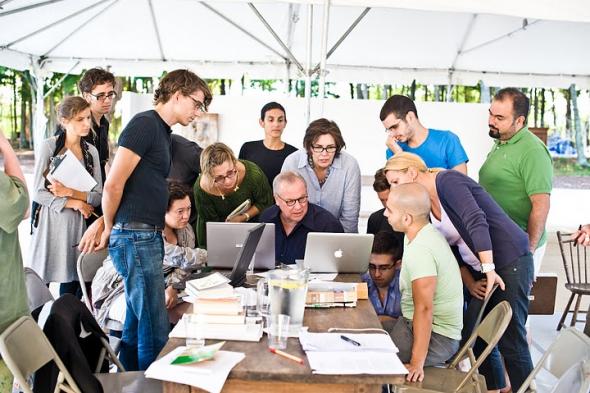 Image courtesy of Lovis Dengler
The Watermill Center is currently looking for artists of all disciplines between the ages of 18 and 40 to apply for The 2011 International Summer Program running from July 18 – August 21, 2011. The program is looking for emerging and mid‐career artists including architects, visual artists, directors, actors, dancers, choreographers, costume/scenic/lighting designers, performance artists, graphic designers, archivists, landscape artists, dramaturgs, and writers.
About the International Summer Program
For the past 17 years, The Watermill Center has hosted an International Summer Program led by Artistic Director, Robert Wilson. Each summer, approximately 65 artists from over 30 countries gather at Watermill’s Long Island, NY six‐acre campus. Selected participants spend two to five weeks in intense creative exploration which provides a unique opportunity to learn from established professionals, particularly the development and performance methodologies of Robert Wilson and his peers; forge lasting relationships with other artists from a broad range of experience levels and disciplinaryspecificity; develop networks of US and international professional contacts; focus on new work, and embody what it means to be a “global artist.”
Participants receive access to an extensive collection of resources central to the Watermill experience: ongoing apprenticeships and daily workshops with Robert Wilson and his collaborators; lectures on various subjects from theatre and opera innovation, installation, design, and science led by international cultural luminaries, established artists, and scientists; opportunities to develop new work for public presentation during the annual Watermill Summer Benefit and Discover Watermill Day; access to 20,000 square feet of rehearsal/performance/design spaces; a theater production archive; a 6,000 volume library; outdoor stages; the Watermill Art Collection; and the Center’s landscaped grounds.
In addition to workshops, all participants share in the responsibilities of daily life: housekeeping, cooking, cleaning, and maintaining the Watermill grounds and gardens. Daily physical labor, including landscaping and the construction of site‐specific installations is an integral part of the Summer Program. This live/work environment reflects the Watermill idea that an artist works differently in an environment that he or she has helped to create and maintain.
All participants are lodged in shared rooms in either the Center's dormitory or rented summer houses. Shared vans are provided for transport to and from the Center. All participants spend the entire day (from 9am to 10pm, seven days a week) at the Center. All meals are prepared with trained chefs and served at the Center.
How To Apply Click Here -->
Does one always set out to communicate when one writes?
No, sometimes you are just trying to understand your thoughts, study your dreams, wrestle with something you heard, did, or saw, come to grips with the mysteries of being.
Communication begins when you think about someone other than just yourself.
This might be why good writing is also known as re-writing. You can jot down your thoughts for yourself. But, if the time comes to share those thoughts, then you can re-read what you've written to see if anyone might vaguely follow you. You check to make sure you're not repeating yourself. Am I building a persuasive argument, creating a flow, varying the rhythm enough to incite a riot of tension and excitement?
The literary giants, as well as the leaders in any art, have sorted through their thinking, stories, methods so that their work holds us captive from the first to the last word, the first to last frame in the case of dance on camera. How? is often their secret.
Communicating with images as one does in dance on camera effectively implies visual literacy on both the "writer" and the viewer. An innumerable number of decisions made in the course of the creative process separate the amateurs from the pros. But just as a dancer trains like a devil to transform impossible tricks into seemingly effortless feats of imagination, so the capable dance filmmaker can dupe a beginner into thinking dance on camera is quite facile.
Get a camera, find a space, press play and jump in front of the lens.
We've found over decades that everyone seems to be tolerant and satisfied to watch a live, not particularly stellar performance but watch that same performance on video? We cry to be released very quickly. Dance filmmakers have to be deft at capturing our audience from the get-go and hold them. How do we do that?
We have no formulas for success. Composers have music theory to back them up. Doctors have centuries of analysis and practice. But dance filmmakers? How do we gain the craft?
By being aware of our sensual reactions, perhaps number one. We can mine our own image databank, our mental reference library, learn to trust our intuition, and note continually what fascinates us, makes us laugh, squirm, and think.
Can the dance filmmaker discover the equivalent of musical dominant/tonic resolution in the visual world. I asked once Mark Morris, the choreographer known for his musicality, had he found the equivalent. It was the only question I had for him that left him stumped.
Will we be able to teach visual harmony and counterpoint at some point?
Certainly the narrative film world has its myriad film schools, theory, and formulas. How can those be applied to the world of dance - with care and study.
Reading the fascinting book "Cutting for Stone" by Abraham Verghese, I was struck by a chapter called "Prognostic Signs." He writes, "Life is full of signs. The trick is to know how to read them. Ghosh called this heuristics, a method of solving a problem for which no formula exists."
Heuristics, otherwise known as rule of thumb, trial and error, - according to Wikipedia - refers to experience-based techniques for problem solving, learning, and discovery. Heuristic methods are used to speed up the process of finding a good enough solution, where an exhaustive search is impractical. Polya's 1945 book, How to Solve It:[2]
All good advice for dance filmmakers. The importance of envisioning the final film, the experience of the viewer, beginning at the end desired result is paramount.
Each of the pioneer dance filmmakers from George Melies to Maya Deren, dancer/choreographers working in commercial films Gene Kelly to Michael Jackson, concert choreographers Jerome Robbins to Edouard Lock had their specific intention and goal.
George Melies wanted to entertain and dazzle his audience with his magic tricks of superimposition. Maya Deren, the daughter of a Russian Psychologist, drew from her studies of Voodoo wanted to hypnotise her viewer. Gene Kelly wanted to stretch beyond his known success as a macho physical dancer to being referred as an innovator who could use the frame of a story to experiment. Michael Jackson worked with choreographer Vincent Patterson to pay homage to the Film Noir in "Smooth Criminal." Both Jerome Robbins, Bob Fosse, and Edouard Lock analyzed their own choreography to discover what would be the exact camera angle, at the right moment, to reveal the unique thrust of their movement and what it could trigger in the viewer.
The Australian born choreographer Lloyd Newson of the British based company DV8 was trained in the field of psychology. His stage and film adaptations know just how much prodding and provoking he can do before he pulls back to take a pause. He is a master manipulator but he ingeniously stays within the world of dance without letting all his toolbox show as obviously as in BLACK SWAN. |
Created by San Francisco Bay Area based artist Beth Fein in 2005, dance anywhere® has turned into a world wide dance party with thousands of participants across the globe! Create your profile on the site to put yourself on the dance anywhere® map!
http://www.facebook.com/danceanywhere
Sergi Faüstino
Sergi nos ha pasado este apetito sobre Estilo Internacional, sobre el ir trabajando y el ir entendiendo conforme se trabaja, sobre el cansancio, sobre el correr, sobre un hacer que muta en relación a los espacios, sobre el hacer sin representar, …
Esto no es una explicación.
Vladimir Miller
Renegotiating the Space: Interview with Vladimir Miller
Una entrevista entre Vladimir Miller y Dmitry Paranyushkin sobre estrategias en relación al espacio y cómo este puede facilitar la renegociación de ciertos comportamientos, interacciones, pensamientos y relaciones entre los participantes.
Bea Fernández
de lo invisible durante el proceso en Pontós Girona

no se porqué a veces se me escapa hacer los puntos de las íes con un circulito en
vez de con un punto,..dicen que es signo de egocentrismo… otros dicen inmadurez
y también falta de afecto?? no sé…… donde me debo colocar.
Será que tengo un hígado congestionado?
Cada vez que vuelvo al estudio sola, cada vez que vuelvo a empezar, tengo que
ponerme al día con este cuerpo que me encuentro, este cuerpo que ha vuelto a
cambiar………………………………………………………………………………………………………………………………………..
Hoy he intentado activar mi abdomen, estaba abandonado y mis lumbares doloridas,
 he abierto espacio y para eso necesito ir en contra de la gravedad.. con lo que a
mí me gusta ir a favor…………………………………..¿que es la continuidad?
Me monto estrategias para movilizar todas las partes y sin querer la memoria
empieza a trabajar con materiales antiguos, me vienen instantes de espectáculos
pasados………hoy he intentado trabajar con la sequedad y fuerza muscular de Bajo
cantos rodados, sin rescatar la forma…………………………………………………..era un
cuerpo+ingenuo-experimentado pero con mucha pasión esa que tiene el cuerpo
del PRINCIPIANTE.


Masu Fajardo escribió desde el contexto de la última edición el Festival A ras de
suelo (Las Palmas, 2010) esta reflexión sobre la pieza creada por Bea Fernández:
"Este texto es simplemente una reflexión a posteriori como aquellas que me gusta
hacer cuando entiendo que algo tiene una potencia que no está únicamente en su
estimulación más directa, sino que detrás, abajo, o no sé donde, hay una esencia
muy sencilla, y con esto me refiero a muy humana."
leer más
Sònia Gómez Sònia en casa y en acción...
Durante todo el mes de marzo iremos publicando en este Blog diferentes Apetitos relacionados con los artistas que presentan sus trabajos o propuestas en LP’11.
Los apetitos-fuentes son textos, vídeos, audios, imágenes (vamos, cualquier cosa que podamos colgar o de la que podamos daros la referencia a través de la red) que no tienen porqué estar directamente relacionados con el trabajo específico que el artista o teórico presentará en LP’11. A veces los apetitos serán invitaciones en las que los artistas os propondrán una reflexión sobre cuestiones que les ocupan o que transitan por su obra en general, otras serán textos o entrevistas en vídeo en los que se cuestionan el contexto o el medio. En otros casos no serán materiales propios, sino citas de textos o imágenes que les han servido como fuentes, como motores, como inspiración; en algunos casos serán breves filmaciones de otros trabajos que no se presentarán en LP’11 y, en ocasiones, reflexiones críticas de otros autores sobre obras anteriores o relatos de experiencias pasadas…
Los apetitos son una forma de invitaros a abrir la mirada y acercarnos a los diferentes autores que conforman ese cuerpo múltiple que es LP’11.
¡Bon appétit!
Aquí va un primer aperitivo en “acción”: “I’m going to perform one of my musical compositions….” John Cage
John Cage performing “Water Walk” in January, 1960 on the popular TV show I’ve Got A Secret
Discover Spider Galaxies, the new creation of the Cie Gilles Jobin, in pre premiere on March 3rd at 4 pm for the opening of the Swiss Dance Days festival in Bern.
After the heady Black Swan he created in 2009, Gilles Jobin commits himself further into movement with this new piece. Accompanied by 4 iconographer dancers, he conceives elaborate generators of figurative abstraction, while Cristian Vogel and Carla Scaletti invoke the particles and Daniel Demont disperses the spectrum. Protean, infinitely large or infinitesimal, such are the Spider Galaxies…
More information on the cie's website
ABSTRACT
Politically engaged art practices have been important inputs for feminist theory throughout history. In the contemporary art landscape, the work of Spanish multimedia artist Jaime del Val proves to be as innovative as it is provocative in how it reflects complex phenomena – from the undoing of traditional understandings of bodies and identities, to the capitalism of affects and the influence of surveillance technologies. Del Val's expressive strategies such as combining urban interventions with microcameras, and dance movements electronically coded and turned into visual images, create engaged artistic projects such as his ‘Antibodies of Surveillance’ and ‘European TelePlateaus’, respectively. The interview format allows for the exchange of first-hand information from a creative and multidisciplinary posthuman standpoint that questions dichotomous thinking in terms of sex/gender, human/non-human, activism/academy, ability/disability, among others. The result is a mapping of the work of this transnational artist that might inspire fruitful debates on ways to develop alternatives for social, cultural and political change.
assuminggender.com
In Volume 1, Issue 2
Autumn 2010
http://www.assuminggender.com/2010/11/cecilia-gordano-pangendered-cyborg-of.html
Seriously, when there is no music all I hear is the scuffing and dragging of feet and for the youth-fully challenged, some joints popping. Unless I watch a video of you dancing and the music has been either disabled by youtube or there is simply no sound available.
I challenged you dancers to show me a dance sequence without any music. Why? Well, what else can a DJ blog about on a 'dance' blog?
What if you could have music made specifically to your talent, speed or routine? How about a sound-alike music track? Matched precisely to your desire.
I use to customize a dozen songs for aerobic instructors. Just a thought.
Thank You,
Roman-Gabriel
MotionFrames is an integrative installation that explores evolving dance images under software controlled video playback. A collaborative project in the generation of an aesthetic environment that conveys the urban landscape of the city and movement artists from Switzerland. Under the direction of composer Cristian Vogel, dancers from Bern will create video clips that feature the interaction between dancers, the environments of the city and real time software processing. These clips will be displayed during the festival and participating artists of the festival will be offered to participate and create new content. Content will be updated daily during the festival.
Conception: Cristian Vogel and Gilles Jobin
Direction: Cristian Vogel and Marlon Barrios Solano
Programming: Cristian Vogel
Production: Gva Dance Media Lab/Cie Gilles Jobin
In collaborations with Bern dancers:
Marion Ruchti
Marcel Leemann
Dominique Cardito
Ismael Oiartzabal
Maja Brönnimann
Azusa Nishimura
Emma Murray
Motion Frames has been initially developed in the Gva Sessions Made In Yokohama/Japan in summer 2010 and it is the inaugural project of the Gva DanceMedia Lab/Cie Gilles Jobin
Upcoming this summer!
GVA Sessions 011
Dialog: Sound and Movement
July 16th - 23rd 2011
Contact: gvasessions11@gillesjobin.com
Studios 44,
44, rue de la Coulouvrenière, Geneva
Switzerland
Don’t miss the 3 projects of Cie at 8th edition of the Swiss Dance Days from March, 3 till 6 in Bern (Switzerland)!!
> Spider Galaxies
Discover Spider Galaxies, the new creation of the Cie Gilles Jobin, in pre premiere on March 3rd at 4 pm for the opening of the festival and on March 4th at 8 pm.
> A+B=X
The Cie Gilles Jobin will present an excerpt of the first group piece of the choreographer, A+B=X (creation 1997), on Saturday, March 5th at 2:30 pm.
> Motion Frames
Integrative installation directed by Cristian Vogel and Marlon Barrios - March, 3rd till 6th.
The dancers will create video clips that feature the interaction between dancers, urban environments and real time software processing. These clips will be displayed during the festival, and artists present at the festival will have the opportunity to participate and create new content.
It is the inaugural project of the Gva Dance Media Lab.
Conception: Cristian Vogel and Gilles Jobin.
Work:
louder (2008)
A telling orchestra is rigged on a rusty wire and a tidal wave of pictures and sounds is thrown at us by a machine so fragile that it is in constant danger of short-circuiting. Among a pile of megaphones that hurl sound in all directions, and a knot of wires so stretched that they may break at any moment, we glimpse people. People who are trying to interact with this landscape, tugging at strings that are everywhere in the room. The strings hanging from the ceiling form the stage for a mass of figures. A mechanical puppet play takes place here - over the heads of the human figures. louder is a storytelling orchestra that hangs by a rusty wire and narrates a multitude of tales through sound and images. Tales from a distant past, tales from our time, about wars, river, the theatre, the nation, music, nature, technology, the journey and about exile. In the midst of this throng, we find a heart of darkness - a long, black barge on the open sea, radiating coldness and stories.
FORTELLERORKESTRET (2005/06)
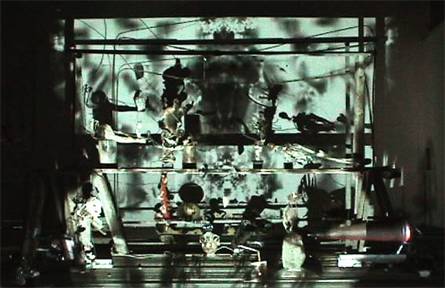
"FORTELLERORKESTERET" ("The Telling Orchestra") is a "live" room-installation that can be described in many ways: An audio-visual composition where rusty mechanics meets new technology on the backside of a "video-shadow-theatre" on Greenland. A machine, a polyphonic instrument, or a whole orchestra with many voices and tunes,mutating shapes and interwoven stories. An electro-mechanical construction that functions as an audio-visual "animation-machine"or a mechanical figure-theatre machinery, where images, sculptures, sound and video is deeply integrated into each other to form an audio-visual-spatial composition.
By use of computer controlled motors and robotics the primitive wooden construction of old weather-beaten planks has become
an automatized sculpture-machine with the ability to in a second, totally transform the space in radical ways.
CONCERT FOR GREENLAND (2003/05)
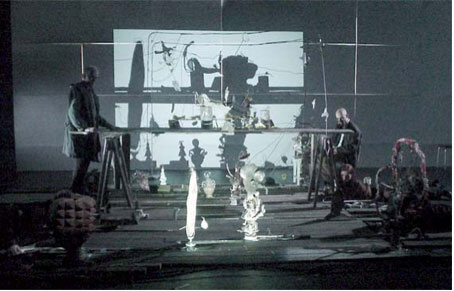
"CONCERT FOR GREENLAND" is an audio-visual composition where rusty mechanics meet new technology on the backside of a "video-shadow-theatre" on Greenland. A performance/installation where visual art, sound, video, installation, text and theatre try to unite into one composition.
The background for "Concert for Greenland" is a journey Verdensteatret made to Greenland and other north-Atlantic islands in 2003.
Greenland as the focus point of this work is, as often before, a result of an intuitive attitude towards use of artistic material and the fact that research on travels has worked very well for us on several occasions earlier. The material is based on travels and research around the Northwest-Atlantic countries from august till November –03. -Greenland, Iceland, Faeroe Islands -and Norway.
In the further working process in Oslo all the material collected on these trips went into a deeper artistic process that in the end "sweat out" a poetic concentrate. The longest stay was in Greenland and has obviously made a deep impression on us since so much of the material we ended up using comes from our travels there. The ambivalent impressions we often felt during our stay in Greenland has changed into deep fascination. "Concert for Greenland" reflects this journey on several levels simultaneously.
On the first level it mirrors the actual trips (specially Greenland). But the structure and artistic expression of the performance is more like images and sounds from the subconscious experience of these Nordic journeys, rebuilt through our dreams or our unreliable memory. On still another level its an expedition through a sound-scape, through language and visual transformations.
MORE INFO, IMAGES, AND VIDEO -->
Body Pixel is:
"Deborah Hustic aka body pixel – artist, blogger, web dreamer… working with analogue and digital media."
The blog keeps popping up in my Google Reader with neato interviews, complete with fascinating questions and suggestions about dance & technology intersections:
example:
Interview with Scott deLahunta, part 1: On working processes and digital realmsPLEASE CIRCULATE
Call for papers
Music and Gesture : 2nd Musical Itineraries Forum
Lisbon, Portugal, 28 and 29 October, 2011
The Center for the Study of Sociological and Musical Aesthetics – CESEM (Faculty of Humanities and Social Sciences, University NOVA of Lisbon), announces the call for papers for the 2nd Musical Itineraries Forum: ‘Music and Gesture’ taking place in Lisbon, 28 and 29 October 2011.
The Musical Itineraries Forum was established in 2010 as a meeting place for interdisciplinary debates and presentation of scientific projects, encouraging the discussion between researchers, performers, students and creative artists. This Forum promotes an open critical reflection on contemporary subjects in artistic practices fields and music and sound discourses and its relationships with other disciplines. Its main purposes are: 1) to address innovative areas of research in the fields of music and sound and establish synergies between a variety of scientific and artistic domains providing e opportunities for meeting and discussion between artists and researchers from diverse origins, as well as promoting the crossover between theory and practice; 2) to establish dynamic and interdisciplinary methodologies that will contribute to “the state of art” advances in this field of study, revisiting and highlighting scientific questioning and providing the opportunity for collaboration between national and international researchers.
The 2nd Musical Itineraries Forum, dedicated to music and gesture will focus on the study of the relationships between sound, music, gesture, performing arts and technology. A reflection on how the discourses of identity, culture, power and knowledge are encoded in body gestures involved in artistic expression, links the main lines of thought to be presented at this Forum. Theater, dance, audiovisual, new technologies, and their crossover with sound and musical expression are the areas on which reflection and debate will be developed, particularly in relation to the representation and dramaturgy of gesture. Keynote speakers will include Atau Tanaka (Director of Culture Lab, Newcastle University), Adam Parkinson (Culture Lab, Newcastle University) and Paulo Ferreira de Castro (Universidade Nova de Lisboa).
We invite all those interested to submit their paper proposals for a 20-minute presentation, on the above topics and including title, abstract (up to 2000 characters) and five keywords. We also request a brief biography (up to 1500 characters), a phone number and an email address, as indicated on the attached form. Proposals should be submitted via email until 16th March 2011 to itinerariosmusicais@gmail.com and cesem@fcsh.unl.pt.
The acceptance of proposals will be communicated until the 10th of April 2011. All additional informations on the 2nd Musical Itineraries Forum can be found at the CESEM’s website: http://cesem.fcsh.unl.pt.
Forum Topics:
1. Gesture, Body, Sound and Space
- Gesture dramaturgies in a performative context. Sound and visual interaction and bodily representation.
- Relationships and ruptures between sound, visual and scenic arts. Gesture and sound expression onstage (classical, virtual, public, hybrid… ): opera, theater, dance, audiovisual, and other artistic expressions and practices.
- Sound production gestures, embodying, technology and performance.
- Information sources for musical and scenic gesture theatrical piece, opera and ballet libretto, film script, iconography…). Problematics of movement notation.
2. Sound, Gesture, New technologies
- Body virtualities, interactive gesture and sound production: problematics, potentialities and interdependences.
- Gesture and virtual sound spaces creation. Virtual gesture and playability: sound and videogames, gesture and sound representation reciprocity.
- Performing arts and new technologies of sound and gesture: body and instrument extension, post-human body, meta-body and meta-instrument.
- Semiotics, semiology and digital semantics: transcription and representation of sound gesture.
- Phenomenological aspects: experience and analysis of gesture’s embodying.
3. Sociology of Performance Practices: discourse, representation, power and mediation
- The power discourses, knowledge, culture and identity in gesture, choreography, staging and the performing arts.
- Institutional aspects, markets, production networks, industry and public of performative arts.
- Performative gesture representation in the visual arts: film, literature and other collective cultural practices.
4. Gesture Ontologies and Performative Practices
- Gesture, communication, language.
- Theoretical and historical studies of gesture and body in performance practices. Iconographic sources and dance treatises. Choreographic notation issues in historical musical sources.
By decision of the Scientific Committee any proposals that do not address these topics may however be included in a free communication session.
Coordination:
Paula Gomes Ribeiro and Isabel Pires
Scientific Committee:
Carlos Sena Caires (EA / UCP), Isabel Pires (CESEM / UNL), Isabel Valverde (IHSIS), Luís Sousa (CESEM / UNL), Paula Gomes Ribeiro (CESEM / UNL)
Organizing Committee (CESEM):
Beatriz Serrão, Ernesto Donoso, João Romão, Luzia Rocha, Manuela Oliveira, Rui Araújo
Calendar:
Proposal Submissions: from 20th January to16th March 2011
Acceptance Notification: until April 10th 2011.
Language:
Portuguese, English and French
Subscriptions:
Subscription with communication including two meals : 50€
Subscription with communication without meals : Free
Entrance is free
Organization:
CESEM, FCSH, UNL
Subscription Form / Proposals Submission
2nd Musical Itineraries Forum: Music and Gesture
Lisbon, 28 and 29 October 2011
Please complete the following information and send to itinerariosmusicais@gmail.com and cesem@fcsh.unl.pt
First Name:
Last Name:
University or Institution / Profession:
Address:
City:
Postal Code:
Country:
Telephone / Mobile:
Email:
Paper Title
Abstract (up to 2000 characters):
5 keywords:
Supplementary Informations:
Musical Itineraries Forum : itinerariosmusicais@gmail.com
CESEM (Centro de Estudos de Sociologia e Estética Musical)
Faculdade de Ciências Sociais e Humanas, Universidade Nova de Lisboa
Av. de Berna, 26-C 1069-061 Lisboa Portugal
cesem@fcsh.unl.pt
Tel. (351) 217 908 300 ext. 1496 Tm. (351) 96 555 37 55
