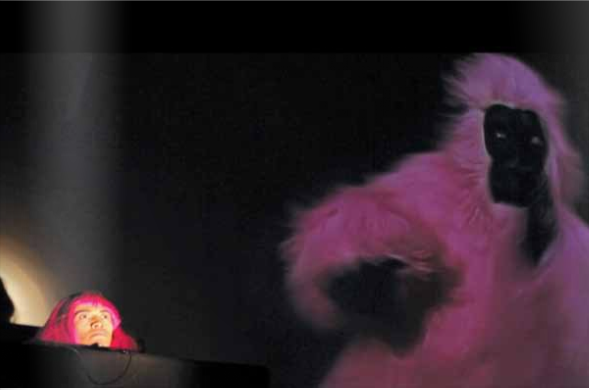
Please join us at 92YTribeca for an evening of historical and contemporary short videos and live performances featuring strange, gross, funny, and wondrous creative adventures with living organisms.
Appearing LIVE!
* Collaborative neuromuscular circuit hacking by Toringo:Margolis and Loud Objects! * Biofeedback video straight from Zach Layton's brain! * Hot live DIY-bio action with Nurit Bar-Shai and the Genspace crew!
Plus a broad selection of funnystrangeawesomestupidgross videos showing life at its wrongest.
WARNING: Some content inappropriate for ALL HUMANS. Really.
Curated by Douglas Repetto, Jenny Torino, and Marie Evelyn (Analogous Projects). Thanks to 92YTribeca for making BioWrong possible!
* * * * * * *
Next regular dorkbot-nyc meeting: 06 April, 2011
..............................
.......................................... .........dorkbot: people doing strange things with electricity.......... ......................... http://dorkbot.org ........................... ........................................................................
The Adobe Museum of Digital Media (www.adobemuseum.com) announces its second exhibition, John Maeda: Atoms + Bits = the neue Craft (ABC), on view March 23–December 31, 2011. The exhibition is a digital representation of Maeda, president of the Rhode Island School of Design (RISD), leading an interactive lecture on how artists are connecting the worlds of digital creativity and analog (or handcrafted) creativity. Titled Atoms + Bits = the neue Craft (ABC), the lecture underscores the mission of the AMDM to provide an interactive venue for presenting digital media works as well as providing a forum for expert commentary on how digital media influences culture and society.
According to Maeda, "Computers let us imagine digitally what we once could only validate by handcraft in physical form—the infinite malleability and reusability of bits have forever changed the creative process. But just as it took Icarus to first imagine human flight by carefully observing how birds can fly, digital tools have relied on many of the original tools and media used by artists in the pre-digital world." Maeda sees the thread that runs between the tools of physical art making—such as pens, brushes and pigment—and the way new media has co-opted many of the same tools to manipulate bits in digital art. Through the exhibition, he examines the history of linking analog and digital creativity within his own work and the works of others.
The exhibition takes the form of an interactive lecture, with a digital representation of Maeda speaking on a simple stage resembling his office at RISD. Dynamic infographics, video content and audio remarks illustrate Maeda's talk. Scenes from RISD art studios, including wood, glass, metal, and paper workshops, demonstrate the richness of expression Maeda feels must be captured in digital art's next chapter.
About John Maeda John Maeda is a world-renowned artist, graphic designer, computer scientist and educator whose career reflects his philosophy of humanizing technology. For more than a decade, he has worked to integrate technology, education and the arts into a 21st-century synthesis of creativity and innovation. A recipient of the National Design Award and represented in the permanent collection of the Museum of Modern Art, Maeda became president of the Rhode Island School of Design (RISD) in June 2008.
A former professor at the Massachusetts Institute of Technology, Maeda taught media arts and sciences there for 12 years and served as associate director of research at the MIT Media Lab. Maeda's early work redefined the use of electronic media as a tool for expression by combining skilled computer programming with sensitivity to traditional artistic concerns. He has published four books including The Laws of Simplicity, now translated into 14 languages. His new book written with Becky Bermont, Redesigning Leadership, expands on his micro-posts on leadership and innovation as @johnmaeda on Twitter. In 2008 Maeda was named one of the 75 most influential people of the 21st century by Esquire magazine and in 2010 he was called the "Steve Jobs of academia" by Forbes magazine.
A native of Seattle, Maeda earned bachelor's and master's degrees in Computer Science and Electrical Engineering from MIT, followed by a PhD in Design Science from the University of Tsukuba Institute of Art and Design in Japan and a master's in business administration from Arizona State University.
About Adobe Museum of Digital Media (AMDM) The Adobe Museum of Digital Media (www.adobemuseum.com) is a one-of-a-kind online museum and interactive venue designed to showcase and preserve groundbreaking digital media works and provide a forum for expert commentary on how digital media influences culture and society. The AMDM is open 24/7, 365 days a year, free of charge. Visitors are invited to sign up for free membership to enjoy special benefits including advance viewings of exhibits and exclusive events.
The AMDM launched in October 2010 with inaugural exhibition, The Valley, a specially commissioned work from renowned American artist Tony Oursler. Exhibitions are curated by leaders in art, technology and business, changing regularly throughout the year. A permanent exhibition archive remains indefinitely accessible at www.adobemuseum.com.
About Adobe Systems Incorporated
Adobe is changing the world through digital experiences. For more information, visit www.adobe.com.
Join La Mama for these experiential workshops for professional directors, playwrights and actors at La MaMa Umbria International in Spoleto, Italy during 4 Programs this summer.
Erik Ehn presents his workshop on Spatial Writing at the 5th Annual La MaMa International Playwright Retreat, July 3 – 13, 2011 at La MaMa Umbria is Spoleto, Italy.
The 12 Annual La MaMa International Symposium for Directors takes place from July 15 – August 15, 2011 at La MaMa Umbria. There will be 2 two-week sessions, featuring teaching artists Ping Chong, Ruth Maleczech, Dijana Milosevic, Luca Ronconi, Hjalmar-Jorge Joffre-Eichorn, Baba Israel, JoAnne Akalaitis, Dorcy Rugamba, Marco Martinelli, Ermanna Montanari* and special guests. In addition, participants visit local cultural sites, attend arts festivals and community fairs and meet local artists.
Tina Landau and André de Shields share their approaches to actor training during the inaugural year of the La MaMa Umbria Master Acting Workshops, August 17 -27, 2011.
Cricot-2 Workshops, led by leading actors from legendary director Tadeusz Kantor’s company, will be held June 13 – 26, 2011.
The international symposium “Dance, Politics & Co-Immunity“ is dedicated to the question of how dance, both in its historical and in its contemporary manifestations, is intricately linked to conceptualisations of the political. Whereas in this context the term “policy” means the reproduction of hegemonic power relations within already existing institutional structures, politics refers to those practices which question the space of policy as such by inscribing that into its surface which has had no place before. Thinking politics as the absent political within policy is therefore by definition linked to the idea of choreography in the truest sense of the word: The art of choreography consists in distributing bodies and their relations in space. It is a distribution of parts that within the field of the visible and the sayable allocates positions to specific bodies. Yet in the confrontation between bodies and their relations, a deframing and dislocating of positions may take place. This ongoing distribution and reconfiguration of the sensible (Jacques Rancière) which structures the body and its parts and links it to the existing symbolic order of any given society can be considered a site of resistance allowing for interventions into hegemonic discourses, traditional distributions and fixed framings. In the public space of theatre, whose characteristic feature is the separation of stage and auditorium, dance may not only distribute its bodies, but also split and to share that which is separated and yet united: The community of bodies as well as their words and the objects they produce.
Over the past years the term “policy” has undergone a renaissance in political philosophy. On the one hand there are those who bemoan the disappearance of politics (Alain Badiou), on the other hand others welcome its return and relational integration into sociability (Nicolas Bourriaud). Inbetween these extremes there are those who accuse political philosophy itself of playing into the hands of the powers and of thereby sacrificing the idea of politics for a universal process of administration (Colin Crouch, Chantal Mouffe, Jacques Rancière). In the course of this discussion the question of what constitutes a democracy becomes more and more virulent. Recent developments in the world economy suggest that Michel Foucault’s concept of “governmentality” of self, other and society, which he developed in his lecture series between 1977 and 1979, is more pertinent than ever. Whereas the citizens of the one world have involuntarily become bearers and sharers of incalculable risks, the frontiers to the other world are protected more and more rigorously. Examples of this are the overflowing refugee camps e.g. on the southern Italian shores as well as international airports that resemble high security tracts searching and registering masses of bodies in their microstructures with new technological devices. While one part of the world population deterritorialises itself voluntarily, the other part is forcibly prevented from entering this space defined by its increasing mobility, acceleration, and high speed communication highways. Neoliberal dispositives of power are linked with technologies to secure and enclose territories, discourses and bodies whose general health is cared for while they are deprived of a possible shared way of life.
The renaissance of the political goes together with the rebirth of a long discredited term: That of community. In the German political tradition of Ferdinand Tönnies, community - in a Romantic understanding - opposed to society. In the works of Jean-Luc Nancy and Roberto Esposito, however, community no longer appears as a simple opposition to political developments, but rather as a contested space of discussion that risks community in a dialogue between equals. Although contemporary developments in world politics and world economy establish increasingly asymmetrical relationships between people, it is the idea of a community of equals that may subvert these developments.
Viewed against this background, how did dance and how does dance, then, do politics with the body in the public (theatrical) space? How can it become political? The symposion looks for theoretical models, historical constellations, contemporary experiments and practical consequences that elucidate the relation between dance, politics and policy – which, in Jacques Rancière's terms, might be called ”police” as well. What does the structuring and distribution of bodies and their parts look like in historical formations of dance such as the court ballet of the 17th century, the Romantic ballet of the 19th century or the German Dance tradition of the Weimar Republic? What historical departures of dance where linked with political contexts and how? Which political contexts provoked dance as a critical intervention? Which contexts suppressed dance or, contrary to that, teamed up with dance in order to change and rearrange the distribution of bodies in the social and theatrical arena? What does a critical bodily practice look like in the age of genetic engineering and reproduction by the mass media? Does the relation between body and text have to be redefined? Are there choreographic practices that may subvert the dominant powers? How do the artists themselves think about their aesthetic practice and how does that influence the choices they make? What are the consequences of these choices for their institutional working conditions and practices?
Participants of the symposion are invited to think about the multiple connections between politics, community, dance, and globalisation from the perspective of Dance and Theatre Studies, History, Philosophy, and Sociology. One focus of "Communications” will be the discussion of recent developments in contemporary dance and the production of new spaces for collaboration and exchange. In how far do they help to reformulate what economists call the “becoming immanent” of the world”? On an artistic level the conference wants to look for possible answers by presenting pieces by dance makers dealing explicitly with the issues raised here. Apart from more established artists like Xavier Le Roy or Mette Ingvartsen a younger generation of artists shall use the conference as their platform. This is why the organisers are planning to draw on artists and their work from institutions that have been supported by Tanzplan Deutschland over the past years. They are invited to explore the relation their work undergoes with social or political developments. The title of the conference paraphrases on purpose a text by Roberto Esposito. In his trilogy Communitas-Immunitas-Bios Esposito describes the reciprocity of opening and closure of social systems and of bodies alike. He tries to make this movement productive for a rethinking of the political in terms of an interweaving of communitas and immunitas - in a space where life is given a form in order to grant all bodies survival.
Thinking - Resisting - Reading the Political What perspectives and methods does advanced cultural theory offer for our attempts to grasp political discourse and analyze aesthetic treatments and performances of resistance? The international conference THINKING – RESISTING – READING THE POLITICAL brings together scholars from the fields of theatre, literature, art and media studies, from cultural theory, sociology, and philosophy, to discuss possibilities and limits of current models and attempt new approaches. The deliberately ambiguous German title exemplifies the bidirectional design: ‘widerständiges denken’ refers both to manners of thinking resistance, and to the search for a quality of resistance in manners of thought. Similarly, ‘politisches lesen’ intends both the search for a political element in dispositions towards reading, and that for an adequate disposition to read for an element of the political as understood in recent conceptions by Jacques Rancière, Chantal Mouffe and Ernesto Laclau. The conference assembles a set of thinkers from the fiels of theatre, literary, media and art studies, from cultural theory, sociology and philosophy, to discuss consequences that follow from these models: In what theoretically describable forms of thought can resistance appear, and how can resistance be thought of as an object of theory? How can the political mark certain texts, and what procedures are available for a reading that is marked by an appropriate sensibility for the contents and orders of the political?
In recent years, theory, art and feuilleton have all seen a recurrence of notions hailing from ethics and politics, including the controversial concept of an ‘ethical’ or ‘political turn’, but also an increased interest in ethical evaluation and political engagement, and new studies into social preconditions, as well as into reflections of the juridical and legislative influence on the shape of art’s production and reception. These movements join a by now well-established discourse on topically related objects within post-colonial and gender studies, and not least a renewed attention for politically engaged positions of previous theoretical discourses, which are now often read in new ways that are quite removed from their original and immediate political intentions.
At the same time, we find – often in different places, contexts and traditions – an increasing attention for far-reaching conceptions that entertain new claims to universality or an autonomous weltanschauung or agenda. What these contributions in the context of radical democracy theories and recent philosophical interventions concerning politics share despite their differences is an emphatic valorization of concepts of the political, the event or of truth, taken in the sense of a radical interruption and re-constitution of historical aprioris; a tendency that recurs in as different a manner as those of Badiou and Rancière, of Critchley and Esposito.
With an aim to better understand, clearly describe and critically discuss such concepts of a political dimension in aesthetics, the talks at this conference will look at those facets of the ‘political’ that are problematized in their discourses: At phenomena, that is, that depend upon their fundamental incommensurability with representations and institutions, with stable notions of political order and uninterrupted political discourse. Such interpretations distance themselves from a simple equation of political reading with an interest in politically engaged, appellative texts and literatures that support or accuse specific party politics or revolutionary programs; nor does their focus rest on purely literary treatments of categorical de- and re-differentiation in established political discourse, as they are discussed in postcolonial, gender and minority studies among others. Rather, following La Mouffe and Laclau, the political is here intended as a complementary and opposing concept to that of politics, confronting that incoherence that balances the politics of coherent commonality and communicability in favor of conflicting political autonomy and enouncement.
So far, the demands and possibilities of these concepts have rarely been fulfilled or even systematically considered in cultural studies. Faced with a large number of almost positivistically empirical studies focusing on particular phenomena on the one hand, and ambitioned speculative designs on the other, we find a vast array of possible links, each of which has proven itself productive, and yet each of which threatens to oversimplify the ‘application’ of single terms and ideas taken from overarching theories by turning them into tools for highly specialized disciplines. At the same time, it is the political ambitions and presuppositions of many superficially adopted theories that seem to be insufficiently reflected, sometimes even hardly made aware, in such ‘applications’.
We want to attack both deficits. Both, we suggest, are owed not least to the difficulties engendered by the very idea of an ‘application’, a ‘use’ that is in itself often foreign to the main tenets of the original discourses. A naïve concept of method in the sense of established philosophy of science, or even following traditionally hermeneutical, descriptive, e.g. structuralist, and most poststructuralist approaches sometimes misrepresents theory as a toolbox, its instruments readily separated from their originating beliefs and turned to the screws and nails of otherwise unconnected objects of culture and art. But this stand in stark contrast to the central observation that political, social, conceptual conditions and artistic practices are incontrovertibly interlinked. Similarly unconvincing are those adoptions of radical theory that avoid discussing any consequences from the positions they adopt, omitting the necessary reflection of their own view of scientific and scholarly practice in contemporary cultural studies.
Returning to an interest in the political, we thus propose to accompany such interests with an intention towards theoretical conceptions, and to openly examine if and how that intention might translate into specific analytic or descriptive measures: The conference will discuss the problematic ‘consequences in methodology’ attributed to these theories from a number of different vantage points. The interdisciplinary setup will hopefully provide opportunities to productively discuss theories of various provenience and to grapple with works of art and individual analyses, examining, defending or rejecting the possibility of a methodology informed by advanced theory. The conference will aim not only to continue a critical reflection upon the proposals offered by current theories, but to constantly accompany that reflection with a conscious question as to the specific consequences that flow from these theories to the practice of cultural study and the analysis of individual and concrete pieces of art; a question that might well have to be answered in the negative, but deserves an explicit answer nevertheless. Can there be methods for a scholarly sound reading of the political? Is the activity of dealing with always already elusive and thus doubly resistant categories at all graspable in terms of methods or techniques? And whatever the answer may be, can it in turn help us to better understand common suppositions of methodology and contribute to a productive argument on what a method is?
Posted by Pepe Zapata on March 22, 2011 at 10:29am
Mercatde lesFlors, a venue -locatedinBarcelona, Spain-devotedtothe artsofdanceandmovement,celebratesits 25thanniversarythis season.And the active participaticion of audiences play a fundamental role in this celebration. How? Recoveringtheirmemoryand becomingparticipant andprotagonist ofthe celebration:
BE PART OF THE MERCAT'S MEMORY. You have lived unforgettable moments in the Mercat... you have been in the best shows... you have been moved by artists and companies you met... Share your memories with the rest of the Mercat's audience, in video or in text. WE ALL ARE MERCAT.
Toaccomplish this,Mercat de les Flors has just launched a sitethat will bring together25 yearsuntilthe endof the seasonallthe memories-invideo andin writing-of thosewho haveenjoyedthe shows at theMercatde lesFlorsandwant toshare them withtheotherspectators.These memoriescan be sentusingtheMercatprofilesonfacebookandtwitter,email,andalsoin thelobbyofthe venue,whichalsohasinstalledawebcamplatformtocollectpublic testimony.
Rise Up, Fallen Angel is an Integrated Media Performance that will involve live improvised music accompanying images projected on three large screens. The curator will group the images so they will be displayed to create a non-linear narrative relating to the theme. The exhibition will be different each time it is shown, but documentation of the event will be available for viewing. We are seeking images and video that do not contain text or language, but connect with the viewer on a primal, emotional level.
From artist and friend Keiko Uenishi (based in NYC) I share with you:
It's been quite long while.
I'm writing this because I'm a part of a friends group trying to do something for the people in Tohoku region in Japan.
We are going to visit Japanese restaurants, cafes, other stores to place donation boxes. We also just got an approval and official labels from Japan Society to make all the donations through their relief funds for Tohoku disaster.
So, we are to make bunch of the donation boxes a.s.a.p. but then, I thought about your craft night.
I'm wondering if some of NYCR people can help building the donation boxes with us on this Thurs?! More people can make more boxes!
It'd be very helpful - as we already noticed that it is effective to have a donation box for people who are not necessarily going to donate online but may consider if it is right there at their favorite restaurants/cafes etc.
Thank you so much if you'd approve such project brought in the craft night!
We've had alot of requests to extend the call for proposals to be included in our first Contemporary Performance network publication titled Contemporary Performance TXTS. So we have extended the deadline to March 21, 2011.
A little more about the book and how to apply:
This will be a network produced book about how we as contemporary performance makers prepare, road map, document, and archive our work. In essence, what does the contemporary script look like? This book will have bios, interviews and examples of performance creators and their performance TXTS. To propose your work, please log in to the network and post a blog. Then follow these directions
2. Write a very brief introduction to you and your work (i.e. where are you from, what kind of media do you work in, what are some of your performative concerns)
3. What are some of the mediums you use to prepare, road map, document, and archive your work. Why do you choose these mediums and what are their benefits to you and your work.
4. Copy/past an example of your performance txt. This can be text, images, embedded video or anything of your choosing. (Please try to limit it to 3 pages long)
5. !VERY IMPORTANT! In the TAGS section under the blog post type in "TXTS01". This is so we can find your blog using the search function.
6. Feel free to look around at the other proposals and comment.
DEADLINE for proposals is midnight EST March 21, 2011
Gilbert Keith Chesterton (1874-1936) was a British writer whose criticism holds up over time. His depiction of "A Midsummer's Dream" reveals such a fresh perspective with an acute sense of how Shakespeare "catches the atmosphere of a dream. The personalities are well known to everyone who has dreamt of perpetually falling over precipices or perpetually missing trains. ... The author contrives to include every one of the main peculiarities of the exasperating dream. Here is
the pursuit of the man we cannot catch,
the flight from the man we cannot see,
here is the perpetual returning to the same place,
here is the crazy alteration in the very objects of our desire,
the substitution of one face for another face,
the putting of the wrong souls in the wrong bodies,
the fantastic disloyalties of the night, all this is as obvious as it important."
Chesterton continues "But yet by the spreading of an atmosphere as magic as the fog of Puck, Shakespeare contrives to make the whole matter mysteriously hilarious while it is palpably tragic, and mysteriously charitable, while it is in itself cynical. He contrives somehow to rob tragedy and treachery of their full sharpness, just as a toothache or a deadly danger from a tiger, or a precipice is robbed of its sharpness in a pleasant dream."
He writes of "the mysticism of happiness." ... " We cannot have a midsummer night's dream if our one object in life is to keep ourselves awake with the black coffee of criticism."
About Low Lives: Now entering its third year, Low Lives is an international exhibition of live performance-based works transmitted via the internet and projected in real time at multiple venues throughout the U.S. and around the world. Low Lives examines works that critically investigate, challenge, and extend the potential of performance practice presented live through online broadcasting networks. These networks provide a new alternative and efficient medium for presenting, viewing, and archiving performances. Low Lives is not simply about the presentation of performative gestures at a particular place and time but also about the transmission of these moments and what gets lost, conveyed, blurred, and reconfigured when utilizing this medium. Low Lives embraces works with a lo-fi aesthetic such as low pixel image and sound quality, contributing to a raw, DIY and sometimes voyeuristic quality in the transmission and reception of the work.
Low Lives is pleased to announce a strategic partnership with Chez Bushwick, an artist-run organization based in Brooklyn, New York dedicated to the advancement of interdisciplinary art and performance, with a strong focus on new choreography. Chez Bushwick is co-producing Low Lives 3 and is instrumental in extending the platform’s international reach. Low Lives 3 will feature a ‘spotlight’ on Contemporary Choreography throughout the exhibition program.
Artists working in any media are invited to submit proposals for live performance-based works.
Selection Process: Each Presenting Partner (see list below) will follow their curatorial process to select one performance to take place at their venue. In addition, 30 artists will be selected from artist proposals responding to this Call for Artists, and will be invited to present their work across the Low Lives network. These performances will be transmitted through the internet from a location of the artists’ choice. The Selections Committee will be comprised of Directors and Curators from each of the Presenting Partner institutions. A full-color catalog and companion DVD with information and an image for each participating artist will be produced for Low Lives 3 after the exhibition takes place.
Artists selected to participate in this exhibition will be instructed on how to transmit their performance through a live online broadcasting network. Performances will be projected in real time across the Low Lives 3 network of Presenting Partners and venues. The exhibit will also be available for online viewing, both in real time as it unfolds across political boundaries and time zones, and on the Low Lives website after the event.
The editor Daniel Kontz for THE CAMERA BETRAYS YOU submitted by Liz Staruch and Mark O'Maley from West Chester University is a young talent to follow. Daniel transformed the team's flip-book idea into a dynamic, graphically pleasing jaunt, taut with tension. Shot on the High Line in NYC, THE CAMERA BETRAYS YOU makes you grin and wonder, as it draws you into its go-go/freeze rhythm. The video was created with 10,000 photographs of action and celebrated by the High Line on their website. See http://www.thehighline.org/blog/2011/02/07/video-the-camera-betrays-you
The video was one of nine from six colleges submitted to American College Dance Festival's 2011 Northeast Regional Conference at Muhlenberg College. Joshua Phillip Gleason's black and white cinematography and editing for SPOTLIGHT submitted by Maria Claudia Jaen from Towson University is also astounding.
As is sadly so often the case, the choreography was the least notable aspect of these videos with the exception of BENCHMARK, an improvisation by Katie Fierro and Jeremy Arnold from Muhlenberg College. Katie and Jeremy slump, slide, and confront each other with an organic grace and wit making the viewer feel like a wistful voyeur. They had their moment, a sweet if fleetingly honest one, and we were the witness. If only the camera left its frontal position in the end to zoom into the bench, still warm from the heat of their encounter.
Hats off to Corrie Cowart, dance professor at Muhlenberg for giving dance on camera a strong presence in this year's conference. She featured an installation of Tiny Dance Series, which DFA had celebrated in its 2010 Festival at the Walter Reade Theatre, a video of Allen Fogelsanger's movement interactive installation CANVAS & TRIGGERS_ SUITE mounted at the Varmlands Museum in Karlstad, Sweden, a lecture and workshop by myself, a marketing workshop and 48 Hour Challenge judged by Anna Brady Nuse.
My name is Nadia Lesy. I currently work as a freelance videographer and editor in New York City. I often shoot dance performances at Dance New Amsterdam. I currently own professional High Definition video equipment and edit on Final Cut Pro.
I am available to shoot a your next dance performance or edit a reel showcasing your company's best work. I can also convert your old vhs or dvd copies into almost any format you wish.
My rates are reasonable and I also work as a dancer and choreographer. So unlike some media professionals, I understand the specific needs of dancers and choreographers.
Russian (Moscow-based) Dance Agency TsEKh started in 2000 when several Moscow independent dancers and choreographers created an artistic association "TsEKh" thus opening the space for experiment and innovation. The association launched the project "Saturdays in TsEKh" which for the first time was regularly presenting dance theatres' works to Moscow audiences.
In 2001 with the support of the Ford Foundation the association developed into the non commercial partnership Dance Agency TsEKh. The agency is dedicated to establishing fertile artistic environments and an efficient infrastructure for contemporary dance in Russia. In the 10 years of its existence TsEKh has managed to develop high standards of professionalism, established national and international cultural links, and become an expert, and highly regarded consultant in the Russian contemporary dance field.
The agency is the member of a number of national and international networks. In 2002 TsEKh was an initiator of Russian Dance Theatres Network, listing cities such as Arkhangelsk, Ekaterinburg, Krasnoyarsk, Kaliningrad, Novosibirsk, Saransk, S.-Petersburg, Yarolsavl and Moscow.
The agency TsEKh represents the interests of Russian dancers, choreographers and performers at local, regional and international levels. The activities run by TsEKh emphasise the independent and innovative character of Russian dance theatre today, an art form which is an important and integral part of Russian culture.
The agency has its own performing space at the outskirts of Moscow city historical center - Aktiviy Zal, where most of our projects take place. Aktoviy Zal is a unique place for Moscow-based and touring contemporary dance choreographers to rehears, to direct and to perform.
This edition of Test_Lab will showcase new technology-inspired modes of live musical performance that radically transform the performer’s relationship with the audience.
The lyrics to Daft Punk’s “Technologic” – “Touch it, bring it, pay it, watch it, turn it, leave it, start, format it” – allude to the omnipresence of technology in our daily lives and the many different ways in which we engage with it. At a Daft Punk live show, however, it’s predominantly the artists themselves that interact with technology, through musical interfaces. The audience, by contrast, passively observes or dances but rarely touches, brings, starts or formats any of the technology involved in the performance. Yet there are artists who explore technology’s potential to radically break with the traditional performer-audience relationship.
According to Chris Salter, the concert hall has shifted “from a passive arena of listening to an interactive zone of improvisation between sound-making technical apparatuses and their players” (Entangled, 2010). The exciting new modes of performance resulting from this shift have recently gained much attention in publications and conferences. Exactly how these new performance modes affect the performer-audience relationship has however hardly been explored. What does it mean to be an active listener in an “interactive zone of improvisation”? And what does the audience gain from it all?
This edition of Test_Lab will showcase new technology-inspired modes of live musical performance that radically transform the performer’s relationship with the audience. While some of these projects and performances, such as CrowdDJ - Tom Laan, and Nomadic Sound System - Ben Newland; turn the audience into co-performers, others, like Microscopic Opera -Matthijs Munnik, Evolving Spark Network - Edwin van der Heide and SPASM 2.0 - V2_Lab; give rise to entirely new modes of listening. As always at Test_Lab, you can touch it, bring it, pay it, watch it, turn it, leave it, start, format it…
This event will be streamed live on v2.nl from 20:00 to 23:00 CET.
Creation in Bonlieu - Scène Nationale d'Annecy on March 4th 2008
A journey is often the opportunity to revisit, the moment to take stock of one’s identity or rather one’s identities. Those we have inherited, those we embody in the eyes of others and those we project to ourselves, that we try to emancipate. Whether national, economic, ethnic, minority, cultural, sexual, psychological or affective, a journey brings into question all of these layers of identity, which form new configurations throughout our movements. The different faces we have often result from a negotiation between the legacy of the past and the identity that is being constructed in the present. It is during these movements that the feeling of being a FOREIGNER appears. Our assumed differences and our poor understanding of elsewhere create a place where we can rethink our perceptions. This crossroads of thought is the axis around which I have constructed this choreographic project. During a recent journey to Vietnam and to Cambodgia, I discovered a new way to explore this feeling of being a foreigner. In a discussion about the violence of the conflicts that have torn these countries apart, I remembered the pages of my father’s military papers; my father, who was made to crush this Indochina of earlier times. As the discussion progressed, because of my French nationality, I realized that I was considered the son of a colonialist, even though what linked my father to Indochina was the legacy of another colonisation, that to his country, Algeria. Once again during this conversation, it struck me that the upheavals and the devastation caused by the violence of armed conflict should lead us to reflect upon the image of the foreigner in many areas of th world. In what way does the violence of armed conflict make us foreign? What sensitivity is born out of this violence? These are the questions addressed in this itinerant project; a project that will trace the steps of a journey made more than 50 years ago.
Rachid Ouramdane
Credits:
Conception and performance : Rachid Ouramdane Music : Alexandre Meyer Video: Aldo Lee Lights : Pierre Leblanc Costume and make up: La Bourette Set : Sylvain Giraudeau Realisation assistant : Erell Melscoët
Stage management and sound : Sylvain Giraudeau Video management : Jacques Hoepffner Lighting management : Stéphane Graillot
Production L’A.
Coproduction Théâtre de la ville à Paris Bonlieu, scène nationale d’Annecy Biennale de la danse de Lyon With the help of Le Fanal, scène nationale de Saint-Nazaire for the residency of création With the support of Cultures France, Wonderful district à Hô-chi-minh – Vietnam, de L’Ambassade de France au Vietnam – L’Espace, Centre culturel à Hanoï et le service de coopération et d’action culturelle à Hô-Chi-Minh and the Théâtre de Gennevilliers.
Special thanks to : Fatima Ouramdane, Tuan Andrew Nguyen, Tam Vo Phi, Tiffany Chung, Anna Tuyen Tran, Chong Dai Vo, Richard Streitmatter-Tran, Sandrine Llouquet, Tran Cong, Tran Luong, Dinh Q. Lê, Zoé Butt, for their memories, theirs words and their silences, Bertrand Peret for his warm welcome, Armando Menicacci, Jacques Hoepfner and Benjamin Furbacco for their precious advices, for her advices, Sylvaine Van Den Esch and Vanina Sopsaisana for their assistances.
Interviews with Rachid Ouramdane for dance-tech.net:
About FAR at Dance Theater Workshop New York, USA
Creation in Bonlieu - Scène Nationale d'Annecy on March 4th 2008
Creation in Bonlieu - Scène Nationale d'Annecy on May 27th 2009
Rachid Ouramdane, by Rosita Boisseau
« The choreographer Rachid Ouramdane likes to hide his face behind his masks. Whether under a clown’s make-up, behind a metallic sculpture or inside a motorbike crash helmet, the face, the mystery of the person, is concealed to focus the gaze elsewhere. According to the choreographer, though the mask is a way to display the myriad facets of his fragmented personality, he also maintains that one’s identity is a bottomless pit, an illusion to which the face gives a single interpretation. By altering the appearance, the mask enables the body to develop new strategies to exist in other ways and erases the contours that are too easy to read. Since the creation of the company ‘Association Fin Novembre’, cofounded with Julie Nioche, Rachid Ouramdane, who for many years interpreted the works of choreographers Odile Duboc, Hervé Robbe , Meg Stuart and Emmanelle Huynh, has tried to lift the veil of obviousness that covers everything. For this discreet man, the son of Algerians who sought refuge in silence, the words denied to his parents’ generation on the Algerian war of independence in an open wound that the stage allows him to soothe. In ‘Au bord des métaphores’ (2000), video was used to pulverize identities with the risk of becoming lost in surface effects. For ‘+ ou – là’ (2002), inspiration came from television and its icons, from the narcissism of the new media. Directly connected on the internet, in Les Morts pudiques (2004), a solo self-portrait fuelled by research on youth and death, life blood flowed through plastic tubes of pure medical beauty. The play on images, on signs, and on their ambivalence electrifies Rachid Ouramdane’s performances, often comparable to secret ceremonies for mutants who’ve broken free. For example, in Cover (2005), a precious monochrome created after a series of visits to Brazil, men painted from head to toe in gold paint circle the stage, contemporary idols sucked into the twilight with no return. » Panorama de la danse contemporaine, Editions Textuel, 2006
Prior to founding the L’A. association in 2007 – a site for artistic exploration of contemporary identity – choreographer Rachid Ouramdane had collaborated with artists such as Emmanuelle Huynh, Odile Duboc, Hervé Robbe, Meg Stuart, Catherine Contour, Christian Rizzo, Jeremy Nelson, Alain Buffard, and choreographer Julie Nioche, with whom he co-founded the Fin Novembre association in 1996. From the start, Rachid Ouramdane’s projects have exemplified the conceptual upheaval taking place in the realm of dance since the mid-90s. Following in Ouramdane’s footsteps, artists have been reassessing the definitions of “performer” and “choreographer”, and questioning modes of producing and circulating artwork. The nature of his work has led to collaboration with institutions that traditionally focus on the visual arts (the FRAC Champagne/Ardennes in 2001 within the framework of his residency at the Manège de Reims from 2000 to 2004), and to a residency from 2005 to 2007 at the Ménagerie de Verre in Paris, a multidisciplinary space dedicated to contemporary artistic output. Very quickly, Rachid Ouramdane’s shows integrated video as a springboard for thinking about body-memory. The key element of each show is a unique encounter, resulting in an original artistic approach. Founding L’A in 2007 was a turning point for his work, which now aims to blur the boundaries between dance and documentary. It was in this period that he began his residency at the Théâtre de Gennevilliers, in parallel to his ongoing association with the Bonlieu-Scène Nationale d’Annecy as of 2005 and become associated to Théâtre de la Ville de Paris in 2010.
Alongside his creative projects, Rachid Ouramdane is actively involved in dialogue and pedagogy. He is regularly invited in France and abroad to lead artistic workshops and to moderate international encounters with artists (Russia, Romania, Holland, Brazil, the U.S...).
What can dance do that history books can’t?
"History books may supply documents and facts, but this has nothing to do with our experience." Rachid Ouramdane hears this statement time and again when pursuing the traces of military violence. What is the nature of the gap between personal experience and official history? What can dance do that history books can’t?
These questions are pivotal for someone bent on conveying the collective by way of the individual. They are questions that have been kindling Rachid Ouramdane’s choreography over the past 13 years and spanning 15 shows. The same questions propelled the association Fin Novembre, co-founded with Julie Nioche in 1996, and are now being developed through the company L’A., founded in 2007. Whether dealing with recent geographic upheaval, population movements or changes triggered by new technologies, the focal point of Ouramdane’s work is contemporary identity. He creates onstage transformation of live testimonials, for the most part gathered beyond the confines of dance studios: such as in the 2001 show De Arbitre à Zébra with the community of wrestlers and boxers from the city of Reims, or in the 2007 show Surface de réparation with 12 young athletes from the city of Gennevilliers. Ouramdane concocts series of “choreographic portraits” that delve into the undercurrents between individuals and their practices. The aim is not to beautify the practice at hand, but rather to “dancify” it by offering a new “montage”.
The term “montage” aptly describes an approach to dance that encompasses sound-space, lighting design and video tools. The show Au bord des métaphores (1999) launched this onstage friction between bodies and their video-captures. Next came + ou – Là (2002), which questioned “TV grammar”, followed by Les morts pudiques (2004), which explored youth and death based on history fragments culled from the Net. All of his shows share similar underpinnings: depiction of a body pierced by other people’s history, bodies that bear the imprint of history’s spasms and the living memory of adjacent tremors. Each of these bodies grapples with space by way of video screens, much like windows onto the outer world, bodily extensions or glimmers of absence. Rachid Ouramdane probes the polyphony of body-archives, where bodies are often faceless – via helmets, hoods, clown makeup and other sorts of identity-blurring masks. The recurrence of the identity issue - whether social, geographical or cultural - echoes the second-generation immigrant experience. Ouramdane’s Algerian born parents immigrated to France, and this “third identity” imbues his work and has yielded the 2008 semi-autobiographical solo Loin...
In his recent projects, Rachid Ouramdane has been joining forces with documentary-makers, and radicalizing his examination of the boundaries between dance and documentary.
Partners L’A. / Rachid Ouramdane receives the support of Ministère de la Culture et de la Communication / DRAC Île-de-France, of Conseil Régional d’Île-de-France and of ’Institut français for its international projects
The main theaters in which we perform... Théâtre de la Ville - Paris, Bonlieu-Scène Nationale - Annecy, Festival d’Avignon, Festival d’Automne à Paris, Théâtre de Gennevilliers, Festival d’Athènes, Biennale de la danse de Lyon, Festival Montpellier Danse, Tanz im August - Berlin, Kaaitheater - Bruxelles, Halles de Schaerbeeck - Bruxelles, Festival Panorama - Rio de Janeiro, Centre National de la Danse, MC2 Grenoble, Southbank Center Londres, Centre Georges Pompidou, Festival de Liège, Opéra de Lyon, Festival Latitudes Contemporaines, Pôle Sud - Strasbourg, Théâtre Forum - Meyrin, Teatro Central - Séville, Festival Crossing the Line - New York, DTW - New York, TBA - Portland, Springdance Festival - Utrecht, Tanzquartier - Vienne, Theater der Welt, Dublin Dance Festival, TU Nantes, Sadler’s Well - Londres, Wexner Center for The Arts - Colombus, Le Quai - Angers
Association and residency France: Association with Théâtre de la Ville de Paris since September 2010 (first choreographer associated to Théâtre de la Ville since 1991).
Ménagerie de Verre à Paris from 2005 to 2007.
Residency in Théâtre de Gennevilliers from 2007 to 2010 (first choreographr in residency in a "Centre dramatique national").
Association with Bonlieu, Scène nationale d’Annecy since 2005.
Residency in Scène nationale - Le Manège de Reims from 2000 to 2004.
International :
Participation in the frame of Intradance, Europe-Russie collaboration programm : creation in situ in Kirov (Russia).
Participation in the frame of «Colaboratorio» international residency in Rio de Janeiro - Brazil.
Regular participation in internationals events of french dance (FranceDanse Nouvelle Zélande, FranceDanse Europe, FranceDanse Asie 2007, Focus Danse 2008, French Move 2005, La Francia si muovo 2004...).
Artist associated to Festival Klapstuk in Belgium in 2005.

 LITHIUM FERRUM (2011)