
All Posts (2056)
Sort by

This is the second time that HELLERAU-European Center for the Arts will be putting on show the signature styles of up-and-coming European choreographers. The festival will be presenting both finished works and some which are still being created, with lectures, workshops and a wide range of films rounding off the programme.
The modul-dance projects programmed are:
Marcos Morau/La Veronal, Siena. 13/9/13 - 14/9/13
A woman looks at a Titian painting. A man stands at the door watching the woman look at the paiting. Who sees whom? What is art and how do we look at art? Siena investigates the constant human need for self-observation.
Agata Maszkiewicz, Duel. Work-in-progress showing. 13/9/13 - 14/9/13
Imagine a world in which every conflict is resolved as a duel; every argument is a matter of life and death; every presidential candidate puts their life at risk. In Duel, two dancers face one another and act out a series of confrontations.
Marie-Caroline Hominal, Froufrou. Work-in-progress showing. 19/9/13
The works of Marie-Caroline Hominal revolve around ideas of identity, transformation and anonymity. Her new project Froufrou investigates multiple identities and the question of how these identities are revealed and passed from one person to another.
Patricia Apergi/Aerites Dance Company, Planites. 20/9/13 - 21/9/13
The collective mind and body of the city provides the raw materials for the this work. Here, these elements have been re-evaluated so that the concept of wandering aimlessly in the streets (drifting) also applies to strangers, immigrants, people who travel for pleasure or because they have no other choice. This is a very physical dance, full of emotion.
The modul-dance artists Antje Pfundtner and Marie-Caroline Hominal will be also performing Tim Acy and BAT. The programme also includes two days of ShortDanceFilms sessions curated by Núria Font-NU2's.
Detailed programm at www.hellerau.org.
Analogic Drowning is a constant attempt of a resuscitative process of bringing back to life a stored and videotaped memory. It is an experimental video art where the original material is used both as an inspiration and final object itself, an intersection of both analogic and digital procedures that carry a sum of errors from the process and convert them into the core of this piece.
While the basic elements of the first action dated from 2003 are still present, they are residual within a 10 year working-in-progress experience approaching video as an artistic medium.
As any other being on the earth we strive to survive, we constantly regenerate from residual primary and basic instincts. We keep trying to have our heads above the water because that’s one of the only things that we can control between life and dead. We keep playing “rewind” in order to move “forward” while we “play”. II . [STOP]
2013
4th modul-dance conference What do you want to share with others?Tanzhaus NRW Düsseldorf4-6 September 2013
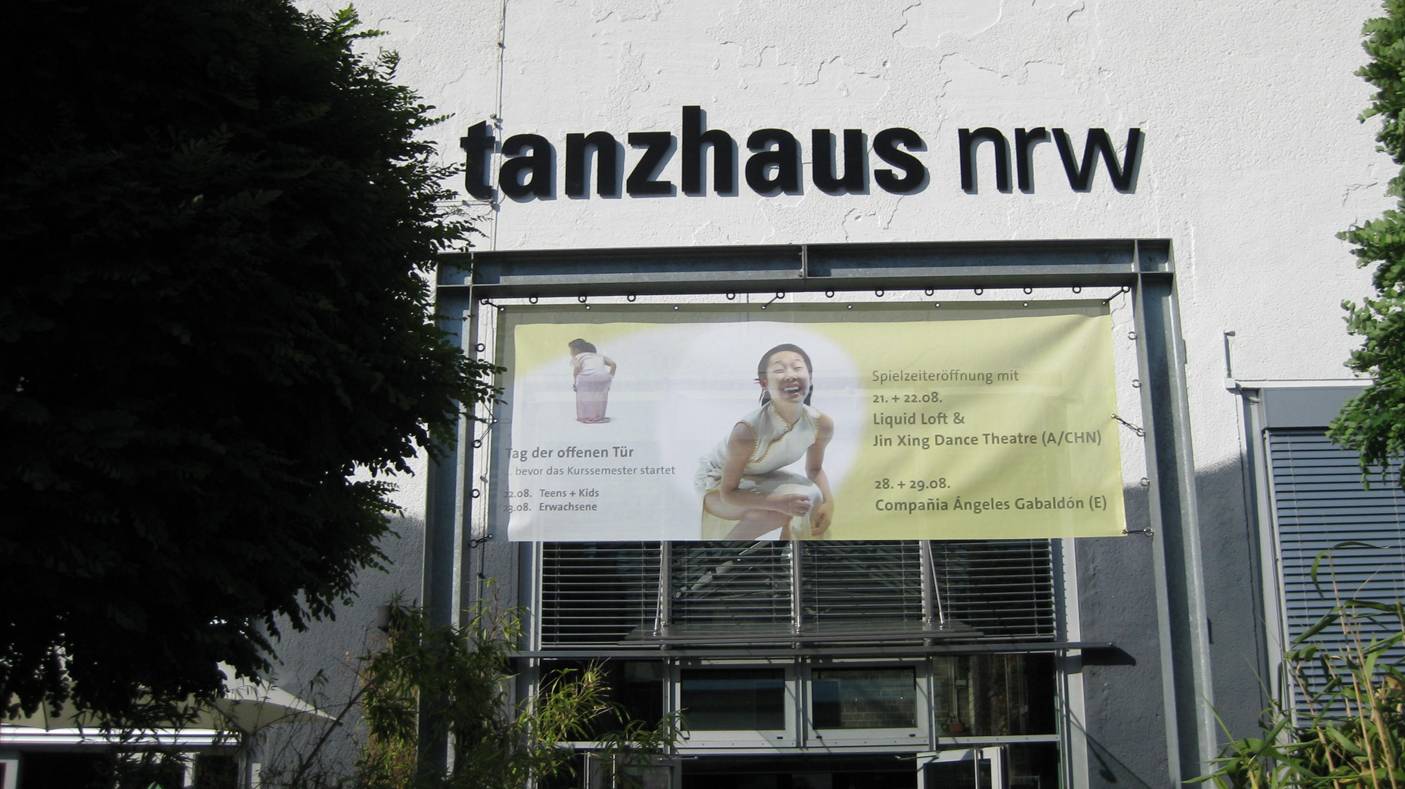 Three years after the EU project modul-dance has started the directors of almost all dance houses from Europe and more than 50 artists and dance companies meet at Tanzhaus NRW in Düsseldorf. The modul-dance conference concentrates at perspectives of networking and internationally based collaborations. Planned as an “open space”, the conference features a program of lectures, thematic discussion panels, lecture demonstrations, presentations, showings and an ongoing forum. The program is completed by evening performances of modul-dance artists, curated by Tanzhaus nrw.
Click on here to discover the complete programme.
We will be broadcasting LIVE selected talks from an extraordinary gathering!
School of Arts and Department of Computing
Corporeal Computing
Live on dance tech tv
Monday September 2, Tuesday September 3, Wednesday September 4, 2013
WATCH AND PARTICIPATE HERE:
http://dance-tech.tv/videos/dance-techtv-live/
From the program:
We are delighted to welcome all participants to the Corporeal Computing
conference, co-hosted by the School of Arts and the Computing Department,
University of Surrey.
Increasingly, human-computer systems involve the capture and interpreting of
motion in high-level 3+D environments, for more embodied interfacing across a
number of social and cultural settings. This digitized form of ‘physical thinking’
bears upon a number of emergent narratives and discourses relating to the
performance and performativity of body-machine systems. This conference
brings together computer scientists, cultural theorists, digital media artists
and artists in the movement arts (dance, theatre and digital music), to discuss
the use of motion responsive and motion-calculative systems in digital live
performance.
We have put together an exciting programme of papers, demonstrations,
forums, and performances, with world-leading practitioners and scholars. The
event is a truly international gathering, with participants from over fifteen
countries.
Organisers:
Nicolas Salazar Sutil, School of Arts, University of Surrey
Paul Krause, Department of Computing, University of Surrey
WATCH AND PARTICIPATE HERE:
http://dance-tech.tv/videos/dance-techtv-live/
LIVE STREAMING PROGRAM
(UK Times)
HERE TIME ZONE CONVERTERS:
http://www.hongkiat.com/blog/time-zone-converters/
Conference Schedule
Day 1
Monday September 2,
08.30 - 09.30 Registration and Coffee
09:30 - 09:40 Welcome: Phil Powrie (Dean, Faculty of Arts and Human Sciences)
09:40 -10:40 Keynote Presentation by Paul Kaiser (OpenEndedGroup)
10:40 - 11:40 Archaeologies of Digital Performance
Oskar Schlemmer’s programmatic gesture – Sally Jane Norman (University of Sussex)
CODA, a stereoscopic computer choreography after Stravinsky’s Rite of Spring— Martine Epoque and
Denis Poulin (LarTech, Canada)
11:40 -12:00 Coffee Break
12:00 -13:00 Corporealities and Materialities I Placing the body in virtual reality – Sita Popat
(University of Leeds)
Blended bodies and notions of materiality in live-digital dancing – Kerry Francksen (de Montfort
University)
13:00 -14:00 Lunch
14:00 -15:00 Keynote Presentation by Mark Coniglio (Troika Ranch)
15:00 - 16:30 Tools and Technologies I
I-CARE-US – Fernando Nabais (YDreams, Lisbon)
The TKB project: creative technologies for the multimodal annotation of performance composition
and documentation – Stephan Jürgens (New University of Lisbon)
Kinect: organising movement between measuring, calculating and perceiving – Irina Kaldrack
(University of Basel)
16:30 – 16:45 Coffee Break
16:45 - 18:00 Round Table Discussion Mark Coniglio, Paul Kaiser, Kirk Woolford, Tom Calvert (with
Sita Popat)
18:00 - 19:30 BBQ Dinner (venue depending on weather, tbc)
19:30 - 21:00 Live Art Installations/ Performances
Electrode, by Daniel Ploeger (UK), Dance Studio
Moments in Place, by Kirk Woolford (UK/US), various locations
NEX, by Cia Proyecto Uno (Spain), Studio 3
After Ghostcatching, by OpenEndedGroup (Paul Kaiser, US), Studio 2
21:00 Reception
Day 2
Tuesday September 3
09:30 - 10:30 Keynote Presentation by Tom Calvert (Credo Interactive)
10:30 - 10:45 Coffee Break
10:45 - 11:40 Corporealities and Materialities II
Transgressing the sonified body – Daniel Ploeger (Brunel University)
Hacking the body – Camille Baker (Brunel University) and Kate Sicchio (University of Lancaster)
11:40 - 12:30 Gesture and Haptics
Conversation with phones – James Charlton (Auckland University of Technology)
Haptics and particles (demo) –Doros Polydorou (Cyprus University of Technology) and Tychonas
Michailides (Birmingham Conservatoire, Birmingham City University)
12:30 -13:30 Lunch
13:30 - 14:30 Keynote Presentation by Kirk Woolford
14:30 - 15:30 Data, Visualisation, Motion
Modulation in interactive video installation – Nic Sandiland (Middlesex University)
MoveEngine – movement values visualized – Henner Drewes (Folkwang University of the Arts,
Germany)
15:30 - 15:45 Coffee Break
15:45 -16:30 Performance / Lecture Perfect Paul: on freedom of facial expression – Arthur Elsenaar
(Royal Academy of Art- Royal Conservatoire, Netherlands)
16:30 - 17:30 Forum 1 Cyborgs and Ghosts Laura Karreman (Ghent University, Belgium) and Seok Jin
Han (University of Surrey) present and chair
17:30 -19:00 BBQ Dinner (venue depending on weather, tbc)
19:00 - 21:00 Screendance session (Main Theatre)
Structured Light (Short) by Sebastian Melo (Chile)
CODA by Martine Epoque and Denis Poulin (Canada)
Installations:
All day: After Ghostcatching, by OpenEndedGroup (Paul Kaiser, US), Studio 2
21:00 Reception
Day 3
Wednesday September 4,
08:30 - 10:30 Current Approaches in Digital Laban Studies
Panel 1 (8:30)
Intentional and behavioral movement in virtual worlds: A Laban Movement Analysis approach –
Leslie Bishko (Emily Carr University of Art + Design, Canada)
How to make human animation more alive - Viewing human animation through the lens of Laban
Movement Analysis – Sandra Hooghwinkel (Moving Technology, Netherlands)
Panel 2 (9:30)
Movement archaeologies: digging for meaning in new landscapes of movement data – Thecla
Schiphorst (Simon Fraser University), Karen Bradley and Karen Studd (Laban/Bartenieff Institute of
Movement Studies)
Can affective movement be quantified? A Laban-based approach – Sarah Jane Burton, (Sheridan
College, Canada) Ali-Akbar Samadani, Rob Gorbet, Dana Kulic (University of Waterloo, Canada)
10:30 - 10:50 Coffee Break
10:50 - 12:00 Corporealities And Materialities III
Exploring the capacity of embodied, spontaneous interfaces to support creativity – Michael Neff
(University of California-Davis)
Behavioural coding and segmentation: Signifying practice and value production in technology –
Wangi Lee (Centre for Cultural Studies, Goldsmiths College)
12:00 -13:00 Lunch
13:00 - 14:00 Forum 2: Digital Feminism Margaret Jean Westby (Concordia University, Canada) and
Legacy Russell (Goldsmiths College) present and chair
14:00 - 14:15 Coffee Break
14:15 - 15:15 Tools And Technologies II
Materialising Acts: Exploring movement data for digital interaction through the Sync application –
Lise Amy Hansen (The Oslo School of Architecture and Design, Norway)
Sensor based motion capture in balletic dance – Corinna Spieth-Hoelzl (Dance Institut, Munich)
16:00 -17:15 Performance (+ Q & A’s with artists):
REACH by Mindbeat 2, Dance Studio
17:15 Coffee
DOWNLOAD CONFERENCE BROCHURE HERE
WATCH AND PARTICIPATE HERE:
http://dance-tech.tv/videos/dance-techtv-live/
Broadcast enabled by dance-tech.tv in collaboration with Digital Computing Conference organized by Nicolas Salazar Sutil, School of Arts, University of Surrey and Paul Krause, Department of Computing, University of Surrey
We’ve been working with Wayne McGregor|Random Dance and OpenEndedGroup on Becoming, an algorithmic “virtual dancer” that grows and evolves in response to emulated mechanical constraints and to a database of film material.
Becoming is currently being used in the studio in the making of Atomos, which premieres in October. Becoming will also be shown as part of the exhibit Thinking with the Body at the Wellcome Collection, opening September 19th.
More info: http://www.cassiel.com/2013/08/29/becoming/.
WANTED: 3 FEMALE ACTORS with movement skills or DANCERS with acting skills,
FOR ELENA BAJO'S PERFORMANCE AT FORT DU BRUISSIN, LYON (FRANCE) 11th and 13th of September, within the framework of the Lyon Biennial
-3 female actors (the performance will be in French) to be a part of an experimental piece, outside of the 'comfort zone' in an art exhibition space in Lyon
DESCRIPTION
The piece is created by Elena Bajo, a visual artist who has exhibited internationally and focuses on the social, political aspects of the site in the city of Lyon. Bajo combines performance with large scale installations to investigate the political and social conditions of change in post-industrial structures, creating site specific work and a space of collective action.
The performers will be required to perform in the space of Fort du Bruissin (Lyon). They will be required to do both improvised and choreographed script/movements determined before hand with the artist. The generator of the piece is a political text/poem. This political text-manifesto will be handed to the performers and it will be used to generate their individual script/choreography. Total duration of the performance around 20 min.
REHEARSALS
2 days, 1 hour/day individual work with the artist and 1 day (1 hour) run-through in the space with all the performers
If you are interested in this project please send me an email to elena@elenabajo.com including a web link where I can see your work and a brief bio/cv. Express briefly why you want to participate in the project. You will be contacted by email to proceed forward. If you don't have a link to video online let me know and I would send you a text fragment to prepare something short 1-2 min that you could record in Skype or video camera or iphone.
You will receive dvd video footage and photos of the performance as well as credits on the program. The greatest reward of this project lies in that you're interested in the experience. This is an event widely advertised and expected to be a good exposure.
More information about Elena Bajo’s work you can find in her webpage: www.elenabajo.com
Introducción: Arte, Cuerpo, Tecnología Aproximación a un Panorama Actual Latinoamericano" from Caída Libre on Vimeo.
ABTRACT
Art, Body and Technology: an overview of current approaches from Latin America
By: Brisa MP (Chile)
The presentation aims to make a brief tour of the current state of the art of the production that articulates the human body and the technology in the fields of dance and performance. This tour offers a mapping of various levels of production, such as artists, work of art , theoretical production, collaboration networks, research in Latin American festivals and an analysis of the general situation in the region.
No doubt that the art-technology development in Latin America has been largely led by artists from the visual arts. In this scope we can see that the performative arts are not far behind, while its approach to science and technology has been happening slowly, it is now possible to recognize several projects developed in our region. These projects constitute a network of performances, educational and outreach that have shaped a recognizable set between dance-performance and technological mediation.
Moreover, the state of the art makes evident conceptual, aesthetic and economic problems, it proposes new ways of collaborative creation, instances of intercultural exchange and training that have allowed local development of projects pushing the boundaries of traditional Dance and Performance Art territories.
Meanwhile It is recognized that in Latin America a first approach to the relationship between dance and technology, comes from the videodance production, in which the initial scenic event moved to digital imaging and the screen. This is evident in several countries, making it visible a second state of the dance-performance and technology exploring more complex technical and aesthetic structures therefore presenting unequal levels of development in the countries of the region.
Ben Riepe's Hundstage was the first project to be premiered within the framework of modul-dance. It was acclaimed by audiences and the media alike.
This piece, for seven performers, deals with existential questions: What is left when what is real presents itself in all its artificially? When does the cynical distance to the world lose its protective smile?
Ben J. Riepe has created complex arrangements, which are defined by, on the one hand, a precise choreographic management of space, time and movement and, on the other, by the individual improvisational creativity of the performers.
The italian choreographer Luca Silvestrini lives and works in London and leads the company Protein. "Border Tales" is the title of his modul-dance project, with which Silvestrini explores the idea of migration. Interview done during a research period at Graner, in Barcelona.
More videos on Numeridanse.tv
Hello Everybody,
on our new issue you can find (among other things) an interview with Bojana Bauer and an essay by Monica Gillette describing her vision on the similarities between dramaturgy and film editing.
you can also upload information regarding workshops, performances etc.
Ma'akaf - online magazine for performance
best,
Lior
Concentric: Literary and Cultural Studies 36.2
Sept. 2010: 89-102
Malabou, Plasticity, and the Sculpturing of the Self
Hugh J. Silverman
Department of Philosophy
Stony Brook University, U.S.A
Abstract
In What Shall We Do With Our Brain? (2004), French philosopher Catherine
Malabou returns to the traditional philosophical mind-body problem (we do not
experience our mind as a “brain”) and introduces the concept of a difference or
“split” between our brain as a hard material substance and our consciousness of
the brain as a non-identity. Malabou speaks of the brain’s plasticity, a term
which stands between (as a kind of deconstructive “indecidable”) flexibility
and rigidity, suppleness and solidity, fixedness and transformability, identity
and modifiability, determination and freedom. This means seeing the brain no
longer as the “center” and “sovereign power” of the body—as it has been seen
for centuries, at least in the West—but as itself a locus and process of selfsculpting (self-forming) and transdifferentiation, as being very closely interconnected with the rest of the body. Malabou also speaks of our own
potential to sculpt or “re-fashion” ourselves, and (by further extension) to reform our society through trans-differentiating into new and potentially freer, more open and more democratic socio-political forms. In this bold project
Malabou still remains close to her Hegelian roots, and she is also influenced by
Merleau-Ponty’s notion of the body-subject and Nancy’s alter-mondialisation
(other-worlding) as an alternative to globalization.
Keywords
brain, plasticity, non-identity, self-decentering, transdifferentiation, entre-deux
altermondialisation, sculpting the self, Hegel, phenomenology
For the rest of the doc go to: http://www.concentric-literature.url.tw/issues/M/5.pdf
The Hartel Dance Group and I have been invited to perform at The Brincos International Dance Festival in Guatemala next month. We launched a kickstarter to help get us there, please check it out!
Great documentation about the meeting that gathered
The conscious body: an interdisciplinary dialogue. Paris 8 5-7 October 2012
See documentation here:
http://theconsciousbodymeeting.wordpress.com/media/
This workshop proposed a meeting place for two communities who have been investigating the nature of consciousness in, possibly radically, different perspectives. Over the past half a century (and especially over the last 15 years) cognitive scientists and neuroscientists have been studying the nature and neural basis of our phenomenological ‘subjective’ experience of the world, our own body and action and ultimately our selves. This research has employed traditional paradigms and scientific protocols of experimental (neuro)psychology as well as the emerging technology of human functional brain imaging (fMRI, EEG, MEG, TMS, intracranial recordings). Though most of the research on the topic has taken the traditional “third person perspective”, the intimately subjective nature of this topic has led scientists to integrate subjective reports into their experimental paradigms.
The study of consciousness and awareness using subjective (first person) phenomenological tools has been a central occupation within post-modern dance and related somatic techniques since at least the 1960′s. Despite the shared topic of interest, there has been little cross-talk between neuroscientist and dance makers .We believe that such dialogue is possible and that it has the potential to cross-fertilize the research in both domains. For this purpose we have organized this weekend long workshop. The workshop will be organized in 3 blocks, each highlighting a specific dimension of inquiry (shared by both domains). Each block will consist of a presentation of cutting edge research in the field of cognitive neuroscience, followed by a movement practice led by a dance/somatic practitioner addressing the same general issues. Finally, each block will end with an open, informal discussion. The workshop will start with a live dance performance and will end with a poster session which will allow for non-presenting workshop members to share their ongoing dance/scientific
research.
http://theconsciousbodymeeting.wordpress.com/media/
Friday 5 October 2012 – Studio Keller
1. Arrival and introduction
2. Myriam Gourfink – “The Breathing Monster”
Saturday 6 October 2012 – Paris-8 University
Body awareness and the self (1)
3. Erik Myin
4. Lisa Nelson
Body awareness and the self (2)
5. Steve Paxton
Sunday 7 October 2012 – Paris-8 University
Consciousness of movement, movement of consciousness
6. Aaron Schurger
7. Eva Karczag
Sunday afternoon presentations
8. Konstantina Georgelou
9. Florence Daupias d’Alcochete
10. Christophe Lopez
11. Emilie Gallier
12. Frédéric Bevilacqua
13. Joachim Forget
14. Luciana Cheregati & Ibon Salvador – “coletivo qualquer”
15. Malcolm Manning
16. Iris Trinkler
17. Suzanne Cotto
18. Natalie Heller
TITLE: Effects of Group-Delivered Improvisational Dance on Balance in Adults with Middle Stage Parkinson Disease: A Two-Phase Pilot with fMRI Case Study
AUTHORS:
Glenna Batson,1,2 Christina Soriano,3 Jonathan H. Burdette,4 Sara Migliarese,2 Paul J. Laurienti,4 and Nickolai Hristov5
1Wake Forest University Translational Science Center, Winston-Salem, N.C.
2 Department of Physical Therapy, Winston-Salem State University, Winston-Salem, N.C.,
3 Department of Theatre and Dance, Wake Forest University
4 Laboratory for Complex Brain Networks, Department of Radiology, Wake Forest Baptist Medical Center, Winston-Salem, NC
5 Center for Design Innovation, Winston-Salem, N.C.
ABSTRACT - not for distribution or publication People with Parkinson disease experience motor problems that place them at risk for falls. Research on visually cued rhythmic dance has shown select functional gains in balance. What remains uninvestigated is the effect dance improvisation has on the ability to self-generate strategies needed for complex balance tasks. This two-phase pilot first examined the effects of group-delivered improvisational dance on balance. Subsequently, changes on whole-brain functional network connectivity using functional magnetic resonance imaging (fMRI) were examined in a neuroplasticity case study. In Phase I seven community-dwelling adults (mean age 69) with middle stage Parkinson disease completed a 7-week improvisation series. Group pretest-posttest balance comparisons were significant on the Fullerton Advanced Balance Scale (p=.017) with a total group average increase of five points. In Phase II (3 months later), one participant from the pilot group underwent brain scanning following a 5-day intensive trial of the same dance protocol. Following the intervention week, the posttest fMRI scans exhibited significantly increased network connectivity between the basal ganglia and premotor cortices. For this group, dance improvisation resulted in significant gains in balance. For one participant, positive neuroplastic changes in brain connectivity were recorded in the strength of network connectivity between the basal ganglia and cortical motor centers.
.
Key Words: Parkinson’s, dance, balance, fMRI, global efficiency
TEST
meta-academy@Bates 2013 presents:
MINDED MOTION
an online lab exploring embodiment and co-creation on the internet using Nancy Stark Smith’s Underscore and other moving ideas.
Facilitated by Marlon Barrios Solano and Rachel Boggia

Photo by Raisa Kyllikki Karjalainen
How can embodied knowledge be shared and deepened through the internet? What unique forms of collaborative learning and creative activity might the internet offer?
MINDED MOTION, a 3 week pilot program for meta-academy.org, is a collaborative co-learning lab that will address these questions. Lab participants will use free internet-based tools to creatively explore questions about embodiment, training and memory, composition, and politics of the body. They will also explore how to translate embodied practices onto the internet. The lab will be structured around Nancy Stark Smith’s Underscore, an approach improvisational dance/movement that she has been developing for over 30 years, which she will be teaching at Bates Dance Festival July 22-August 10 2013.
Screenshot from video interview An Emergent Undersore on dance-tech.tv
Lab Details:
- The lab activities include: embodied activities, guest lectures, small creative projects using online tools to explore a pool of written and video resources, threaded discussions, and online synchronous video encounters (video chats).
- The time commitment is 4-8 hours per week for 3 weeks spanning July 22-August 10 2013.
- The lab is offered FREE of charge and uses free internet-based tools aggregated through google+.
- The lab is open to all interested dance, movement and multimedia artists, teachers, scholars researchers, journalists, writers and more.
- Benefits of participation include: increased understanding of on-line collaboration, increased literacy in internet-based creative tools, exposure to core principles of Nancy Stark Smith’s teaching, membership in a strong intellectual and creative community, and much more.
- The language of facilitation and presentation is English.
- If interested in participating, contact marlon@dance-tech.net by July 18, 2013.
How it works:
- EMBODIED ACTIVITY Each week, on-line participants focus on something that Nancy is teaching in her course at the Bates Dance Festival. For example, Nancy Stark Smith or the lab facilitators might share a score for solo movement or a compositional exercise through video or text directions. Lab participants will try the exercise at the beginning of each week.
- ONLINE CREATIVITY Each week, the lab facilitators will suggest online creative activities for the lab participants related to the embodied activity. These might include: blogging, micro-blogging, video mashups, screendances, online editing, collaborative writing and editing, collaborative curation of images and videos, playlist essays, mind and conceptual mapping, collaborative word cloud. All participants will be credited as collaborators.All material produced in this lab is available for remixing and mashup and it is delivered with a Creative Commons Licenses.
- GUEST LECTURES/LIVE CHAT Each week, lab participants will meet in a Google+ hangout to hear a short lecture by a guest expert on a topic such as body politics/theory, composition, or training. All lab participants, Nancy Stark Smith, and the expert will then discuss the topicand debrief about the week’s activities. Guest lectures are listed below. Hangout times will be announced soon. The video from this encounter will be archived and made available and become part of the creative assets of the projects.
- RESOURCE POOL Supplemental resources such as readings, images, and videos will be made
- available to– and editable by– participants.
- ONLINE FORUM A forum moderated by Dr. Hannah Kosstrin will allow lab participants to discuss concepts, activities and resources.
- SUPPORT Lab facilitators will be available every day for conceptual and technical assistance.
Word cloud of the text of this page created with www.wordle.net/
Roles and participation:
Everyone in the lab is considered a co-creator and is valued as an artist and designer of the shared experience. Therefore, we propose the following structure, but are open to shifts and feedback.
Lab co-facilitators suggesting structure for lab experience, available for consultation:
Core expert providing core content and consult on structure:
Guest experts providing specific content through lectures and discussions in Google Hangouts:
- W. P. Seeley (Philosophy and Cognitive Science/ Bates College, USA)
- Corinne Jola, (Dance and Neuroscience, NSERM/CEA in Gif-sur-Yvette/Paris.)
- Bertha Bermudez (Dance Researcher/ICKAmsterdam, The Netherlands)
- Norah Zuniga-Shaw (aance and technology, composition, critical theories of the body | Associate Professor @ The Ohio State University)
- Bojana Kunst (Dance and performance theorist/Giessen University, Germany)
- Susan Kozel (Philosophy and Phenomenology of the Body/Malmo University, Sweden)
- Hannah Kosstrin ( Resident Scholar @ Bates Dance Festival 2013 and Visiting Assistant Professor @ Reeds College, USA)
Lab participants: participating in Lab activities, produce creative projects, consulting on structure:
- You!
- LIMITED TO 50 PARTICIPANTS
- INTERESTED/QUESTIONS: marlon@dance-tech.net
meta-academy@Bates 2013 is the first pilot of the project meta-academy.org conceived by Marlon Barrios Solano with the partial yet crucial support of:
- ICKAmsterdam, The Netherlands
- STEIM, The Netherlands
- DanceDigital, UK
- Mount Tremper Arts, USA
- Rachel Boggia, Bates College, USA
- Laura Faure, Bates Dance Festival, USA
- HZT Berlin, Germany
- MaryAnn Sanford, Peaks Island, USA
All material produced in this lab is available for remixing and mashup and it is delivered with a a Creative Common License.
This work is licensed under a Creative Commons Attribution-NonCommercial 3.0 Unported License.


A dance doccie by dance filmmaker Jeannette Ginslov (Teaser)
"Birgitte Skands: At rejse er at leve...at leve er at danse..." * (2013)
Original film 52'00.
*trans. "To travel is to live... to live is to dance..."
A documentary with
Dancer/Choreographer
Birgitte Skands
With gratitude and respect I wish to thank
all my mentors and teachers who have
inspired me in my life and dance expression
in Denmark New York City, Salvador Bahia, Brazil
and Senegal
Music
A la Hongroise: Kim Sjøgren
Live recordings with Musicians of Bougarabou Ballet
Sali Senegal
Traditional Berimbau Music
Direction
Jeannette Ginslov
Interview
Jeannette Ginslov
Camera, Edit, Fx & Sound
Jeannette Ginslov
Location
Hellerup Beach
Copenhagen
Denmark
Video produced by
Walking Gusto Productions
© 2013
INTERACTIVE INSTALLATION PARADISO senses+spaces
at JULIDANS FESTIVAL AMSTERDAM
7th-8th July from 18h00 until 20h00
The interactive Installation PARADISO senses+spaces will be presented at the international Dance festival Julidans.
PARADISO is a series of two interactive dance films. Its two levels, "senses" and "spaces," address sensory awareness and kinesthetic learning. Dancer and choreographer Bertha Bermudez (Amsterdam), her filmmaker Maite Bermudez (Barcelona) and media artist and director Chris Ziegler expand cinematic experience into physicality and deliver an artistic review on the present hype surrounding 3D cinema. The film was shot in the eternal ice of the Arctic and Antarctic, in the deserts of Africa and in other inhospitable parts of the world.
In the first level of PARADISO - "senses" - the viewer is "touched" by the dancer’s movement. Force feedback sensors with electroactive polymers and a custom-built 4D chair give tactile feedback on the skin of the viewer. Image, sound, wind and evaporated perfumes activate almost all the senses: sight, hearing, touch and smell.
PARADISO’s second level - "spaces" - connects the viewer’s kinesphere to the camera of the film. Watching the dancer’s movements in the film leads the viewer into the movement of the camera’s viewing angle. In an expansion of Vertov's mental montage in early 20th century filmmaking, the viewer of PARADISO generates an interactive physical montage.
PARADISO is the last phase of the film project film trilogy IMAGINED DANTE by Las Negras Productions, Imagined Hell, Imagined Purgatory and Imagined Paradiso. This project is inspired by choreographers Emio Greco and Pieter C. Scholten and their Dante's trilogy, Inferno, Purgatorio and you Para | Diso.
With support from The Amsterdam International Choreographic Arts Center ICK/Emio Greco | PC (NL) and Flying Elephant Foundation - Gregory Colbert (USA/FR), city council of Munich, Muffathalle Munich and Center for Art and Media ZKM Karlsruhe.
