All Posts (2056)

Sort by

Another Language Performing Arts Company invites you to XYZ, an upcoming telematic cinema project created by Company Directors Elizabeth and Jimmy Miklavcic.

XYZ takes place in a Visualization Laboratory, the VisLab Black Box Theater, where the audience will experience 3D projections throughout the performance. Audience members will wear active stereoscopic glasses during the performance to view the 3D projections.

XYZ performances will be held February 22-23 at 7:00pm and February 24 at 4:00pm & March 1-2 at 7:00pm and March 3 at 4:00pm. The performance space will be at the University of Utah Intermountain Networking and Scientific Computation Center and will be in the Visualization Lab Black Box (VisLab) on the second floor, room 294. Admission is $7.00 general, $5.00 Another Language members and seniors. Students from any school will receive free admission. The VisLab seats 20 people, so reservations are highly recommended and can be made through the Another Language Web Store Box Office www.anotherlanguage.org/store, by calling the Another Language Office (801) 531-9419 or by emailing info@anotherlanguage.org. An audience discussion will follow the twenty-five minute performance.

Another Language Performing Arts Company holds a reputation for creating unique, cutting edge work and XYZ will continue in the tradition of the unexpected. Be a part of this one of a kind event by attending the performances at University of Utah. Information on live streaming viewing options is available.12249535884?profile=original

Read more…

Extended deadline:

February 28th 2013!
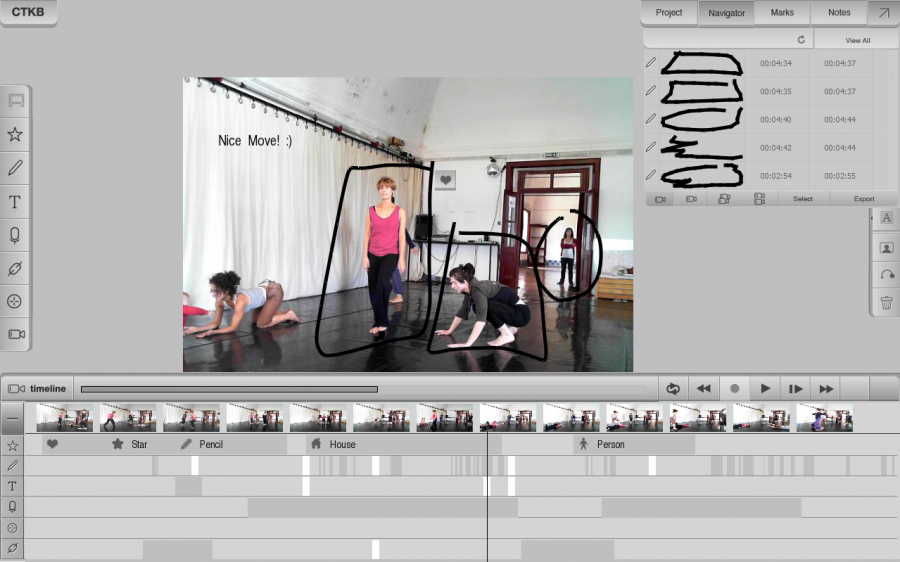
navigator%202.PNG

1st. CALL for PAPERS

In the framework of the TKB project conclusion (http://tkb.fcsh.unl.pt), a 1st. CALL for Papers is now open for submission of abstracts to the following international conference on:

"Multimodal Communication: Language, Performance and Digital Media"

Event dates: Thursday 02 to Friday 03 May 2013

Venue: CCB, Lisbon (http://www.ccb.pt/sites/ccb/en-EN/).

The CCB are co-producers of the conference and associate partners of the TKB project, running at the Centre of Linguistics (CLUNL) of FCSH-UNL.

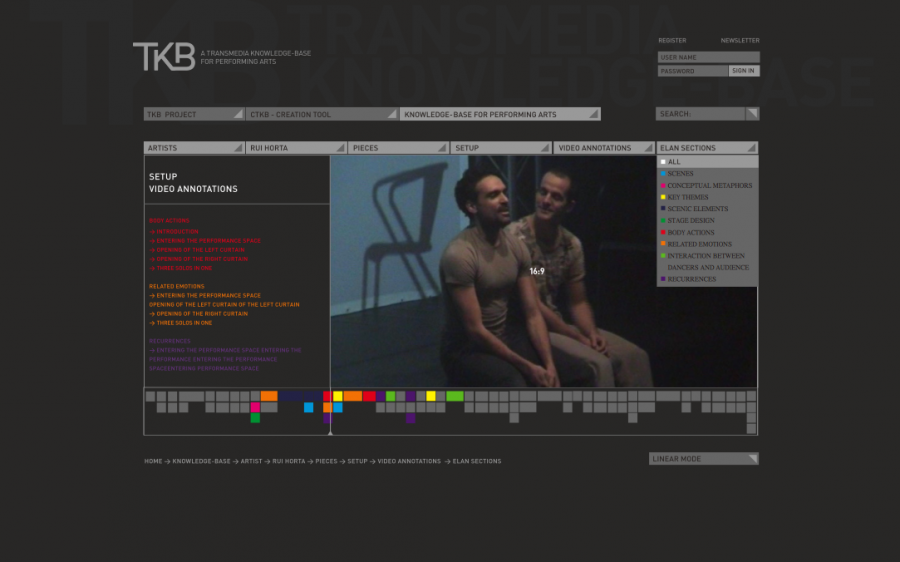
The Conference is organized in the framework of the TKB research project conclusion (http://tkb.fcsh.unl.pt) and aims to: present the results and software tools developed during the TKB project; provide a multidisciplinary forum for researchers from different disciplines and artists interested in the documentation of Performing Arts (with a focus on contemporary theatrical dance and Performance), as well as in issues of multimodality in human communication and in human-computer interaction, particularly regarding video annotation tools and collaborative platforms for cultural heritage. It is organized by the FCSH and the FCT of Universidade Nova de Lisboa, Portugal.

The event wishes to bring together contemporary artists and researchers from a broad range of academic disciplines, working within different theoretical and methodological paradigms in a creative, internationally oriented, and stimulating atmosphere. The importance of multimodal communication and creativity is now generally recognised by researchers from either the Humanities, Information Technologies or Cognitive Science. This conference therefore offers an opportunity to present and learn about research findings concerning human behaviour and agency in different types of communication and their cognitive, cultural, narrative, technological, social, textual or discourse functions.

Conference Topics (but not limited to):

    Documentation of Performing Arts

    Performance Studies

    Multimodal Corporal

    Digital Media applied to Performance

    Cultural Heritage

    Performance Philosophy

    Cognitive approaches to theatrical performance

    Multimodal Metaphor

    Applications of Conceptual Metaphor Theory to Performing Arts

    Applied Linguistics

    Speech and gestures in human communication

    Verbal vs. non-verbal interactions

    Intercultural aspects of multimodal behaviour

    Human-computer interaction

    Video annotation

    Annotation schemes and tools for multimodal corporal

    Motion Tracking

    New approaches to Digital Games
Imagem%201.png

Keynote speakers:

Sally Jane Norman (Attenborough Centre for Creative Arts, Sussex: UK)

Charles Forceville (Universiteit van Amsterdam, NL)

Irene Mittelberg (University Aachen, DE)

Scott DeLahunta (Forsythe Foundation: Motion Bank, DE)

Scientific Programme Committee:

Carla Fernandes (FCSH-UNL: CLUNL)

Nuno Correia (FCT/UNL: Dept. Computer Science)

João Sáágua (Director FCSH-UNL)

Teresa Romão (FCT/UNL: Dept. Computer Science)

Isabel Rodrigues (Faculdade Letras da Universidade do Porto: CEAUP)

Sally Jane Norman (Attenborough Centre for Creative Arts, Sussex: UK)

Rui Horta (Director O Espaço do Tempo Transdisciplinary Centre)

Dalila Rodrigues (CCB Lisbon)

Sarah Whatley (Coventry University and Siobhan Davies Dance, UK)

Scott DeLahunta (Motion Bank project: Forsythe Foundation, DE)

Stephan Jürgens (IPL: Escola Superior de Teatro e Cinema, PT)

Bertha Bermudez (ICK Amsterdam - Emio Greco|PC, NL)

Irene Mittelberg (University Aachen, DE)

Charles Forceville (Universiteit van Amsterdam, NL)

Rute Costa (FSCH-UNL: CLUNL)

Teresa Lino (FSCH-UNL: CLUNL)

Antónia Coutinho (FSCH-UNL: CLUNL)

Isabella Paoletti (FCSH-UNL: CLUNL)

Gil Mendo (Culturgest, PT)

Maria José Fazenda (Escola Superior de Dança, PT)

Samuel Rego (Director-Geral das Artes, PT)

Organization: FCSH/CUNL (www.fcsh.unl.pt) and FCT-UNL (www.fct.unl.pt)

TKB Project Supporters:

Fundação para a Ciência e a Tecnologia

O Espaço do Tempo (Transdisciplinary Arts Centre)

Centro Cultural de Belém

Fundação Calouste Gulbenkian

Atelier Re.Al

Deadline for abstract submission (400 to 700 words limit):

Extended deadline:

February 28th 2013!

The abstracts should be sent by e-mail attachment to carla.fernandes@fcsh.unl.pt

Abstracts should be included as Word or PDF file attachments, and be anonymised for blind review. Please indicate clearly in your email the name(s) of the presenter(s), university affiliation(s) and email address(es).

Selected papers will appear, after extension and peer-review, in a special issue of international journal (currently under negotiation).

Notification of acceptance will be communicated by 15 March, 2013.

Conference fee:

General public: 70 €

Students: 35 €

The fees include coffee/tea and other refreshments, as well as the conference abstracts.

The Payment procedure will be published soon in the conference webpage to appear at the TKB project's site.

Read more…

12249550490?profile=original

Tuning Scores Laboratory Intensive–composition, communication and the sense of imagination

7 days in Les Ailes de Bernard

april 25 - may 1, 2013

A multi-sensorial approach to the questions: what do we ‘see’ when we look at dance? what do we ‘see’ from within the dance?’ The scores offer inner and outer communication tools and practices that make apparent the ways each of us sense and make sense of movement. Initiating a playful and rigorous dialogue-in-action about space, time, movement, and the innate desire to compose our experience. Performers/creators of all disciplines (dance, music, visual art, theater) are welcome. 

cost: 370 euros before march 23; 420 euros after.

deadline for registration: april 9, 2013

for full information & to register

contact La Trisande:  

http://trisande.pagesperso-orange.fr

trisande.gaud@wanadoo.fr // tel +33 (0)4 77 51 59 25

12249551470?profile=original

Read more…

Danc 340 Blog Post 1

The Moebius Strip (2001) by Gilles Jobin


http://dance-tech.tv/videos/the-moebius-strip/


The movement and choreography in this video, while very simple, is very interesting and captivating. The camera work throughout the piece accentuates the sensual and mysterious feeling of the movement. The space that the dance was filmed in is very plain and geometric. There is simply a black floor, with tapelines making squares throughout it, and beyond that it seems to just go into darkness. There are no distinguishable walls or features other than the floor. This provides a lot of interest when the camera angles shift because all of the backgrounds are the same; it allows the focus to really be on the body of the dancers. The dancers begin dressed in pedestrian street clothes, doing very simple movements at a moderate pace. The camera is slowly panning across the space, allowing dancers to move in and out of the camera frame. As the movement slows down, the camera gets closer to the dancers, really putting the connections made by the dancers in the focus. There are a lot of angles with the camera close to the floor where the dancers are. Eventually the dancers remove their shoes and clothes until they are wearing only white shirts and black trunks. From here there seem to be even closer up shots, and the lights fade throughout the second half of the video, making it seem very sensual.

There did not seem to be any effects used in the editing process, only different angles and zooms, until the very end of the video. At the end the geometric nature of the space is heightened by pieces of plain white paper laid in rows on the floor. The dancers are crawling across the floor in a very animalistic way as the camera pans across. Here the video seems to be slowed down, sped up, and blurred. Once all of the dancers are gone, the video is turned upside down, twisted, and manipulated in really interesting ways before completely fading to black. I would be curious as to how these effects were all done, and why they were only used at the end of the piece.


TEDxSummit intro: The power of x


http://dance-tech.tv/videos/tedxsummit-intro-the-power-of-x/


            The movement and choreography in this video were very simple and symmetrical. There were many dancers used, all in red, white, black, or yellow jumpsuits. Most of the movement is done on the floor and lying down. This worked very well with the camera, as most of the video was filmed with a bird’s eye view. In fact, only once does the camera angle change to be more on the level of one dancer walking. The camera does zoom in and out allowing us to see more spatial patterns sometimes and more of the actual movement other times. It is also very fun to see a balloon let go and floating up into the camera.

            The most noticeable aspect of this video was done with it’s editing. The video was edited so that it looks like you are looking into a kaleidoscope. The symmetrical movement of the dancers adds to the effect. While the movement is simple, this editing really captures the viewers’ attention throughout the entire video. I’m curious if there is a single editing tool that makes it look like a kaleidoscope or if there is multiple editing techniques you would have to do.


Read more…

From 14 to 23 February at Mercat de les Flors, Barcelona

IDN_cat_portada-884x600.jpg

Mercat de les Flors announced the fourth IDN festival, a biannual event whose programme is devoted to showing different ways of building a dialogue between dance, the moving image and digital tools.

This is one of the few professional international curated festivals dedicated to exploring the intersection of dance and new media.

A programme that lasts two weeks this year and makes a firm commitment to local productions and the presentation of two companies of international repute. With Nico Baixes, Oscar Sol+Iris Heitzinger, Pierre Rigal and the Australian Dance Theatre in the stage productions; Guillermo Pfaff, Francesca Llopis, Alba G.Corral, Mim Juncà and Errequeerre presenting installations and a large number of artists in the dance film section.

Watch Playlist with 5 trailers from 5 of the invited artists!

_

-It places technology at the service of the body and make dance the guiding thread of the creative act.

Organized by NU2’S and the Mercat de les Flors with artistic direction by Núria Font

Read more…

DANCE 340 Blog #1

http://www.dance-tech.net/video/pan-contemporary-dance-for-film

The first video that I watched was “Pan- A Contemporary Dance for Film”.  The movement was more so humanistic gestures as opposed to classical dance elements.  These gestures gave the connotation of anger, stress, and anxiety.  The movement was very emotion based.  The choreography throughout the video was repetitious and often used unison.  Floor work, shaking, touching of the face, and tossing of the hair were key movement choices in the piece.  

The use of the camera was very effective in creating the atmosphere of this piece.  It zoomed very close on body parts that were important to be seen.  Some parts of the video were sped up and slowed down, as well as focused and unfocused.  There were very quick cuts to different locations and often flashed between two locations.  There were many changes in camera angle, for example, in one scene the camera was lower than the dancer, which created an interesting effect. 

Combined, the music, locations, costumes, movement, and camera effects/angles created a creepy, anxious atmosphere.  I felt that the video was well made and very interesting to watch.


http://www.dance-tech.net/video/the-follower-sarah-olivia

The second video I watched was titled “The Follower”.  The movement in this piece played with the location.  Repetition was used a lot in the dance, as well as a lot of kicks.  The camera angles of the piece panned across the room to follow the dancer, but also stayed still at times as well.  There were changes in level of the camera, which made it indicative that someone was following the first dancer.  The piece also used camera angles to call attention to something behind the dancer by taking the dancer out of the center of the shot and only filming the dancer from the waist down.  One interesting thing that I saw in this video was in the hallway, the dancers got farther and farther away from the camera while moving as the camera stayed still.  I felt that this was an interesting way to use the location.

Read more…

Blog 1

The first video I viewed is called "Lucky Trimmer Tanz Performance Serie 19". It can be found here:http://www.dance-tech.net/video/lucky-trimmer-tanz-performance-serie-19-teaserThe purpose of this video is to showcase snippets of performance and choreography (shown through a series of solos and duets), rather than to create a work of art in itself. The camera techniques and cuts were simple so the focus was on the dancing, which was quirky and full of contorted positions and movements. The performers were generally centered in the frame, and the dancer's bodies were mostly presented in their entirety. The camera tended to remain stationary. The video cuts lacked transition, but I think the intention was to not distract from the choreography.The second video I chose to watch and comment on is called "HUMANS (2012)". It can be found here:http://www.dance-tech.net/video/humansThe reason I decided to write about this video is because it greatly differs from the first one I viewed. "Lucky Trimmer" was a video designed to showcase dance for an audience through the medium of video, while "HUMANS (2012)" was created to be a video project. "HUMANS (2012)" features three performers: two dancers clothed in white undergarments, and a video technician in a silver mask who alters the dancer's appearances via video projection. The video presented clips from the same location in a sequential order, whereas the other video showed multiple locations in a seemingly meaningless order. The camera was not always still in "HUMANS (2012)", but panned occasionally as well as zoomed and tipped. This video enhanced the perspective of the viewer by moving the camera very close to the performers, rather than keeping their entire bodies in the frame. The camera work, in my opinion, was used to show the perspective of the live video technician featured in the work.
Read more…

#1


The Moebius Strip by Gilles Jobin

This seems to be choreographed and performed specifically for video. The dancers are in a studio with a black background so that they immediately stand out, as they begin to move, twirling and intertwining within each other, the camera begins to move in closer. It is as if we the viewer are a participant. The music is haunting as if from a sci-fi thriller and the slower and steady camera movement and jump cuts work in partnership with the sound.

The movement is slow and pedestrian, the dancers walk, stand, crawl, sit around and on each other. Honestly if it weren’t a well produced and edited video it would be an insanely boring to watch despite the story progression, costume changes and set and lighting changes.

 As a visual artist I appreciated the cinematography, work and dedication awarded to the video project.


One Flat Thing by William Forsythe

http://vimeo.com/39875376


This particular video the camera is distant and still as a silent observer. The dancers fill a large ballroom or hall. In the foreground stand several rows of wooden tables. There is a feeling of a cafeteria present. The dancers one by one travel downstage toward the tables and begin what seems to be an improvisational performance, climbing, dancing, and laying on, under and around the tables. The only sounds we hear are the dancers moving about.  I think the idea is best suited for a live performance. I felt the need to be more present in the space and closer to the dancers than what the camera allowed. 

Read more…

Blog Post Number One Due 2-12-13

https://www.youtube.com/watch?v=GLz_AiOEnZY&feature=player_embedded#!

"Pan" a piece inspired by Guillermo del Toro's film Pan's Labyrinth, explored the journey through emotion and experience. An exploration of fear and anxiety, "Pan" used a lot of short and repetitive movements both on the floor and standing. Set in a small abandoned house, the dance took on a eery and fearful tone which was matched with its frantic and dramatic movements. Much of the dance was put together using short and abrupt cuts, with a lot of zooming in and out focused on the faces of the dancers to capture emotion. The camera was also moved around frantically to match the dancers frantic movement, making the piece more emotionally driven.

I think that what made this piece so interesting to watch was the match in the movement and the way the camera was used. Using the camera in the way it was used, shows the viewer the deep emotional connotations the piece is clearly trying to show.

Read more…

Blog 1

http://www.dance-tech.net/video/15-steps

http://www.dance-tech.net/video/this-is-concrete-by-thiago-granato-and-jefta-van-dinther

The video that I chose to look at was called 15 steps, and was very interesting because of all the combined effects instead of the just the choreography alone. The movement by itself was very simplistic and repetitive. There was a lot of stillness, and by itself, would probably have been pretty boring to watch. The elements of lighting, sound, and camera angles combined with the simple movement, however, created a very interesting video.

The piece was about decision-making, and choosing a direction in situations. The dancer wore a black dress against a black background, and followed an arrow of light around the stage. Eventually, the arrow of light developed into the arrow plus white lines of light making patterns and appearing and disappearing all over the stage.

The camera changed angles many times, and created a lot of cool views that an audience member in a live performance would not get to have. At one point, the camera is at a bird's eye perspective directly above the dancer. Because of that, we get to see the pattern of the lines on the stage whereas if you were watching from an audience seat, you wouldn't see what the light lines actually looked like. It was necessary for this dance to be a dance film project, because technology and views were needed to understand the concept that are not available to the regular observer in an audience.

With very intricate choreography and all of these effects, the visual outcome would have been overwhelming. The simplicity of the piece is beautiful and clean looking, and allows the viewer to take in the light and create an impression about the meaning. My only question is about the light. I am wondering if the lights were projected on the actual floor while she was dancing and being recorded, or if they were edited in later. Both seem like hard things to achieve, but I would be interested to know how they did that.

The second piece that I watched was very different from 15 steps. It was called This is Concrete and instead of a solo it was a duet between two men. They were dressed in gray clothing and dancing to a techno beat. The movement seemed to be in slow motion and first and was mostly very flowy, body ripple sort of dancing. As the music sped up and increased into a stronger beat, their dancing changed into more individual, fast, movements on the floor which reminded me more of a hip-hop style.

The camera angle in this video didn't really change as much as it did in 15 steps. It started with a side view, then moved to a front view, and then at one point cut to a closer up view of the dancers when the music changed. Though at one point there was a shot from above, I think that this dance could have been viewed from an audience perspective without losing too much meaning.

This dance also made use of light, but in a simpler way than the 15 steps video. In This is Concrete, it started out with a big white spot light and darkness everywhere else. Then when the music change happens, the camera angle changes and the light switches to two green spots moving about the stage. The key thing with these lights was that the dancers stayed fairly stationary so you only caught glimpses of what they were doing when the lights washed over them, which I thought was interesting.

As for similarities, both videos had a fairly grayscale color scheme, made use of the bird's-eye camera perspective, and used distinct lighting choices to enhance the choreography and videography. But as I stated before, 15 steps was more of a dance for the camera project than was This is Concrete.

Read more…

Blog #1 DANC 340

http://www.dance-tech.net/video/kampa2

The first video I viewed was called KAMPA and it was directed by Lucie Mirkova. The dancer's movement was very interesting in this video. Most of the mobility of the movement came from the upper limbs, head, and torso. The dancer only used her legs to bend and walk a few steps. The majority of the movement was in consistent contact with the concrete wall. The dancer's attachment to the wall  created a feeling of longing and/or connection. The dancer also chose not to look directly into the camera. This made her movement more internal and personal.

The different camera angle choices made it seem like the viewer was only an observer. For the most part, the camera remained distant from the dancer, creating space between the audience and the performer. The editing effect that used still shots that left a "mirage-like" image were also intriguing because it looked like the performer was moving around and through herself. However, the most interesting effect in the video had to be the lighting. The lighting created large shadows which made the movement seem bigger than what it was. 

http://www.dance-tech.net/video/muan-60secondsdancedk

The second video I viewed was called Muan and was filmed by Shumpei Nemoto. The movement in this video was unusual and chaotic. Unlike KAMPA, this clip had camera angles that were very close and invasive. The closeups on the performer's face, invite the audience to take a closer look as to what the performer is thinking/feeling/experiencing. The editor decided to end the film with a similar shot that the performer started the film with. There was also the use of speed in the editing process. Many of the shots were played very quickly, right after another, sometimes creating a blur of images. These editing choices insinuated the idea that we are viewing the dancer's reaction to something that is going on in his mind. 

Read more…

Blog 1 DANC 340

“uValo”

http://www.dance-tech.net/video/uvalo-2012-for-screendance-africa-pty-ltd-workshop-albany-grove-d

I found this video to be very interesting because the choreographer and the videographer both appealed to human senses in a very striking way. The dancer was in a small hallway with a barred exit, and although in reality there was plenty of space, the choreographer and videographer worked together to make it seem like the dancer was trying to escape from a very confined area. The dancer performed movements that were too big for the space and stretched and expanded to his fullest potential in order to make the space seem smaller.  He worked against the two walls to create shapes to seemingly fight the confines of the walls.  Much of the movement was directed towards the exit with a sense of desperation.

The camera would pan from down the hallway so we could see the confinements of the hallway in full, as well as zooming on the dancer in such a way that made the viewer feel as if they are also stuck in this space because we are so close. The camera zoomed in on the dancer’s sweat, the rising and falling of his chest, and his expressions so we could sense his anxiety. When zoomed away, the dancer was backlit and we were able to see the contrast between the space he occupied and the very little space he wasn’t.  The editor also cut to different clips very quickly, and one moment that was particularly interesting was when it cut from a back-lit silhouette to a fully lit shot of the dancer’s face. This effect, combined with the focus of the camera going in and out, created tension and almost felt like the panic was hindering the sight of the viewer. A choice that I thought was incredibly effective in creating tension was the increased volume of the dancer’s breathing and the white noise in the background. This made it seem like we were inside the dancer’s mind and the viewer and the dancer became the same person.


“The Astronaut”

http://www.dance-tech.net/video/the-astronaut

This was a film project done by a student, and although I disagree with some of the choices, I think there were smart choices made in regards to the spaces chosen. In the beginning of the video, we see the dancer in a brown and grey, rocky, plain area. The dancer is dressed in a bright orange astronaut costume, and the focus of the shot is on the hay in front of the dancer. This makes the dancer seem separate, smaller, and less significant than the actual space. The camera zooms to the dancers feet as she takes a few steps, and because it is slow it seems like she is walking somewhere without the force of gravity, making it look as if she is on another planet. She leaves this barren place and arrives at a green, luscious field, and she moves within a few small places that aren’t covered in plants. The shot is filmed from above, so the dancer still seems small and in space, but like she’s on another planet as the scene is so opposite from the first. We later see the dancer backlit by a sunset over the ocean, and while this is beautiful, I wondered how this was relevant or if the videographer just wanted to seize a great opportunity for filming.  The choice of spaces to film was the most striking part of this video, as the main film and editing techniques were zoom and the manipulation of time.

I had questions about the choreography of this video. Because it was titled The Astronaut, I had some preconceived notions about what the dancing would be like. Most of the movement was grounded, inherently slow, and inward towards the dancer. I am not sure what the intention of the choreographer and videographer was, but because it seemed as if she was on another planet, I wanted to see the dancer leap in slow motion over the camera or suspend in positions that could be manipulated to look like she was floating. Again, maybe this wasn’t the intention, but I feel like there were missed opportunities. The second choice I did not agree with was the use of text and lyrics in the music. There were too many words to focus on, and eventually I had to ignore them all. I feel as if the music and lyrics were the only words or the poem was the only text, than it could be more effective. Overall I thought this was a good video, but served as a learning experience for me as a future dance videographer!

Read more…

From 6 to 9 July 2012 the Festival DIES DE DANSA held its 21st edition with many contemporary dance companies in different venues of Barcelona. We thank to dancers their participation as well as to collaborators and organizations that helped making this artistic and human event happen. Thanks also to all the team and especially to the public, without whom the festival would have no sense!

With the participation of:
Liant La Troca (Catalunya) / James Wilton Dance (Anglaterra) / La Macana/Unusual Symptoms (Espanya/Cuba) / Kaori Ito (Japó/França) / Arthur Bernard Bazin & Candelaria Antelo (França/Argentina/Espanya) / makinadT (Mèxic) / Sachiko Fullita-Cia. Recorridos (Catalunya/Perú) / Laila Tafur (Catalunya) / Compagnie 7273 – Laurence Yadi, Nicolas Cantillon (Suïssa) / Roser López Espinosa (Catalunya) / Itamar Serussi/Danshuis Station Zuid (Israel/Holanda) / Company Eléonore Valère Lachky (Hongria) / Sònia Sánchez (Catalunya) / Sol Picó Cia. de Dansa (Catalunya) / Compañía Israel Galván (Espanya) / Sònia Gómez (Catalunya) / Compagnie IETO (França) / Tumàka’t Danza Contemporánea (Mèxic) / Shang-Chi Sun (Taiwan/Alemanya) / Par Terre/Anne Nguyen Dance Company (França) / Miryam Mariblanca (Alemanya/Catalunya) / Roser Tutusaus i Joan Català (Mataró) / D’BLOCK, the on stage company (Mataró) / Alumnes de dansa de l’Aula de Teatre de l’IMAC (Mataró)

http://dance-tech.tv/videos/dies-de-dansa-2012-21st-aniversary-documentary/

Go to dance-tech.tv to watch!

12249548285?profile=original

Read more…

Breve CV. Alejandra Ceriani.

12249547093?profile=originalGraduada en la Facultad de Bellas Artes, Universidad Nacional de La Plata, Profesora en Artes Plásticas orientación Pintura y Cerámica; Licenciada con orientación Pintura y Cerámica; y Magíster en Estética y Teoría de las Artes.

Jefa de Trabajos Prácticos cátedra de Didáctica y Práctica de la Enseñanza, y en Dibujo I y II, FBA, UNLP. Coordinadora de Educación Artística, Dirección de Gestión Curricular y Formación Docente de la Nación.

Instigadora categorizada III y becada por la UNLP, para el estudio de las interrelaciones entre las disciplinas del cuerpo  y el espacio escénico.

Especialista en performance interactivas en tiempo real. Trabaja en instalaciones interactivas con captura óptica de movimiento, en dos obras:

Proyecto Hoseo de su autoria: Invitada a Cuerpo Digital, Festival Internacional de Videodanza, Cuerpo y Nuevas Tecnologías, Cochabamba, BOLIVIA, Octubre  2010. FIVU 09, Uruguay, Centro Cultural España en Montevideo, http://www.cce.org.uy. Fase 1 Expo-Trastiendas mayo 2009,  Curadora: Graciela Taquini. Proyecto en representación de la FBA, UNLP. http://www.fase1encuentro.blogspot.com; Museo de Arte Contemporáneo 2009(Salta): Diálogos Montevideo 2008 /; Interfase, Cuerpo Y Nuevas Tecnologías, Santiago, Chile, octubre 2007; Festival de Arte Contemporáneo AONI, Viedma, Río Negro, Argentina, Diciembre 2010; Seminario POETICAS TECNOLÓGICAS MAPAD2, Directora Ivanni Santana, Salvador de Bahía, Brasil. Noviembre del 2010 y 2011.


Proyecto Speak junto al artista sonoro y músico programador Fabian Kesler <www.fabiankesler.com.ar>  y el creador del software MOLDEO <www.moldeo.org> programador de video e imagen Fabricio Costa. Invitados la Intervención “El insomnio de los monumentos”, instalación de Norberto Laino, Hall Central Carlos Morel del Teatro San Martín;  al Festival Internacional de Videodanza del Uruguay FIVU, Octubre 2011, Montevideo Uruguay, http://www.fivu.org/; NHT. Septiembre 2011, C C. Recoleta, http://www.iuna.edu.ar/wordpress-2/?cat=10; VIII Festival de Nuevas Tendencias LA MENAGE, Teatro Real, Agosto 2011, Córdoba http://lamenagefestival.blogspot.com/p/programacion-2011.html; Ciclo La Plata Arde, plataforma para artistas locales, Teatro Argentino de La Plata, Sala TACEC, julio 2011, La Plata, http://www.teatroargentino.gba.gov.ar/2011/tacec2011/la_plata_arde.html.


Trabajos de Video Danza con el Proyecto Webcamdanza: exploración desde las posibilidades técnico-expresivas con la cámara Web, en donde indaga sobre esta relación entre cuerpo y dispositivo a través de la creación de “piezas audiovisuales”. Participa de ponencias y publicaciones en diversos medios en Internet y en papel:http://territorioteatral.org.ar/html.2/dossier/pdf/n5_02.pdf ; “Terpsícore en ceros y unos. Ensayos de Videodanza”; editorial Guadalquivir Festival Internacional VideoDanzaBA; Compilación: Silvina Szperling; ISBN: 9789872213879  “Estudios sobre Danza en la Universidad”, Universidad de la República de Uruguay. Compilación: Lic. Diego Carrera. 2009. ISBN 978-9974-0-6-0605-8,  http://cuerpoytecnologia.files.wordpress.com/2010/02/estudios-sobre-danza-en-la-universidad.pdf.

“Pensar La Videodanza”, I Simposio Internacional de Videodanza “Espacio del cuerpo y de la imagen en la video danza” PG: 76 a 93; http://www.videodanzaba.com.ar. Danzanet Argentina es la revista de Danza Contemporánea. Red Escena Virtual. http://www.danzanet.com.ar/


Dicto talleres: Taller de Vídeo Danza dentro del marco del FIVU09 http://www.cce.org.uy ; “Taller /  Producción / Video Danza A Partir De Tecnología Low-Tech”  Biblioteca Nacional, Sala Cortazar. http://www.VideoDanzaBA.com.ar ; “Realización de una pieza de videodanza-Proyecto WEBCAMDANZA” en Cuerpo Digital, Festival Internacional de Videodanza, Cuerpo y Nuevas Tecnologías, Escuela de cine La Fabrica, Cochabamba, Bolivia, Octubre 2010.


Convocada por los directores Marcelo Delgado y Emilio García Wehbi para “El Matadero. Un Comentario”. Obra dramático-musical. CCR. Rojas, 2009; Ver publicación Libros del Rojas, UBA, ISBN 978-987-1075-90-4. Convocada por los directores de El Periférico de Objetos, D. Veronese y E.G. Wehbi, para la realización de la obra “El Suicidio Apócrifo I”, 2002-2004.

Invitada a trabajar bajo la dirección de Emilio García Whebi en un evento performático “El Matadero, Slaughter House” 2005/08. En línea, 2005/06/07/o8. Ciudad Konex, jueves 7 de febrero.


Ver material en línea:

http://www.alejandraceriani.com.ar

https://www.youtube.com/user/Danzainteractiva

https://www.youtube.com/user/WEBCAMDANZA


Read more…

re:PLAY 2013 in Imphal, Manipur

12249541700?profile=originalThe screening of the two part film OLYMPIA directed by Leni Riefenstahl in 1936 made the women in re:PLAY 1913's audience to acknowledge the power of the female gaze. How often do we see evidence of that? Riefenstahl's exquisite framing of superb bodies in action, rhythmic editing, and the surreal dance film at the close of the diving sequence makes OLYMPIA a natural for a sports and dance film festival. Since Manipur had not largely been affected by the atrocities of WWII, the students openly studied the merits of this masterpiece without fear of condoning the motivations of its producer, Hitler. Sadly, this FESTIVAL OF BEAUTY, as the second part of the film is called, had no impact on the monster, nor has there been another film on an equivalent scale that celebrates the glories of athleticism and young graceful bodies united in a peaceful purpose.


New York based Somi Roy founded the film festival and workshop re:PLAY three years ago at the invitation of  the Governor of Imphal, Manipur. Known for its prowess in sports and dance, Manipur theoretically has an audience ready to embrace a sports and dance film festival, the only one in the world. When he first got the invitation, Somi asked me to curate the festival as we had gotten to know each other when Joanna Ney and I showed in Dance On Camera Festival, ISHANOU, a trance inducing feature written by Somi's mother that is still the only Manipur film to have been invited to Cannes.

For the first time, my schedule allowed me to attend the festival in 2013, lead the discussions and workshop on film appreciation and criticism12249542681?profile=original which opened every day with a dance class. Never having been to Asia or India, I was unsure what to expect of the audience, students, the country, facilities. A stop in Delhi had a dizzying affect so that flying into Imphal, Manipur which is surrounded by mountains was a relief and promised more green, less people, less smog, more calm. Indeed it offers more green, but as much stimulation! The festival screenings for the public were delayed to a date still to be set because a Naga guerilla assaulted a Manipuri film actress, whereas the screenings for the 100 workshop participants and the workshops continued as scheduled.

In my workshop, I was instructed by Somi to spur the growth of criticism in a culture where everyone is an artist and no one a critic. Besides exploring the various ways we could work to instigate a critical forum for the nurturing of Manipur films, we watched and discussed 5 videos made by the students: a martial arts feature, documentary short on a reformed terrorist, amusing commercial and short documentary, and a short travelogue on Andro, made on a lark.  I found this unambitious film by Nelson Elangbam so appealing, I won a trip with him to see this mountain village12249543093?profile=original that makes a vodka that I found tastier than Ketel One. And I am a Ketel One fan! 

The offerings this year beside OLYMPIA included LATCHO DROM, Tony Gatlif's tale of the gypsies in 9 countries, a program of Dutch filmmaker Clara van Gool's shorts, THE LAST TIGHTROPE DANCER OF ARMENIA, MAO'S LAST DANCER, and DANCE OF DARKNESS, chosen because Somi had indicated the people of Manipur are eager to learn more about the dance from their Asian neighbors.

12249545076?profile=original

DANCE OF DARKNESS, shown at right, is one such poetic documentary on the Japanese art Butoh by Edin Velez created in 1989, provoked, disturbed, and intrigued the students. One woman warned that the film should not be shown, without warning families that the images could be disturbing to children.

Quite apart from the Bollywood style, and the violence of Butoh is the traditional dance of Manipur, more of a Tibetan-Burmese culture than Indian. Among my students was a dancer on her way to earn a Phd who informed me that you have to move a figure eight around your heart when you dance the traditional Manipurean dance. "That way, your dance will be graceful." 

In addition to my workshop, Iben Trino-Molenkamp and Alexandra Viets led their own workshops so that all the students joined for the screenings and fruitful discussions. Somi who knows how to sustain an atmosphere of intense investigation and awareness is to be applauded for his leadership of this fascinating festival.

Read more…

SCREENDANCE AFRICA PROJECTS

12249541653?profile=original

Albany Grove is a site-specific dance film documentary project produced by Siwela Sonke Dance Theatre in collaboration with Durban University of Technology.

Albany Grove Film Project Screendance Workshop - 22 Nov to 10 Dec 2012

Conceptualised and Facilitated by Dominique Jossie and Jeannette Ginslov

Albany Grove is a busy street in Central Durban. Home to Siwela Sonke Dance Theatre, where you will find the playhouse theatre, a hotel, a hairdresser, a church, a pub, a dance studio, a restaurant and a gentleman’s massage parlor. This little street receives a daily flux of residences, workers and visitors from various cultures and classes in the city of Durban.

The aim of the project is to give the audience a glimpse of the lives of the people from Albany Grove through the medium of dance on film.
5 choreographers and 5 film directors will join forces to tell these stories in the form of 5 short dance films of 5 to 8 minutes each.

After a four day intensive workshop, the students formed teams and were tasked to interview residences found in Albany Grove. Each team created a short dance film inspired by the interview subject.

A project like Albany grove encourages young choreographers and filmmakers to develop and explore real life stories in their communities through dance on film. The collaboration between filmmaker and choreographer provides and exchange of skills amongst young artists in the creation of new cutting edge work. The idea is to create films with high production value whilst using basic production resources.

The project was sponsored by the National Arts Council with production support from the Durban University of Technology.

FOR MORE INFORMATION ON SCREENDANCE AFRICA (PTY) LTD VISIT: http://www.screendanceafrica.com/

Read more…

12249540265?profile=original


COMPANY AND WEBSITE LAUNCHED!  

SCREENDANCE AFRICA (PTY) LTD


Specialising in Dance on Film for Africa|making dance films that move you.

Based in Cape Town South Africa, Screendance Africa is a (Pty) Ltd company, dedicated to the development, production and distribution of local and international dance films in Africa. Screendance Africa develops and produces dance films in a service, co-production and/or production capacity. Screendance Africa endeavours to push the boundaries of dance on screen giving audiences visual and visceral experiences. Founded by Jeannette Ginslov & Dominique Jossie

Read more…

Blog Topics by Tags

Monthly Archives