All Posts (2056)

Sort by
https://www.youtube.com/TanzRec

The PLAY REC, is a collective exhibition of videodance, which to come about in December 5th, 6th, and 7th 2008 in the Cine-teatro Apolo in Recife. The event, is also a meeting to stimulate the creative work between the video maker and the performer. In the program is the videodance "DEGRAIS" maded by Adriana Carneiro and Carolina Seabra.
Read more…
Second edition of the virtual cycle SOBRENATURAL6 new pieces specially created for the net: video creations, documentaries, short films, tributes, lies, manifestoes... from 12th December at: www.laportabcn.com.( see edition 2007)http://laportabcn.com/laportabcn/Ciclo.do?id_cicle=10La Porta is an artists collective based in Barcelona founded in 1992. Since then, it has generated activities and context for creating, thinking about and investigating contemporary performance based on the body and movement - works, artists and experiences that are changing the way the body and dance are presented and represented.
Read more…
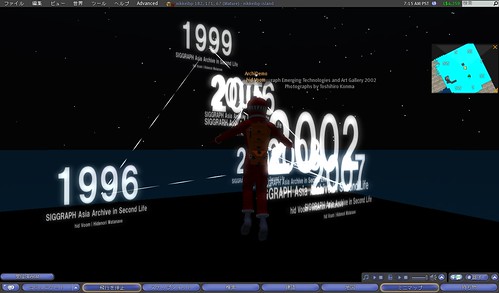
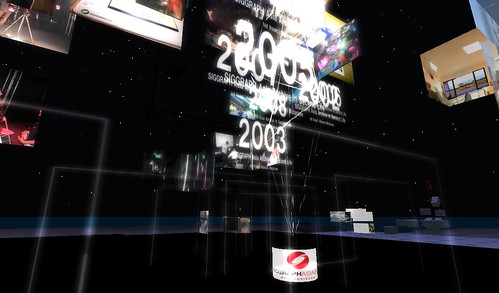
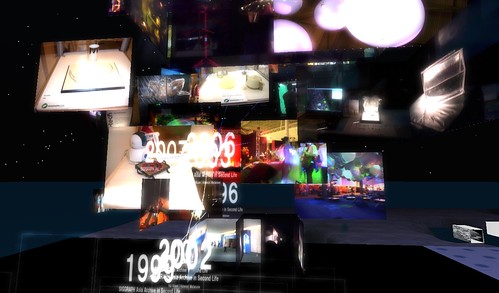
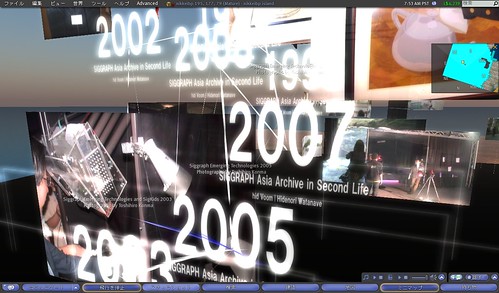
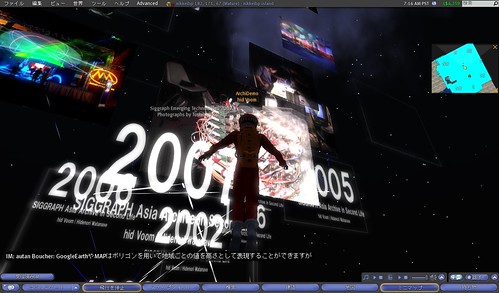
SIGGRAPH Asia Archive in Second Life Project was completed now.This is an art project that collects photographs concerning past "ACM SIGGRAPH Emerging Technlogy" and makes an 3-D image archive in Second Life, aiming at this year's SIGGRAPH ASIA 2008. 600 photographs or more were finally collected.It is created by Hidenori Watanave (Supervisor of Photon,Inc. / Associate Professor of Tokyo Metropolitan University), and conception by Tomoe Moriyama (SIGGRAPH ASIA Art Gallery and Emerging Technology chair / Museum of Comtemporary art Tokyo). Please refer to the lower side of this article about cooperators.It will be exhibited in SIGGRAPH Asia Art Gallery (Singapore, Dec.10 - 13 2008). I will make a machinima (movie) of this project and upload soon.SLurl:http://slurl.com/secondlife/nikkeibp/188/151/62SIGGRAPH Asia Archive in Second LifeSIGGRAPH Asia Archive in Second LifeSIGGRAPH Asia Archive in Second LifeSIGGRAPH Asia Archive in Second LifeSIGGRAPH Asia Archive in Second LifeSIGGRAPH Asia Archive in Second LifeAll photographs of SIGGRAPH were taken and granted by:Jacki Morie - SIGGRAPH 1993 and 1994, The Zone And Neuro Baby/ The EdgeBrian Blau - SIGGRAPH 1996, Digital BayouKathryn Saunders - SIGGRAPH 1999, Millennium MotelToshihiro Konma - SIGGRAPH 2002,2003,2005,2006,2007 and 2008, Emerging Technology / Art Gallery / Kids / NewTech / Slow ArtThank you very much for their contribution!(SIM sponsor: Nikkei Business Publications,Inc.)SLurl:http://slurl.com/secondlife/nikkeibp/188/151/62
Read more…

DANCE TECH Intro

WATCH PROGRAM INTRODANCE TECH is a program that features the highlights of the dance-tech.net interviews. DANCE TECH explores the intersection of cutting edge digital technology and the performing arts. This program is conceived and produced by Marlon Barrios Solano in collaboration with ProgressiveIMG. and distributed by TenduTV, first broadband internet TV channel dedicated to dance.This first episode celebrates the work of three movement artists and their very different explorations with interactive technologies, choreographic approaches and artistic intent.The featured artists are:Gideon Obarzanek talks about the process of creating performances "Glow" and "Mortal Engine" using interactive digital technology.Jill Johnson tells us about her experience working on her performance/installation "The Copier" with the Company "Cedar Lake" using "improvisational technologies" and a non-conventional space.Rachid Ouramdane explores plasticity and multiplicity in his solo multimedia performance works.Watch it in TidalTV!
Read more…

Pequenas Navegações

'Pequenas Navegações', a visual poetry and a DVD vith graphonoptiks ( the way I name my videopoems and videodances) will be launched in Recife, Brasil, at II PLAYREC - Festival Internacional de Videodança.Invite you all to visit the project's blogs and sites:http://pequenasnavegacoes.blogspot.comwww.paolarettore.comhttp://www.playrec2008.com.brregards,Marcelo Kraiser
Read more…
Music has the unique ability to create an infinitely changing experience via pure abstractions of temporal and spatial relationships, most simply perceived as rhythm and timbre. True, we may live in a material world, but within our shared experience, the abstractions of time and space are not imprisoned by the clocks and Cartesian coordinates of modern science. For us, a day can pass like an hour, and an hour can seem like days. The tiniest of space we share with another person, even in the most fleeting touch, can mean more to us than all the stars in the sky. Though musical abstractions, we can share such experiences, but only when the instruments place no constraints on our expression.In the 1960s, musicians started experimenting with electronic sounds. Early artists such as Pink Floyd experimented with many different sounds before finding the rhythm and timbre that led to their great success. In the 1970s, bands such as King Crimson simulated orchestras with tape loops. Modern-day musical instruments have sadly declined into a stock set of widely accepted sound loops and analog synthesizer simulations. To make new and challenging acoustic experiences, artists need to reach outside conventional instrumentation.In the 1990s, a German company released an unusual software program called Generator, which enabled electronic musicians to put together musical instruments of their own design. The program provides a lego-like interface whereby blocks are hooked up between audio inputs and outputs. Because many of the blocks are like hardware components, the blocks are deliberately designed to look like integrated circuits. The unusual characteristic of Generator was that it could also produce sound in real time, while the electronic musician was still putting together the blocks. This was possible because it embedded several kinds of simulator, similar to those used in electronic engineering, but adapted to the needs of the electronic musician. The software was years ahead of its time. It was later purchased by Native Instruments and combined with other programs to make a very sophisticated design environment called Reaktor.A little after Generator emerged, a little-known group of software developers in California created some similar design environments called Max and MSP. These environments are modeled on later DSP simulation programs, rather than the early hardware simulation programs of Reaktor. The interface is more abstracted and extensible. It was never really limited to creating electronic music alone, but always provided a more open and extensible environment such that, for example, it could provide synchronized light shows and a software workbench for the integration of unique control surfaces.Dance-Tech.net has been kind enough to sponsor me as a columnist, and I will be describing some of my experiences with Max/Msp here in the next nine months.Mac, PC, and Version ChoicesMax/Msp was originally developed on the Macintosh platform. There was a day when that made a great amount of difference, More recently, platform convergence has made the choice between such platforms more based on taste rather than application requirements. Max/Msp has run on both PC and Macs since version 4. Those familiar with software migration know that the first generation of software which converges across hardware and OS platforms is frequently buggy and requires a number of revisions. The challenge often extends beyond the software architecture for the application, and a total source-code rewrite is required. For financial reasons, the transfer to the new code base is usually deferred (for example, until the software protection for the original version is cracked). The delay often results in some cross-company migration of members in the talented alpha team, who worked on the original software, and as a consequence, portions of the original functionality do not port to the new code base for some time.In the case of Max/Msp, the new code base of Max5 is much superior to Max4. It is more stable, plays better, and looks better. However some interfaces have taken some time to release. For example, the Software Development Kit (SDK) which permits integration of external devices was only released this month, after delays approaching a year. Also, the ability to make standalone VST instruments (which can embed inside music sequencer programs such as Sonar and Cubase) is not available in Max5 (Max can operate in a VST environment, but others must own Max5 to play the instruments).This last discovery was a little of a disappointment for me. The ability to compile, link, and make standalone applications was a big part of the reason I decided to migrate from Reaktor to Max. I have developed experimental instruments in Reaktor since 1998, but Native Instruments also sells many VST standalone instruments, and providing the ability of native compilation would mean its customers could compete with its own products. Therefore a movement to Max seemed inevitable, if I was to share my musical creations with others besides those who own the expensive application.A number of alternatives exist for VST integration. One developer suggested making the Graphical User Interface (GUI) in a compiled code, such as C, then connect to a standalone Max interface via the now-industry standard Rewire interface. However I prefer Cubase VST/32 5.0 over SX versions (because I think its mixer less muddy), and Cubase 5.0 can only support a limited number of Rewire audio connections (due to an older interface architecture).The less preferred alternative was to develop in the older Max4 application. After some time the idea occurred of creating the UI in Max4, the main app in Max5, and the two parts could communicate over the more recent OSC interface. One other developer said this was possible.I do not intend to develop VST instruments alone--I hope to work with others, and a number of different applications are underfoot--but I did not want to be limited, as I had been in Reaktor, of not being able to share standalone VST instruments. So, I started the installation of both Max4 and Max5.MAX/MSP InstallationInstalling Max/MSP (and Jitter) 5.0 was a snap. The software is fully functional for 30 days, after which registration is required for continued functionality, so one can install while waiting for authorization codes.It is possible to run Max4 and MAx5 at the same time. However, installing the older 4.0 version introduced some unforeseen problems. To provide better latency and higher bandwidth to the audio hardware, electronic musicians often implement an audio I/O protocol called ASIO. I had been trying a freeware ASIO driver which acted as an intermediary between native WDM drivers and the integrated motherboard sound hardware. The Max 4.0 installation had some problems with the freeware so I uninstalled it.Then almost every single software application stopped working. I checked for viruses. No viruses.It took a while to work out, but now I'm pretty sure the uninstallation caused a kickback in my XP3 license, because ASIO drivers are perceived as hardware by the XP OS. After a certain number of hardware changes, the Windows operating system validates the OS is genuine across the Internet, and this time, XP3 also reset the "system ID." This hadn't happened to me before. Many software applications use some sort of Hamming code or CRC check with the system ID as part of their authentication, including Creamware, Cubase, and Native Instruments software. And so as a consequence, I had to reinstall Scope 4.0, Reaktor 2, Reaktor 3, Reaktor 4, Reaktor 5, Cubase VSt/32 5.0, Cubase SX, Kontakt 2.0, Battery Studio Drumkit, and all my audio drivers.The reinstallation has to be in a certain order, and the older software took may slow reboots. So this all took a while, after which my initial enthusiasm was somewhat subdued. I had been warned about problems with Max 4 but I was overconfident, and frankly I had just forgotten how long it used to take to integrate audio applications. System integration used to be enormously time consuming. Again, I reiterate, Max 5 was a snap. Software is just much better than it used to be.Website mountingI hope to create some server-side audio applications, so I also created a Website:http://www.heavensonearth.com

Creating the website cheered me up after the problems with installing Max 4, and also allows me to share some of the prototypes I would like to transfer to standalone applications via Max/MSP. I am just uploading various audio samples and freeware instruments.But it is not just VST instruments on which I am working, as I will describe in the next column.
Read more…
Launched in 2005 in Brussels and Mons (Belgium) by Transcultures (interdisciplinary centre for electronic and sound culture), Les Transnumériques is a nomadic festival dedicated to (trans)digital art emergences and the diversity of electronic cultures. This third edition of Les Transnumériques links Belgian cities (Brussels and Mons) with French cities (Paris and Lille) and focuses on the dynamic digital Quebec scene with guests artists and cultural organizations from Montreal and Quebec as well as featuring Belgian, French and European artists and structures.Les Transnumériques#3 (curator: Philippe Franck) starts in Paris at Centre Wallonie-Bruxelles (29 September – 4 October) with dance and multimedia performances (by Mutin, Thomas Israël & Jacques Urbanska, transitscape, Popcore) and video screenings (selection of Festival Elektra-Montreal and 68 Septante-Brussels), lectures and digital art-industry-research meetings (presentations of French and Belgian artists, researchers and companies).read more atwww.transnumeriques.beorg: www.transcultures.net
Read more…

November 28, 2008 VIA dance-tech list Choreographic Captures 2008: Dear Artists and colleagues, We’re pleased to announce that the www.choreographiccaptures.org website is now online. The website contains about 100 choreographic short films which were submitted to the first international Choreographic Captures competition in 2008. Additional films will be added next year. Choreographic Captures, each of which is maximally sixty seconds long, reclaim the format of the advertising clip for a new and purely artistic purpose. Choreographic Captures are art in public space. The five prizewinning films from this year’s Choreographic Captures competition are now also being shown in selected cinemas, where they’re screened at an unexpected moment: in the midst of the series of advertising clips that precede a feature film, e.g. between ordinary ads for jeans or cars! Shown in the context of such commercial messages, the Captures entertain and surprise movie audiences: entirely in accord with the motto “art for those who didn’t ask for it!” For more information about the project, the upcoming competition in 2009 and the participating cinemas, please visit www.choreographiccaptures.org, where you will naturally also find all of the short films – so there’s no need to wait until the next time you go to your local cinema! Visit the website and discover exciting films. Perhaps they’ll inspire you to create a Choreographic Capture of your own for next year’s competition in the spring of 2009. Of course, we would be pleased if you would forward this link to all your friends and colleagues who might be interested in the project as well. Let’s bring art back to life! Enjoy the films! visit www.choreographiccaptures.org now
Read more…

cimatics bruxelles friday 28th nov'08

http://www.cimatics.com/festival2008/festival/partners.htmlThe festival unites art, music, media and design in a relentless approach of contemporary culture.( es mucho más visual que artes escénicas, pero son artistas que en un momento dado creo han o harían colaboraciones con artistas que trabajan el cuerpo..de todas formas..algunos, seguro, viven de la disco...y donde sinó uno/a mueve el cuerpo..!!)He asistido a screenings de video ( me interesaba el programa de audio visual -proyectaban el DVD contenido en el libro recién sacado/curado por Cornelia & Holger Lund que trata de la historia del visual music) ISBN 978-3-89790-293-0http://www.fluctuating-images.de/en/node/16De los videos que más me gustaron de esta serie (y no entiendo el alemán)https://www.youtube.com/watch?v=fiYTL2gnrWUyhttp://video.aol.com/video-detail/zenitandnadirexploring-party-stuttgart-20070616/1976171304/?icid=VIDURVMUS06Después he ido a las performance liveDe 4 que he visto dos me han gustado mucho por su grado experimenatl pero a la vez muy bien presentados y obras bien acabadas, seguro que había impro pero todo cuadraba a la perfección, excelente efecto sobre el público. Ovación.Eran todos artistas del mismo sello Artkillart ( Paris/berlin)http://artkillart.free.fr/de lo que me gustó mucho se puede ver aquí ( CHDH)http://www.chdh.free.fr/net/rubrique.php?id_rubrique=1( mirad las piezas elektricity)y el otro que decía (CUTTEROFF)http://artkillart.free.fr/AKAvideo.html#CUTTEROFFMañana vuelvo pues actuan unos españoles que conozco Solu&arbolhttp://www.cimatics.com/festival2008/festival/performances/solu_arbol.htmlto be continued

Read more…

Dancing Scientists

Dancing Scientists Invade YouTubeYouTube dancing contests not just for dancers....
via ScienceNOWBy John BohannonScienceNOW Daily News20 November 2008Six weeks ago, the Gonzo Scientist challenged researchers around the world to interpret their Ph.D. research in dance form, film the dance, and share it with the world on YouTube (Science, 10 October, p. 186). By the 11 p.m. deadline this past Sunday, 36 dances--including solo ballet and circus spectacle--had been submitted online. A panel of nine judges--the three winners of the first "Dance Your Ph.D." contest, three scientists from Harvard University, and three artistic directors of the dance company Pilobolus--scored the dances on their ability to bridge the art and science worlds. Today, Science announces the winners of the 2009 AAAS Science Dance Contest in four categories: Graduate Students, Postdocs, Professors, and Popular Choice:Graduate StudentsSue Lynn Lau chose classical ballet and highly kinetic party dancing as the way to interpret her Ph.D. thesis, "The role of vitamin D in beta-cell function." As The Nutcracker Suite lilts in the background, Lau, a graduate student from the Garvan Institute of Medical Research in Sydney, Australia, appears as the Sugarplum Fairy, delivering marshmallow glucose to four beta cell dancers. Meanwhile, a fifth dancer flings and twirls around the stage--representing the sunlight required for vitamin D biosynthesis.
Read more…

European Musicday Anniversary Party in Athens

Call for video entriesEUROPEAN MUSICDAY ANNIVERSARY invites international video-artists to show their work in a celebrating venue that will take place on the 21 of December in Athens, Greece. The video works category includes short videos, music videos, animation, dance videos and video art, that have been completed / released after 1-1-2005.Closing day for submissions is 17th December 2008Requirements for EntrySubmissions must be postmarked by the deadline in order to be considered.Indicate: “With no value/ for cultural purposes only” in your submitted DVD.Submitted materials will not be returned.Submission Material / Screening RequirementsEstimated video length up to 10minutesFormat: DV AVI format (broadcast high quality 720X576)Short biography of the author in word .doc format (100words max)Email address required by all applicantsAll credits/rights should be included at the end of the videoDeliver Submission Pack To:EUROPEAN MUSICDAYPO BOX 26006Athens10022GREECEContactanthony.pls@gmail.com
Read more…

dance-tech.net news 11/26/08

Hello dance-techers; Due to a proliferation of spam and spam-bots (non-human members), as of November 23th new members have to be approved by the administrator and only members are able to see the content of this site. This regulation does not change any of the site features but will ensure the integrity of the site goal and its focus. It is also required from all members to update their profile page with your complete/FULL name and with ALL new required information. We are a community of practice, so it is very important to clearly share who we are and our backgrounds. dance-tech.net is FREE and open to all humans and movement styles, levels of practice and artistic accomplishment but it is focused on innovation, collaboration, creative process and the symbiotic relationship of our bodies and technology. I recommend: Customize your page Invite friends Upload a profile picture Explore, make comments and share your process Organize your photos in albums and they will show in the home page Post upcoming events Use forums and groups: just joining is not enough! Add contextual information and tags to your uploaded media . If you have an external blog, add the RSS feed from your blog to your page. New Feature: Birthdays of the community in the right sidebar! Don't worry: you can select not display your age in your profile but this feature works better if you enter your real birth-date! Take advantage of the tangible benefits of belonging to this community Deadline: Call for Projects: INTERFACING MOTION with Wireless Miditron Fall 2008 Watch DANCE TECH/The Program Episode 1 http://www.dance-tech.net/page/dance-techthe-program-episode Ah...important Support dance-tech.net You can make an on-line Tax-Deductible or a PayPal Donations Watch new interviews:
Find more videos like this on dance-tech.net
New Series dance-tech @ the tech that will show "behind the scenes" images from the technical rehearsals of premieres. Watch dance-tech @ Bebe Miller's Necessary Beauty tech rehearsal at Dance Theater Workshop 11/10/08
Find more videos like this on dance-tech.net
Have a a Happy Thanksgiving! That is all for now! Marlon New York City
Read more…

Android Rehearsal Assistant version 0.0.1 released

For those of you that have access to an Android device (e.g., the new G1 phone):Rehearsal Assistant is a software tool which helps performance artists conduct rehearsals by addressing media-related needs. Version 0.0.1 has been released for the Android platform, and allows choreographers, directors, lighting designers and others to take notes (record audio annotations) while watching a rehearsal run (or any other event), and review them later.The recording interface allows the user to indicate the start of the rehearsal run (by pushing a "go" button) and then start / stop the recording of individual audio annotations (which will be time-stamped relative to the start of the rehearsal run). The playback interface displays the list of recorded annotation and allows them to be played back.See the screenshots for sample use:http://sourceforge.net/project/screenshots.php?group_id=226240See the wiki for download and usage instructions:http://rehearsalassist.wiki.sourceforge.net/Or just download the released application on your device:http://sourceforge.net/project/showfiles.php?group_id=226240&package_id=300408&release_id=642928WARNING: this is an early development version. It uses a single project which will get overwritten every time you record annotations for a new rehearsal run. You are encouraged to try it out and provide feedback, but please use with care.
Read more…
SEEDS FestivalSomatic Experiments in Earth, Dance, + ScienceJune 14 - 28th 2009Earthdance · Plainfield, Massachusettswww.earthdance.net/seedshttp://seedsfestival.ning.comWe are very excited to announce our second annual arts and ecology Festival, SEEDS, from June 14th –28th, 2009. Save the Date!FESTIVAL CALLSPREADING SEEDS: DEADLINE December 20thSEEDS Festival will benefit from projects beyond the scope of our curatorial imagination. We invite you to propose and participate in the following projects:Single Workshops (Green/Body/Local & CI as a Social Experiment), Interdisciplinary Residencies, Presentations, Panel Discussions, Performances, Videos & Films, Archiving, and more! Our website lists the complete descriptions and downloadable application forms. www.earthdance.net/seeds.SEEDS Festival (Somatic Experiments in Earth, Dance, + Science) is a unique interdisciplinary summer festival dedicated to arts and ecology. The two weeks will feature workshops, collaborative design projects, panel discussions, live performances, films, and interdisciplinary investigations. This year's format: Week One: A week of workshops, and a two-track weekend of eco-soma-regional research, & social experiments into CI. Week Two: Interdisciplinary investigations.This year, the Festival will focus on potentiality - in this year of potential political change & community organizing, we invite this phenomenon into our interdisciplinary investigations.SEEDS Festival 2009 Curatorial Team: Margit Galanter, Melinda Buckwalter, and Olive BieringaSEEDS Team: Curators, Earthdance Staff, & Programming Committee.Questions? seeds@earthdance.netEarthdance is an artist-run residential retreat center and an international arts organization. Through a broad spectrum of activities and programs, Earthdance cultivates the art of improvisation, dance, collaboration, and ecological understanding. Located in Pioneer Valley, Western Massachusetts, Earthdance features two beautiful dance studios, farmhouse, comfortable dorm accommodations, delicious cuisine, wood-stove sauna, spring-fed swimming quarry, and 100 acres of outdoor bounty.
Read more…

Leonard has a skin! (And it's green and furry)

In our latest days of Leonard construction, we have ventured away from Chapter 1: the foam and, moved toward Chapter 2: the fabric. These two chapters in The Making of Leonard had a bit of an overlap as you can see in the below pictures.

As these pictures show, we added the center piece to the dome that Shawn will secure to the top of his head. The four triangle-like shapes surrounding the center piece keep it and the dome structure supported. It's pretty sturdy if I do say so myself.As you can see in the pictures above, we have started to add the fabric to the dome and the jaw. Here are some more pictures showing the fabric laid (but not yet glued) to the dome and jaw.

Top of Leonard's head (aka the dome)

Leonard's head with paper cutouts set where his eyes will be (They will be giant plastic googly eyes - and yes, these paper cutouts are the actual size, ha ha ha.)

Leonard's Jaw

The body of Leonard not yet sewn and not yet with arms

A reminder of what the small Leonard puppet looks likeI have been working side by side with a wonderful and amazingly talented couture fashion and costume designer, Galina Mihaleva. As you can see, we have set the fabric where we want it, but we are waiting to secure the fabric until we have all of the parts with sensors built and added to the costume (ears, teeth, etc). We just finished the ears and added the sensors, as you can see here.

These fabric bend sensors are here so that when people scratch Leonard behind the ears or play with his ears, he will make sounds. We plan to cut slits into the foam, stuff the bottoms of the ears through the slits, and glue it down with the same adhesive glue used for the dome. The bottom half of the ear sensors will be sandwiched in the foam, and the top half will be in the exposed part of the ear...

We will use a similar design for the teeth, which will also have sensors.We originally planned to use the conductive thread/fabric to transfer the sensor signal down to the Miditron Wireless transmitter (this would mean less wire). However, because we have several sensors connected to different detachable pieces of the costume (the dome head, jaw, and body) we are now planning to simply use wire. As you can see in the pictures below, I soldered crimp tubes (usually used in jewelry making) to the ends of the wires. I am using these hollow, metal tubes to sew the wire onto the conductive fabric connected to the sensor. I used the conductive thread to sew on the wires. The wires will be strung down to the Miditron Wireless transmitter, which will be secured to the back of the football shoulder pads in a mini pouch.

Crimp Tube Soldered on Wire

Crimp Tube Soldered on Wire

Bend Sensor before its sewn and trimmed. I found that when I sew with the conductive thread, it tends to fray a lot. I use a small pair of scissors to trim away the frayed pieces of thread that you can see here.

Bend Sensor after it's sewn

Bend Sensor after it's sewnI suppose that is good for now. Just to give you an idea of what is coming up. We will be making GIANT googly eyes out of 12" diameter clear domes, which you can see here. They should be coming in the mail within the next couple of days. We will either use painted foam balls or rubber balls to make the bouncy part of the eye inside of the clear domes. (Lots of domes in this project.)We will also be making the teeth with sensors, securing the fabric, and sewing the body of the costume. Heck, the next time you hear from me, the costume might be pretty darn close to done! (Well, then comes the programming part - ha!.....done.....Shya)Jess
Read more…

Call for A-i-R proposals: Soft Technology

V2_Lab, the artistic Research & Development (aRt&D) department of V2_ Institute for Unstable Media in Rotterdam, the Netherlands, has a vacancy for a three-month artist’s residency from January 15 to April 15, 2009.Deadline for applications: December 7th 2008To download your application form please follow this link.BackgroundV2_Lab has an extensive history in the field of wearable technology. In recent years, we have carried out various aRt&D projects in collaboration with various artists and universities. For example, we developed soft, wearable interactive objects with Thecla Schiphorst during Soft(n). We recently took these developments further in the direction of fashion and wearable technology with Di Mainstone’s Sharewear. In these projects, we combine knowledge from various domains to produce surprising or critical artistic statements. V2_ is seeking to further investigate the combination of fashion and technology by means of an experimental residency.IntroductionA true revolution is currently under way in the form of personal fabrication. Wikipedia is already talking about “fabbers” – a new word for the emerging miniature factories. Around the world, initiatives like the Fab Labs and a lively DIY community bear witness to this development. This way of working is also increasing in popularity in the area of wearable electronics.V2_ Lab sees a great need for simple solutions for wearable electronics people can make themselves with a bit of know-how. The proliferation of workshops in things like Arduino and crafting and the success of V2_’s workshops in Shanghai and Cluj, Romania, seem to support this. As a lab, we believe it is important for artists and designers to gain knowledge and hands-on experience with the technical and conceptual possibilities and impossibilities of these technologies in a professional environment.At the same time, we wish to combine our creative powers to develop innovative materials that will enable a far-reaching integration of electronics with their textile carriers. If this technology finds its way to artists and designers, it will certainly have an impact on future wearable projects.Goal of the residencyThe research and development part of the residency will focus on the development of flexible, textile-integrated circuit boards and electronic components, manufactured from easily accessible materials. We wish to involve the artist in this research at the earliest possible stage, so that the accumulated knowledge will remain easily transferable. This residency is also geared toward achieving a satisfying end result in the form of a visually attractive working prototype.This residency is relevant at the artistic level because making low-tech materials and techniques available will enable a much larger community to develop wearables.Technology and way of workingThe artist will be responsible for the artistic theme, design of the wearable, and realization of the prototype; he or she will receive support from the designers and developers at V2_ Lab. In collaboration with V2_, he or she will develop innovative materials and applications that will help to realize the goal of creating a working prototype in which the technology and the textile medium integrate into soft and flexible circuitry. We will work with DIY and crafting technologies as well as with rapid prototyping machines.We highly value convincing design. The integration of technology and craft, however, is part of ongoing research at V2_, so the technological aspects may keep an experimental character. The final result will be presented to the public at one of V2_’s events.Team profilesThe artist will:• be an artist/developer/designer having an affinity with textiles.• be innovative in his/her field and wish to experiment with the aforementioned technologies, and• preferably have basic knowledge of electronics, or at least have experience working in a multidisciplinary team.The experts at V2_ Lab will:• offer support with software and hardware development,• work with the artist on research into the integration of textiles and electronics,• have knowledge of materials, and• be familiar with various crafting technologies.We work with FabLab Utrecht Protospace, which offers• the use of milling machines, laser cutters and 3D printers, and• occasional support from a professional.V2_Lab offers:• an artist’s fee up to a total of €3,000.00, depending on experience and activities,• free lodging in Rotterdam, and• travel to and from Rotterdam up to €250.00.The contact person for this call is Piem Wirtz, piem@v2.nl,Tel: +31-10-206-7273.
Read more…

Arts in the urban space

Contemporary creation as a tool

Circostrada Network, a European information and exchange network on street arts and new circus, has published a collective work called “Arts in the urban space: contemporary creation as a tool”.
"The publication aims to engage in deeper reflection on the effects of artistic intervention in public spaces. We asked European scholars of various fields to analyze, from the perspective of their own domain, the impact that artists’ presence has on the public space. What does it mean for society to see the arts moving into a space that was not originally conceived for them? What role can the street arts play in making adjustments on our cities or improving the framework of our lives? Should we beware of the possible exploitation of artistic creation towards political ends?"

Table of contents:

  • Town Planning and Street Arts
  • Spectator in fabula – What Street Theatre Does to Spectators
  • Public Art: between (street) spectacle and the spectacular
  • Nomadic Creations
  • From the Street Theatre to Theatre in the Public Space
  • Artistic Interventions Affirm Public Space
  • Arts Don’t Have to Know How to Behave – A Commentary on Street arts in Contemporary Urban Surroundings
  • Art, Public Space and Creation Centres
Contributers:
  • Anne Gonon
  • Jean-Pierre Charbonneau
  • Dragan Klaic
  • Alix de Morant
  • Joanna Ostrowska
  • Ramón Parramón
  • Christian Ruby
  • Stéphane Simonin
  • Corina Suteu & Cristian Neagoe
  • Yohann Floch (coord.)
You can download the PDF for free: French and in English
Read more…
Application call« exercer les images » contemporary dance training programex.e.r.ce 09/10 is being shaped around the theme of “the image”, which will serve as a pivot forthe entire program. The image’s role in dance is multifarious. It is a wellspring for work,inspiration and references; it is a powerful tool for writing, memory and props.The ex.e.r.ce09/10 program will pursue three lines of research, exploring how dance has impacted the imageand how the image has impacted dance from a historical, technical, artistic and aestheticviewpoint. We are curious about what might emerge from this specific image relation into theframework of a dance training program that emphasizes research, tool-building, creating andperforming.the ex.e.r.ce 09/10 program is being led by Mathilde Monnier, choregrapher - Isabelle Launay,dance history doctor - Mark Tompkins, choregrapher, singer - Stéphane Bouquet, screenwriter,poet - Loïc Touzé, choregrapher .applicants futur dance artists and other people wishing to work in relation with this artisticfield aged over 20.Dance training program for students and professionalsIn face of the way choreography is evolving and the ever-increasing links among artists from different countries, cultures, age groups and backgrounds, we believe it is important to widen the scope of ex.e.r.ce’s applicants in order to enable experienced professionals to join ex.e.r.ce. The courses will be organized through three 12-week seminars. It will be possible to follow either the full program for student training or an 8-week seminar (full or part) for the professional training.application formswww.mathildemonnier.com until 5 december 2008
Read more…
Call for Proposal 2009.La Granja Art Center is a space for the development, research and exhibition of contemporary art work, and also the promoter of new social dynamics between artist and the community through the Chamaco Project.The residency program offers a unique opportunity to step outside of daily live in order to work in a stimulating environment, and provides the privacy for focused work while still encouraging community exchanges with children, art organizations and other artist in Mexico.The Program Committee of La Granja will select from 2 to 4 artists to develop or finish an artistic project. Artist will have different alternatives for the public exhibition of their work. Consistent to the goal of linking the activities of La Granja with the nearby community, guest artists will conduct a working session with the children of Chamaco Project.Disciplines:all media—visual, literary, performance, interdisciplinary, music, audio, video, digital media.Residency duration:a minimum of 10 days to a maximum of 30 days from March to May 2009.Deadline for the submission of documentation:December 18 2008.Commitments of La Granja and sponsors.1. During the residency:Unlimited use of the studio and / or any other suitable space for the creation of the work.Housing and access to the common areas in the house.Transportation to and from Mexico City to La Granja.Materials for the class with the children of Proyecto Chamaco.One meal each day with Rainbow trout.Servicios de vigilancia y mantenimiento.Logistics and publicity.2. For the exhibition of the work:The Regional Cultural Center of Valle de Bravo:Exhibition of either finished or in progress art work in the auditorium or main gallery. Including but limited to performing arts, confererences, lectures, visual arts exhibitions, etc.50% of the expenses for the installation material for exhibition of visual art work. The other 50% is responsability of the artist.Publicity.Legaria Theater:Presentation of either finished or in progress performing art work. The Legaria Theater will consider the amount of shows (up to three), and will also evaluate paying a fee of $2,000.00 pesos for each performance (around 200 US Dollars), plus 50% of the box office sales, depending on the work to be shown. Publicity.Los Talleres Cultural Center A.C:Housing during the days of the presentations in Mexico City.Exhibition of either finished or in progress art work in the lobby or theater. Los Talleres will consider the amount of shows or time for the exhibition, and will also evaluate paying a fee depending on the work to be shown.Publicity.Senior High Schools and Professional Schools of the National University (UNAM)Presentations in either an auditorium, plaza or classroom. UNAM will consider the number of shows or time for exhibition, and will also evaluate paying a fee to the artist, depending on the work to be shown.Publicity.The Program Committee will select the space for the final presentations depending on the format and technical needs of each project.Artists Commitments1. Expenses paid by artists:Mexican artists: a fee of $160.00 pesos per day.International artists: a fee of $25.00 US Dll. per day.Transportation to Mexico CityAll materials required for their project.2. Collaboration with La Granja´s project:2.1. During the residency:Share their experience with the Children of Chamaco Project (teaching a class, video conference, etc.)Participate from one to a maximum of two hours per day in maintenance activities of La Granja (gardening, general reparations, trash gathering, black berry picking (in season) etc.) and similar needed labors.2.2. At the end of the residency:Submit a written reflexion (three page minimum) about their experience in La GranjaLeave one piece of work made during the residency as a donation to La Granja Art Center. The donated piece is decided upon by the artist and the executive directors.(eg. visual art work, audiovisual o literary work etc.) pieces created specifically to be installed in La Granja are greatly encouraged.Show results of the project (finished or in progress) in the Regional Cultural Center of Valle de Bravo and at least one of the following: Legaria Theater, Los Talleres Cultural Center, Schools at the National University.Answer a written evaluation about the Program of Artistic Residencies.Selection process:The Program Committee composed of artists, curators and other art professionals, will select from two to four of the applicantsTo participate in the selection process each artis should submit either by email or certified mail the following material:Written propousal including: justification, general and specific objectives, needs and expectations, propousal for the work session with the children of Chamaco project and exibition of the art work (no more than 8 pages)Curriculum vitae.Plan to fullfill the compromises required by the program.Supporting material of their art work in an appropiate format (photography, video, cd, publications, etc.)The artist can program their residency in one to three time periods. Each artist will be allowed to have a visitor for up to 2 days by paying the expenses generated by this visit.The final selction will be published by December 25th.The Program for Artistic Residencies 2009 is co-sponsored by: the Regional Cultural Center of Valle de Bravo, the National Coordination for Dance, Dance Coordination of the UNAM, Los Talleres Cultural Center A.C., Legaria Theater, Los Alevines Trout Farm and La Manga Video & Dance.La Manga Video & DanzaContact in México City: Gabriela Medina / Mario Villa / 5563 6433Contact in Amanalco de Becerra: 01 726 2510107Email: mangapc@hotmail.comSend projects to:Nattier 18 - 301Colonia San Juan Insurgentes CP 03730México DF, México
Read more…

Blog Topics by Tags

Monthly Archives