
El 21 de junio de 2014, en el marco del seminario MOV-S que tuvo lugar en Guadalajara (México) del 18 al 21 de junio, se realizó una presentación final de todo el trabajo realizado por los participantes. Se presentaron la dramaturgia, el recorrido por el dispositivo artístico, los tres ejes de trabajo y las concreciones de éstos en los 3 proyectos seleccionados.
All Posts (2056)
Sort by
Ania González y María Ptqk nos ofrecen el siguiente relato del trabajo realizado en el marco del Prototipo Interinstitucionalidad en el MOV-S Bilbao.
Natalia Álvarez y Arantxa Mendiharat nos ofrecen el siguiente relato del trabajo realizado en el marco del Prototipo Plataforma en el MOV-S Bilbao.
El 21 de junio de 2014, en el marco del seminario MOV-S que tuvo lugar en Guadalajara (México) del 18 al 21 de junio, se realizó una presentación final de todo el trabajo realizado por los participantes. Se presentaron la dramaturgia, el recorrido por el dispositivo artístico, los tres ejes de trabajo y las concreciones de éstos en los 3 proyectos seleccionados.
Al final de la última sesión del Prototipo Plataforma en el marco del MOV-S Bilbao, diversos participantes presentaron las claves de 2 de los 3 modelos propuestos como resultado de dos días de trabajo conjunto.
Para entender el contexto os invitamos a que echéis un vistazo a documento en el que se describe la metodología llevada a cabo en las diversas sesiones de trabajo.
Idoia Zabaleta y Ricardo_AMASTE nos ofrecen el siguiente relato del trabajo realizado en el marco del Prototipo Prácticas Artísticas Críticas en el MOV-S Bilbao.
My name is Vanessa Vargas. I was born and raised in Caracas, Venezuela. I'm a contemporary dancer and performer, BA (Licenciate) in social communication, MA in communication for social development. I have worked in these areas for over 10 years. I recently moved to Astoria, NYC -I have been an American Resident for more than a decade, traveling from Venezuela to the US for studies, formation and specific projects-, and I would love to continue sharing this project. I am openly looking for the opportunity to continue developing my work in these fields and expanding my horizons in this city.
As a dancer and social researcher, with my husband Daniel Esparza (art historian-philosopher and musician) we have undertaken a project of social development through arts -Beat Cultural Lab-. We have already developed this project in Venezuela but we want to give it a try in NYC, with the support and collaboration of institutions like yours. If you want any more details on our project, you can check my website at http://vanessavargas.me/2014/07/07/beat-cultural-lab/. I am interested in your feedback, recommendations and insights on the matter.
Very best,
El 30 de mayo en el marco de MOV-S Bilbao, Ania González presentó el proyecto Contrato Interinstitucionalidad / Kit para la construcción de una relación contractual.
El vídeo está disponible en el siguiente link: http://ow.ly/yJHOX Contrato Interinstitucionalidad es un proyecto de creación de un "kit documental" jurídicamente operativo para la formalización de contratos o acuerdos de colaboración en el ámbito de las Artes Vivas que tengan como pares a creadores, medidadores e instituciones culturales, públicas o privadas. A raíz del proceso de trabajo colectivo iniciado en MOV-S, plantea la creación de un documento abierto y transformable capaz de introducir y mantener los criterios definidos por la comunidad de creadores y profesionales acorde con las necesidades técnicas y teóricas de cada una de las disciplinas que integran las Artes Vivas.
Ania González es crítica cultural y co-directora de la revista online especializada en arte contemporáneo Plétora. Colabora en el proyecto de investigación Canales alternativos de creación experimental. Eje noroeste 1975-2012 de la Universidad de Santiago de Compostela.
DEADLINE EXTENDED || Submissions for POOL 14 – INTERNATIONALE TanzFilmPlattform BERLIN are still possible until 14th July!
http://pool-festival.de/anmeldung.html
El 30 de mayo en el marco de MOV-S Bilbao, Blanca Calvo presentó el proyecto Cuando el cuerpo desaparece.
Podéis ver el vídeo en el siguiente link: http://ow.ly/yJKMr
<strong>Cuando el cuerpo desaparece </strong>es un proyecto que ha explorado la desarticulación en <em>performance</em> entre cuerpo y voz a través de emisiones de radio y la publicación de Cuadernos. Ya en su inicio, la voz apareció como el vehículo para realizar el recorrido. En la traslación de la percepción de la performance a otro medio, radio y publicaciones, se intuía que se iban a encontrar preguntas. Se escogió la radio porque permitía, desde el micrófono, acceder a la idea de estar en el aire, en la articulación entre el exterior y el interior del desarrollo del proyecto. Esto tenía que ver más con un cambio de orden de las cosas, con romper unos dispositivos para liberar los movimientos de su propia materialidad.
Blanca Calvo es directora artística, coreógrafa e intérprete. Su actividad está ligada a dos ciudades, Madrid y San Sebastián, entre las que ha transitado y en las que ha articulado diversos proyectos de carácter generativo y procesual.
<a href="http://www.mugatxoan.org" target="_blank">www.mugatxoan.org</a>;
El 31 de mayo en el marco de MOV-S Bilbao, Beatriz Cavia y Leire Vergara presentaron el proyecto Bulegoa Z/B.
Lo podéis ver en el siguiente link: http://ow.ly/yJHrEBulegoa Z/B es un espacio para la producción, la discusión, el debate y la reflexión, el intercambio de ideas, el desarrollo de la investigación y la materialización de proyectos artísticos ubicada en el barrio bilbaíno de Solokoetxe. Esta iniciativa de colaboración, que organiza diversos tipos de actividades y pretende constituirse en un lugar de cruce entre la práctica y la teoría, surge alrededor de las siguiente líneas de investigación: los procesos de historización, la traducción cultural, la performatividad, el cuerpo, el postcolonialismo, la teoría social, las estrategias de archivo y la educación.
Sus componentes son Beatriz Cavia, Isabel de Naverán, Miren Jaio y Leire Vergara. Proceden del comisariado, la crítica de arte,la coreografía y las Ciencias Sociales, campos en los que paralelamente desarrollan distintos proyectos.
THÆTA is the third performance of StratoFyzika’s Shadows Trilogy. With new collaborations in sound and interactivity (sensors building, coding), the concept still steeped in the subconscious realms and dealing with the ego: the dark and light shadow aspects of self (as in the first two parts of the trilogy) but also on the edge of the conscious, waking self; visions on the edge of sleep, whispy light shadows, multi-dimensional geometric objects, sudden sound as if from the halls of a mind in a dream state.
This liminal zone is a state referred to as Hypnogogia.
THÆTA embodies this borderland state.
All merge onto the stage, interactively; body dynamics, auditory sensations and visuals function as the culmination of parts into one constellation in live performance.
Interactive Stratum
The aim of introducing interactivity in our work is to engage a live performative environment where the movement is able to affect the sound and the image as well as with those elements. To accomplish this task in a meaningful way, something beyond a 1 to 1 connection between sensors and effects parameters should be achieved. Data is not information until it is analyzed and transformed. In this direction, different pattern and gesture recognition algorithms are applied to the values coming from the sensors in order to extract the key steps out of the choreography. This technique allows the performer to establish a set of movements to create a new language within the scope of a particular performance.
Sensing Stratum
Body-mounted sensors: three-axial accelerometers and a gyroscope, are being used as the primary sensing mechanism for quantification of temporal variations in motion and gesture. THÆTA uses a specifically designed prototype of wearable electronic devices whose main module is based on Arduino Fio, and an x-bee module for wireless communication.
Sound Stratum
The soundtrack for THÆTA is composed of abstract atmospheres and drones which at a certain point morph into rhythmic patterns and lead the piece to its most intense conclusion. The sound synthesis process is connected to the sensors' signals and the overall quantity of movement is mapped to the occurrence of sound, which shapes refinements with movement data’s details. The sonification of images and movements aims to hypnotize the audience with various tricks, from noise cacophonies to otoacustic emissions - a physiological reaction to a couple of pure tones that makes the ear hair cells resonate and produce a tone.
The main sound sources have been selected from the archives of a free experimental sound internet library, curated and maintained by Thalamus Lab. The project launched an open call called Experimental Sound Lab and many artists from different countries contributed to create a collaborative library.
Visuals Stratum
The stage is designed by the visuals around and together with the performer, investigating the liminal zone through the use of live sketch techniques as well as morphing shapes modeling, audio-driven geometric patterns and pre-shot shadows characters appearences. The projections narrative takes the shape of a path, sinking into the black subconscious world, giving birth to a night creature, shaping its visions and then re-emerging to face the sharp cold touch of the light beam.
Over the whole performance experience, specific interactivity is being used to let gestures drive specific visual impressions. The interactive part of the visuals shows a complex system, where the interaction of a large number of individuals creates a new entity with a different behavior than just the addition of the single ones. This emergent behavior is modeled following the classic flocking rules written by Craig Reynolds in 1986 (separation, alignment and cohesion). To those we added a few more like a bounding area, a noise field or a perlin random walker.
Movement Stratum
The dancer’s torgue, bend, twisting and qualities of movement is the consequence of the mind directing the body’s reactions on/into the audiovisual environment. In THÆTA, the movement is focused on the embodiment of a character which is in contact with light and dark shadows, traveling through the hypnogogic state via an (imagined) Theta wave state. The choreography on it’s own is a movement map written through common brainstorm and then broken down into sections either with specific set choreography and/or an improvised score sometimes employing the Atavistic Technique.
credits:
Hen Lovely Bird : creative direction, movement writer /
Alessandra Leone / creative direction, visual content / www.alessandraleone.com
Davic Nod / sound project / http://www.davicnod.com
Thomas Van Ta / creative code / www.thomasvanta.es
Giovanni-Marco Zaccaria / wearable sensors design & development
Jeanette Bruneau Rossow / costume design / http://www.treches.com/
Thanx to:
B-Seite festival crew
Dario-Jacopo Laganà // photography
Oriol Pastor //creative coding
L'estruch MediaLab - Sabadell
Audio contributors: Felix Blume,Jovica Storer, Dave Pape, Tessa Elief, Dizzy Banjo, Suonho, PJCohen, Virotic, Gabriela Parra, Freed, SubFeld, Sandyrb, Richard Frohlich, Batchku, Patchen, Than van Nispen, Melack, Marco Madia, PoisedToGlitch, Spt3125, Nirtana, Lost Chocolate Lab, J. Simon van der Walt, Koops, Milo, ERH, AlienXXX, Daniel Blinkhorn, Pluja de Metall, Katarrhaktes, Jef Aerts, JQR, David Flood, Kyle Evans, M. Wissar, Toko Okuda // http://www.thalamuslab.com/experimental-sound-lab
Special thanx go to the people who have been contributing to our crowd funding, supporting the production costs for the piece.
with love,
Tina Zimmerman
Wolfram Lakaszus,
Lisa and Jerry Hicks
Garth Webb
Alexandros Drymonitis
Alison Colman
Carly Pick
Margery Fairchild
Daria Kaufman
Gautam Agarwal
Savannah Lees-Haley
Michael Jenkins
Susanne Kirchmayr
Donna Larson
John and Jo Larson
Cio Dorbandt
Han Van Acoleyen
Mumu Mariane Charline Hernandez
Brianne Crabtree
Audrey Panven
Ian Smith-Heisters
Claudia Frickemeier
Tommaso Leone
Judy Kaufman
Helga Jäckel
Mary Franck
and our Private donators, of course.
Costa Contemporánea 2014: V Contemporary Dance & Performing Arts Festival
September 3 – 7 2014, Cabo de Gata, Almería, Andalusia, Spain
Workshops: from 3 to 7
- Contemporary Dance Workshop “Points of view” with Daniel Abreu (Cía. Daniel Abreu)
- Dance Composition/Choreography Workshop “Leche del sueño” (Milk before Bed) with Michelle Man and James Hewison ( Edge Hill University)
Masterclass: Saturday, Sept 6
- Contemporary Dance: “Technical training in contemporary dance” with Chevi Muraday
- Flamenco: “From dance to flamenco” with Anabel Veloso
- Videodance: “Dancing for the camera” with Ana Cembrero
Performances / Program:
Sept. 4: Noche de Varieté – Varieté Night
venue Rodalquilar
- Sandra Antón: “The Big Solution Clown” (Las Hortichuelas/Barcelona)
- Alberto Cortés, Rebeca Carrera: “EXIT” (Málaga)
- Cromática Pistona: Swing Party (Madrid)
Sept. 5: Noche Espectacular – Spectacular Night
venue Centro de Artes Escénicas (CAE), Níjar
- Daniel Abreu: “Gigantes” (Madrid)
- Performance of the Winner at the Choreography Competition Mujer Contemporánea
- Javier Barandiarán: “No estoy para nadie” (País Vasco)
Sept. 6: Fiebre del Sábado – Saturday Fever
venue Centro de Artes Escénicas (CAE), Níjar
- Chevi Muraday y Alberto Velasco: “Cenizas” (Madrid)
- Anabel Veloso: “La generación del 80” (Almería)
- Michelle Man y James Hewison: “Imaginarium” (England)
Costa para Todos - Costa for everyone (free entrance)
- Irene Cantero: “El vuelo” (Sept. 3, venue Camping Los Escullos) (Madrid)
- Ana Cembrero: “Europa Endless” (Sept. 3, venue Camping Los Escullos) (Valencia)
- Cromática Pistona: Swing Concert (Sept. 5, venue Plaza San José) (Madrid)
- Andrea Quintana: “Ángel cojo sin pierna” (Sept. 5, venue outdoors CAE) (Galicia)
- Smantik: Audiovisual Projections (Sept. 6, venue CAE)
- Open performance dance experimentations (Sept. 4, 5 & 7, outdoors: El Playazo, Isleta del Moro, etc.)
See promotional video: Costa Contemporánea - Encuentros de Danza Contemporánea y Artes Escénicas from low visuals on Vimeo.
See Youtube Canal: https://www.youtube.com/user/CostaContemporanea/videos
Meta-academy invites you to engage online with three international dance festivals this summer- Taking Place (July 1-13 in Columbus, OH, USA), Impulstanz (July 21 -August 18 in Vienna, Austria), and Bates Dance Festival (July 21-August 11 in Lewiston, ME, USA). We will also be participating in IDOCDE international symposium on contemporary dance education (August 1-3 in Vienna Austria)
Dance festivals create intimate, hyperlocal communities where dancers exchange creative processes, pedagogies, finished work, and ideas. Now Meta-academy connects these communities to each other, and opens them to YOU at HOME or on the road.
choreographic knowledge, creative process, methodologies, ideas, influences, relevance, trends...stories
Starting with artists from Taking Place: K.J. Holmes (NYC), Peter Kyle (NYC), CoCo Loupe (Baton Rouge),Bebe Miller (Columbus), and Claire Porter (NYC)
Much more...
teach me (not)!
01 - 03 August 2014
IDOCDE (International Documentation of Contemporary Dance Education) organises the 2nd IDOCDE SYMPOSIUM on contemporary dance and its teaching methods at the ImPulsTanz – Vienna International Dance Festival 2014.
teach me (not)!
There are many ways information is being relayed in contemporary dance education settings. Questions around the roles of the dance teacher, the learner and the material arise once opening the thoughts towards this process.
Themed „teach me (not)!“, the 2nd IDOCDE Symposium thus aims to investigate horizontal - or non-hierarchical - learning, use of language and current practices in contemporary dance education and related fields and to look further into the question: How do we teach?
The symposium welcomes everyone interested in contemporary dance and related fields and invites to share teaching practices, questions & ideas around the current teaching of the art form.
It’s free and open. All you need is an internet connection and a few hours per week. You determine your level of involvement.
Facilitated by Marlon Barrios Solano, Rachel Boggia and Josephine Dorado.
Here’s what we’ll do:
1. Share creative and critical perspectives. Select choreographers, improvisors, theorists, and pedagogues from the festivals will upload videos of their process, engage in interviews, and participate in google+ hangouts with other artists and members of the Meta-academy community (the first 5 to join the hangout).
2. Move together online. Join a google+ hangout and experiment with dance professionals as they try translating their creative practices to the online space.
3. Create internet-specific work. You’ll be instructed on using some of the best online (free) creative tools to create your own internet-based videos, word clouds, mashups, and more.
4. Join a global community of dancers. When you’re making, talking and learning together, chances are you’ll make friends.
Here’s how you join.
Create a user profile on www.dance-tech.net and join the meta-academy group
http://www.dance-tech.net/group/meta-academy
You’ll get an email with further instructions on how to join our google+ circle so that you can participate in hangouts. You will need to have a Google Plus account.
Article about my work and meta-academy by Lisa Kraus on ThinkingDance.net
Lisa Para (NYC) and Daniel Pinheiro (Lisbon) in collaboration during meta-academy@Bates 2013
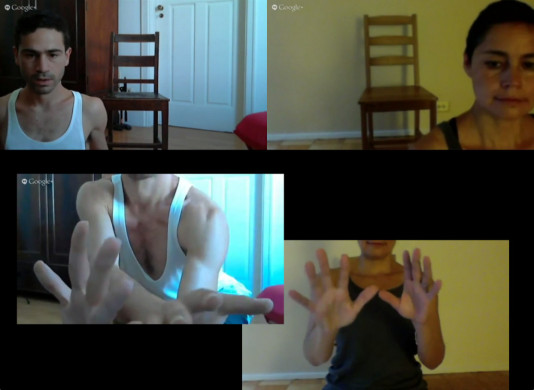
I am honored! Thank you Lisa Kraus for generous and smart article about my work with the dance-tech project and focused on meta-academy!! Please enjoy and share!
The vlogger has been blogged!!
http://thinkingdance.net/articles/2014/06/24/54/Marlon-Barrios-Solano-Drawn-to-the-Screen/
Sherry Turkle, the sociologist/psychologist who rose to prominence as an early internet booster has changed her mind. Today, instead of continuing to marvel at the internet’s potentials she laments that our continual involvement with “screens” creates a culture where we are “alone together.” There are plenty who share her assessment.
Concurrent with this development, some researchers are investigating exciting and fruitful ways to connect through screens. Marlon Barrios Solano, who trained in dance, cognitive science and new media, works in ways that counter the sense of disembodiment and isolation that staring at screens can engender. Solano is drawn to screens but researches how the internet and the tools it provides offer not only ways of building community and sharing knowledge but also new ways to experience our bodies.
 Todas las fotografías del seminario MOV-S que tuvo lugar en Guadalajara del 18 al 21 de de junio están disponibles aquí.

SYMPOSIUM
July 7-12, 2014
THE LIVE LEGACY PROJECT: CORRESPONDENCES BETWEEN GERMAN CONTEMPORARY DANCE AND JUDSON DANCE THEATER MOVEMENT
A PROJECT BY TANZFONDS ERBE
The Live Legacy Project seeks to share the practices and techniques sprouted by the 1960s American avant garde and that migrated to Germany, often through the Dutch institutions (e.g. School for New Dance Development and European Dance Development School). The project reveals these revolutionary influences in German Contemporary Dance training, and highlights the visibility of such corporeal values in choreographic work and practice. What exactly are these embodied philosophies, and what kinds of cultural shifts have been enabled by their transmission?
The Live Legacy Project celebrates this movement by bringing together choreographers, dance artists, scholars, and educators, to converge in a six-day symposium. They will share their movement practices and stories through intensive workshops, lectures and conversations, and performances.
Funded by Tanzfonds Erbe - an initiative by the The German Federal Cultural Foundation.
Come to tanzhaus nrw in Düsseldorf and join us for this landmark event.
....................
Online registration from March 15, 2014. Options and Fees.
A) Symposium with Workshops
Fee includes morning & afternoon workshops, lectures & conversations, corresponding events, performances, lunch and The Underscore with Nancy Stark Smith & Mike Vargas (music).
without Lunch: 190 - 240Euro
including Lunch: 230 - 280Euro
B) For daily visits:
Lunch: 8Euro. Please note: Lunch reservations only possible until June 15th.Live streaming lectures & conversations, corresponding events: 6Euro/Day
C) Evening Performances
Tickets for evening performances will be available through the website of tanzhaus nrw: http://tanzhaus-nrw.de/
....................
For more information: http://the-live-legacy-project.com/
....................
Symposium Guests are:
Ric Allsopp, Angus Balbernie, Agnès Benoit-Nader, David Brandstätter, Fabian Chyle, Trude Cone, Jess Curtis, Joao da Silva, Pauline de Groot, Ingo Diehl, Benno Enderlein, Malgven Gerbes, Yvonne Hardt, Dieter Heitkamp, Ines Heckmann, Peter Hulton, Bernd Ka, Irmela Kästner, Thomas Kampe, Eva Karczag, Gabriele Klein, Stephanie Maher, Nina Martin, Gisela Müller, Martin Nachbar, Lisa Nelson, Mary O'Donnell, Peter Pleyer, Ka Rustler, Isabelle Schad, Barbara Stahlberger, Nancy Stark Smith, Silke Z, Alexandra Waierstall and Gabriele Wittmann.
Hemos charlado con Blanca Ortiga sobre el curso del Prototipo Prácticas Artísticas Críticas.
En el tercer día de seminario, los participantes han trabajado para agrupar las urgencias del día previo en líneas estratégicas que os ofrecemos a continuación:
Creación de espacios de acción y reflexión comunitaria contemplando a los agentes artísticos, institucionales y contextuales.
Provocar exploraciones con varias instituciones (públicas, privadas y civiles) para optimizar la sostenibilidad de una práctica artística.
Sistema orgánico y adaptativo que se compone de los siguientes elementos:
- construir y sostener comunidad
- detectar formas y niveles de vinculación
- empoderar a todos los agentes
- fomentar las relaciones instituyentes
- generar y difundir información rigurosa
- fomentar el discurso teórico-práctico
- crear espacios de acción y reflexión colectiva
- generar estrategias de escucha de los contextos
- activar plataformas de libre desarrollo de la experiencia
- generar una red de circulación de pensamiento, prácticas y recursos microlocales
- posibilitar la organización de las comunidades para incidir en las políticas públicas
- generar flujos para la información en torno a las posibilidades para la gestión de proyectos de vinculación artística y comunitaria.
Existe un elemento del sistema que transita en todo el sistema: construir micropolíticas culturales locales.
Descarga el documento en pdf.
Compartimos con vosotros la entrevista que realizamos a Igor de Quadra, Olatz de Andrés y Matxalen de Pedro. Nos hablan de Muelle 3, dónde se realizó una comida informal con la participación de artistas locales e invitados a MOV-S en Bilbao, y de los paseos que realizaron con dichos invitados por la ciudad.
